Artículo
New multitarget molecules derived from caffeine as potentiators of the cholinergic system
Munafó, Juan Pablo ; Biscussi, Brunella
; Obiol, Diego Javier
; Costabel, Marcelo Daniel; Bouzat, Cecilia Beatriz
; Murray, Ana Paula
; Antollini, Silvia Susana
; Biscussi, Brunella
; Obiol, Diego Javier
; Costabel, Marcelo Daniel; Bouzat, Cecilia Beatriz
; Murray, Ana Paula
; Antollini, Silvia Susana
; Biscussi, Brunella
; Obiol, Diego Javier
; Costabel, Marcelo Daniel; Bouzat, Cecilia Beatriz
; Murray, Ana Paula
; Antollini, Silvia Susana
Fecha de publicación:
26/02/2024
Editorial:
American Chemical Society Inc
Revista:
ACS Chemical Neuroscience
e-ISSN:
1948-7193
Idioma:
Inglés
Tipo de recurso:
Artículo publicado
Clasificación temática:
Resumen
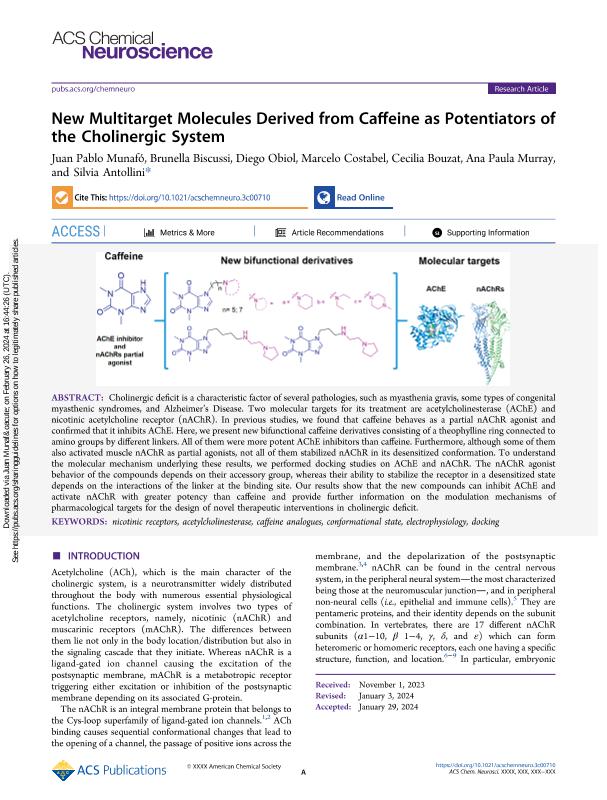
Cholinergic deficit is a characteristic factor of several pathologies, such as myasthenia gravis, some types of congenital myasthenic syndromes, and Alzheimer’s Disease. Two molecular targets for its treatment are acetylcholinesterase (AChE) and nicotinic acetylcholine receptor (nAChR). In previous studies, we found that caffeine behaves as a partial nAChR agonist and confirmed that it inhibits AChE. Here, we present new bifunctional caffeine derivatives consisting of a theophylline ring connected to amino groups by different linkers. All of them were more potent AChE inhibitors than caffeine. Furthermore, although some of them also activated muscle nAChR as partial agonists, not all of them stabilized nAChR in its desensitized conformation. To understand the molecular mechanism underlying these results, we performed docking studies on AChE and nAChR. The nAChR agonist behavior of the compounds depends on their accessory group, whereas their ability to stabilize the receptor in a desensitized state depends on the interactions of the linker at the binding site. Our results show that the new compounds can inhibit AChE and activate nAChR with greater potency than caffeine and provide further information on the modulation mechanisms of pharmacological targets for the design of novel therapeutic interventions in cholinergic deficit
Archivos asociados

Tamaño:
14.04Mb
Formato:
PDF
Licencia
 Excepto donde se diga explícitamente, este item se publica bajo la siguiente descripción:
Creative Commons Attribution-NonCommercial-ShareAlike 2.5 Unported (CC BY-NC-SA 2.5)
Excepto donde se diga explícitamente, este item se publica bajo la siguiente descripción:
Creative Commons Attribution-NonCommercial-ShareAlike 2.5 Unported (CC BY-NC-SA 2.5)
Identificadores
Colecciones
Articulos(INIBIBB)
Articulos de INST.DE INVEST.BIOQUIMICAS BAHIA BLANCA (I)
Articulos de INST.DE INVEST.BIOQUIMICAS BAHIA BLANCA (I)
Articulos(INQUISUR)
Articulos de INST.DE QUIMICA DEL SUR
Articulos de INST.DE QUIMICA DEL SUR
Citación
Munafó, Juan Pablo; Biscussi, Brunella; Obiol, Diego Javier; Costabel, Marcelo Daniel; Bouzat, Cecilia Beatriz; et al.; New multitarget molecules derived from caffeine as potentiators of the cholinergic system; American Chemical Society Inc; ACS Chemical Neuroscience; 15; 5; 26-2-2024; 994-1009
Compartir


Altmétricas