Mostrar el registro sencillo del ítem
dc.contributor.author
Moscuzza, Carlos Hernán
dc.contributor.author
Pérez Carrera, Alejo Leopoldo
dc.contributor.author
Volpedo, Alejandra
dc.contributor.author
Fernandez Cirelli, Alicia
dc.date.available
2025-01-31T15:04:16Z
dc.date.issued
2012-06
dc.identifier.citation
Moscuzza, Carlos Hernán; Pérez Carrera, Alejo Leopoldo; Volpedo, Alejandra; Fernandez Cirelli, Alicia; Forage enrichment with copper and zinc in beef grazing systems in Argentina; Elsevier Science; Journal of Geochemical Exploration; 121; 6-2012; 25-29
dc.identifier.issn
0375-6742
dc.identifier.uri
http://hdl.handle.net/11336/253422
dc.description.abstract
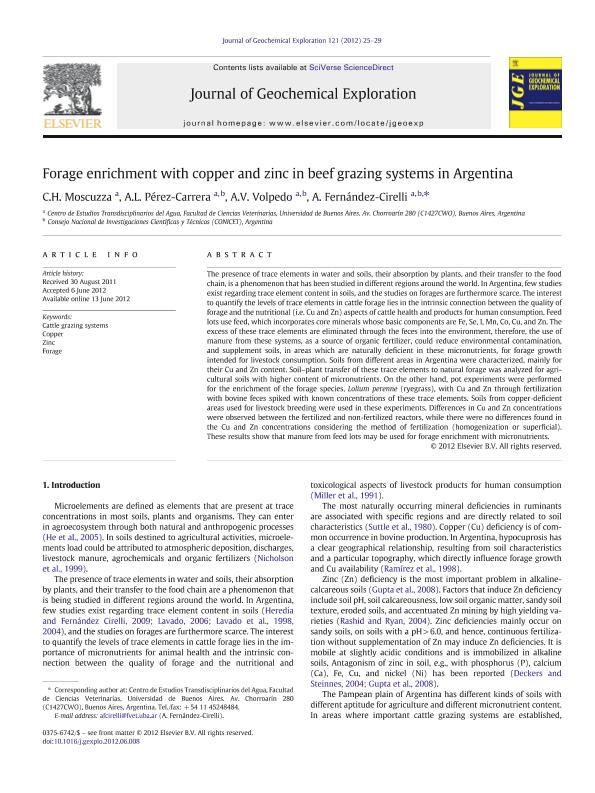
The presence of trace elements in water and soils, their absorption by plants, and their transfer to the food chain, is a phenomenon that has been studied in different regions around the world. In Argentina, few studies exist regarding trace element content in soils, and the studies on forages are furthermore scarce. The interest to quantify the levels of trace elements in cattle forage lies in the intrinsic connection between the quality of forage and the nutritional (i.e. Cu and Zn) aspects of cattle health and products for human consumption. Feed lots use feed, which incorporates core minerals whose basic components are Fe, Se, I, Mn, Co, Cu, and Zn. The excess of these trace elements are eliminated through the feces into the environment, therefore, the use of manure from these systems, as a source of organic fertilizer, could reduce environmental contamination, and supplement soils, in areas which are naturally deficient in these micronutrients, for forage growth intended for livestock consumption. Soils from different areas in Argentina were characterized, mainly for their Cu and Zn content. Soil–plant transfer of these trace elements to natural forage was analyzed for agricultural soils with higher content of micronutrients. On the other hand, pot experiments were performed for the enrichment of the forage species, Lolium perenne (ryegrass), with Cu and Zn through fertilization with bovine feces spiked with known concentrations of these trace elements. Soils from copper‐deficient areas used for livestock breeding were used in these experiments. Differences in Cu and Zn concentrations were observed between the fertilized and non-fertilized reactors, while there were no differences found in the Cu and Zn concentrations considering the method of fertilization (homogenization or superficial). These results show that manure from feed lots may be used for forage enrichment with micronutrients.
dc.format
application/pdf
dc.language.iso
eng
dc.publisher
Elsevier Science
dc.rights
info:eu-repo/semantics/openAccess
dc.rights.uri
https://creativecommons.org/licenses/by-nc-nd/2.5/ar/
dc.subject
Cattle grazing systems
dc.subject
Copper
dc.subject
Zinc
dc.subject
Forage
dc.subject.classification
Otras Ciencias Químicas
dc.subject.classification
Ciencias Químicas
dc.subject.classification
CIENCIAS NATURALES Y EXACTAS
dc.title
Forage enrichment with copper and zinc in beef grazing systems in Argentina
dc.type
info:eu-repo/semantics/article
dc.type
info:ar-repo/semantics/artículo
dc.type
info:eu-repo/semantics/publishedVersion
dc.date.updated
2025-01-22T11:09:06Z
dc.journal.volume
121
dc.journal.pagination
25-29
dc.journal.pais
Países Bajos
dc.journal.ciudad
Amsterdam
dc.description.fil
Fil: Moscuzza, Carlos Hernán. Universidad de Buenos Aires. Facultad de Ciencias Veterinarias. Centro de Estudios Transdisciplinarios del Agua; Argentina
dc.description.fil
Fil: Pérez Carrera, Alejo Leopoldo. Consejo Nacional de Investigaciones Científicas y Técnicas. Oficina de Coordinación Administrativa Parque Centenario; Argentina. Universidad de Buenos Aires. Facultad de Ciencias Veterinarias. Centro de Estudios Transdisciplinarios del Agua; Argentina
dc.description.fil
Fil: Volpedo, Alejandra. Consejo Nacional de Investigaciones Científicas y Técnicas. Oficina de Coordinación Administrativa Parque Centenario; Argentina. Universidad de Buenos Aires. Facultad de Ciencias Veterinarias. Centro de Estudios Transdisciplinarios del Agua; Argentina
dc.description.fil
Fil: Fernandez Cirelli, Alicia. Universidad de Buenos Aires. Facultad de Ciencias Veterinarias. Centro de Estudios Transdisciplinarios del Agua; Argentina. Consejo Nacional de Investigaciones Científicas y Técnicas. Oficina de Coordinación Administrativa Parque Centenario; Argentina
dc.journal.title
Journal of Geochemical Exploration
dc.relation.alternativeid
info:eu-repo/semantics/altIdentifier/doi/http://dx.doi.org/10.1016/j.gexplo.2012.06.008
dc.relation.alternativeid
info:eu-repo/semantics/altIdentifier/url/https://www.sciencedirect.com/science/article/pii/S0375674212001100
Archivos asociados

Tamaño:
221.8Kb
Formato:
PDF