Evento
The physiological role of KCC2 in the cerebellum

Tipo del evento:
Simposio
Nombre del evento:
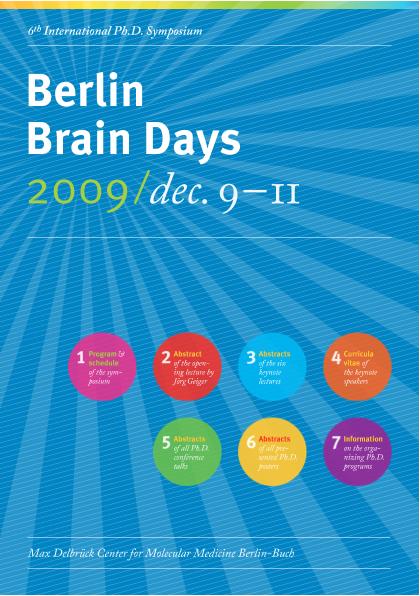
6th International Ph.D. Symposium: Berlin Brain Days
Fecha del evento:
09/12/2009
Institución Organizadora:
Max Delbrück Centrum füu Molekulare Dedizin;
Título de la revista:
Berlin Brain Days
Editorial:
Max Delbrück Centrum für Molekulare Medizin
Idioma:
Inglés
Clasificación temática:
Resumen
Cation chloride cotransporters mediate a coupled electroneutral movement of Cl−, K+ and Na+ across plasmamembranes in many cells. The neuron-specific KCl cotransporter KCC2 is thought to lower the intracellular Cl− concentration below its electrochemical equilibrium potential by using the outwards directed gradient of K+ as a driving force. This low intracellular Cl− concentration is required for the fast inhibitory action of GABA which is mediated by the GABAA receptor, a ligand-gated anion channel. The activation of GABAA receptors drives the membrane potential of a cell towards EGABA, the reversal potential of GABAergic currents. In immature neurons, GABA is excitatory, as EGABA is above the resting membrane po- tential. The expression of KCC2 correlates with the drop of EGABA below the resting membrane potential, and thereby the switch from excitatory to inhibi- tory GABA signaling. The KCl cotransporter KCC3 is expressed more broadly and involved in cell volume regulation. Nevertheless, while KCC2 may be the key regulator of neu- ronal [Cl−]i, a similar role was proposed for KCC3. We investigate the physi- ological role of KCC2 and KCC3 in the murine cerebellum at cellular level via the patch clamp technique in acute slices. We showed that knocking out KCC2 in cerebellar Purkinje cells results in a shift of EGABA, which could be corre- lated with motor learning deficits
Palabras clave:
KCC2
,
CEREBELLUM
,
KCC3
,
LEARNING
Archivos asociados

Tamaño:
304.1Kb
Formato:
PDF
Licencia
 Excepto donde se diga explícitamente, este item se publica bajo la siguiente descripción:
Creative Commons Attribution-NonCommercial-ShareAlike 2.5 Unported (CC BY-NC-SA 2.5)
Excepto donde se diga explícitamente, este item se publica bajo la siguiente descripción:
Creative Commons Attribution-NonCommercial-ShareAlike 2.5 Unported (CC BY-NC-SA 2.5)
Identificadores
Colecciones
Eventos(INIBIBB)
Eventos de INST.DE INVEST.BIOQUIMICAS BAHIA BLANCA (I)
Eventos de INST.DE INVEST.BIOQUIMICAS BAHIA BLANCA (I)
Citación
The physiological role of KCC2 in the cerebellum; 6th International Ph.D. Symposium: Berlin Brain Days; Berlin; Alemania; 2009; 106-106
Compartir

