Mostrar el registro sencillo del ítem
dc.contributor.author
Toblli, Jorge Eduardo
dc.contributor.author
Cao, Gabriel Fernando
dc.contributor.author
Oliveri, Leda María
dc.contributor.author
Angerosa, Margarita
dc.date.available
2025-01-16T10:49:28Z
dc.date.issued
2010-08
dc.identifier.citation
Toblli, Jorge Eduardo; Cao, Gabriel Fernando; Oliveri, Leda María; Angerosa, Margarita; Comparison of the renal, cardiovascular and hepatic toxicity data of original intravenous iron compounds; Oxford University Press; Nephrology Dialysis Transplantation; 25; 11; 8-2010; 3631-3640
dc.identifier.issn
0931-0509
dc.identifier.uri
http://hdl.handle.net/11336/252667
dc.description.abstract
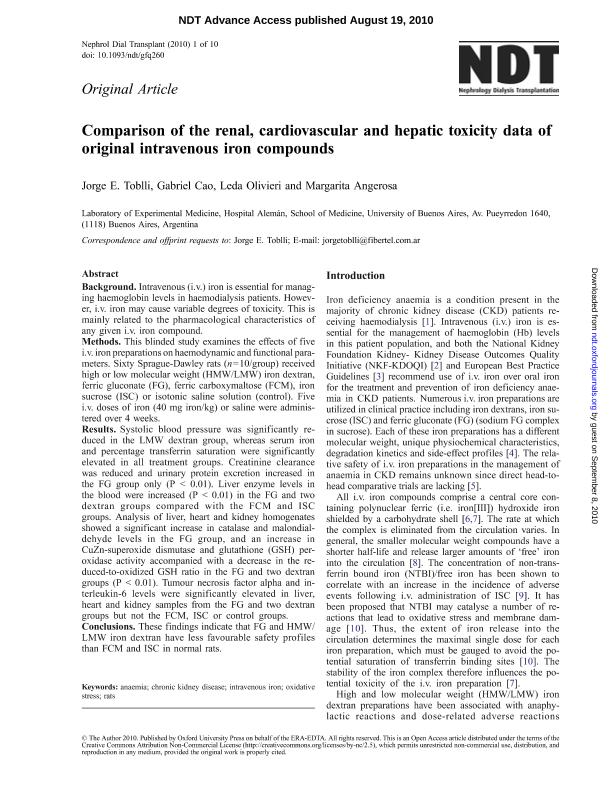
Background. Intravenous (i.v.) iron is essential for managing haemoglobin levels in haemodialysis patients. However, i.v. iron may cause variable degrees of toxicity. This is mainly related to the pharmacological characteristics of any given i.v. iron compound. Methods. This blinded study examines the effects of five i.v. iron preparations on haemodynamic and functional parameters. Sixty Sprague-Dawley rats (n=10/group) received high or low molecular weight (HMW/LMW) iron dextran, ferric gluconate (FG), ferric carboxymaltose (FCM), iron sucrose (ISC) or isotonic saline solution (control). Five i.v. doses of iron (40 mg iron/kg) or saline were administered over 4 weeks. Results. Systolic blood pressure was significantly reduced in the LMW dextran group, whereas serum iron and percentage transferrin saturation were significantly elevated in all treatment groups. Creatinine clearance was reduced and urinary protein excretion increased in the FG group only (P < 0.01). Liver enzyme levels in the blood were increased (P < 0.01) in the FG and two dextran groups compared with the FCM and ISC groups. Analysis of liver, heart and kidney homogenates showed a significant increase in catalase and malondialdehyde levels in the FG group, and an increase in CuZn-superoxide dismutase and glutathione (GSH) peroxidase activity accompanied with a decrease in the reduced- to-oxidized GSH ratio in the FG and two dextran groups (P < 0.01). Tumour necrosis factor alpha and interleukin- 6 levels were significantly elevated in liver, heart and kidney samples from the FG and two dextran groups but not the FCM, ISC or control groups. Conclusions. These findings indicate that FG and HMW/ LMW iron dextran have less favourable safety profiles than FCM and ISC in normal rats.Intravenous (i.v.) iron is essential for managing haemoglobin levels in haemodialysis patients. However, i.v. iron may cause variable degrees of toxicity. This is mainly related to the pharmacological characteristics of any given i.v. iron compound. Methods. This blinded study examines the effects of five i.v. iron preparations on haemodynamic and functional parameters. Sixty Sprague-Dawley rats (n=10/group) received high or low molecular weight (HMW/LMW) iron dextran, ferric gluconate (FG), ferric carboxymaltose (FCM), iron sucrose (ISC) or isotonic saline solution (control). Five i.v. doses of iron (40 mg iron/kg) or saline were administered over 4 weeks. Results. Systolic blood pressure was significantly reduced in the LMW dextran group, whereas serum iron and percentage transferrin saturation were significantly elevated in all treatment groups. Creatinine clearance was reduced and urinary protein excretion increased in the FG group only (P < 0.01). Liver enzyme levels in the blood were increased (P < 0.01) in the FG and two dextran groups compared with the FCM and ISC groups. Analysis of liver, heart and kidney homogenates showed a significant increase in catalase and malondialdehyde levels in the FG group, and an increase in CuZn-superoxide dismutase and glutathione (GSH) peroxidase activity accompanied with a decrease in the reduced- to-oxidized GSH ratio in the FG and two dextran groups (P < 0.01). Tumour necrosis factor alpha and interleukin- 6 levels were significantly elevated in liver, heart and kidney samples from the FG and two dextran groups but not the FCM, ISC or control groups. Conclusions. These findings indicate that FG and HMW/ LMW iron dextran have less favourable safety profiles than FCM and ISC in normal rats.
dc.format
application/pdf
dc.language.iso
eng
dc.publisher
Oxford University Press
dc.rights
info:eu-repo/semantics/openAccess
dc.rights.uri
https://creativecommons.org/licenses/by-nc-sa/2.5/ar/
dc.subject
ANAEMIA
dc.subject
CHRONIC KIDNEY DISEASE
dc.subject
INTRAVENOUS IRON
dc.subject
OXIDATIVE STRESS
dc.subject
RATS
dc.subject.classification
Bioquímica y Biología Molecular
dc.subject.classification
Ciencias Biológicas
dc.subject.classification
CIENCIAS NATURALES Y EXACTAS
dc.title
Comparison of the renal, cardiovascular and hepatic toxicity data of original intravenous iron compounds
dc.type
info:eu-repo/semantics/article
dc.type
info:ar-repo/semantics/artículo
dc.type
info:eu-repo/semantics/publishedVersion
dc.date.updated
2025-01-14T14:35:56Z
dc.journal.volume
25
dc.journal.number
11
dc.journal.pagination
3631-3640
dc.journal.pais
Reino Unido
dc.description.fil
Fil: Toblli, Jorge Eduardo. Hospital Alemán; Argentina. Universidad de Buenos Aires; Argentina. Consejo Nacional de Investigaciones Científicas y Técnicas; Argentina
dc.description.fil
Fil: Cao, Gabriel Fernando. Hospital Alemán; Argentina. Consejo Nacional de Investigaciones Científicas y Técnicas; Argentina. Universidad de Buenos Aires; Argentina
dc.description.fil
Fil: Oliveri, Leda María. Consejo Nacional de Investigaciones Científicas y Técnicas. Oficina de Coordinación Administrativa Houssay. Centro de Investigaciones sobre Porfirinas y Porfirias. Universidad de Buenos Aires. Centro de Investigaciones sobre Porfirinas y Porfirias; Argentina
dc.description.fil
Fil: Angerosa, Margarita. Hospital Alemán; Argentina. Universidad de Buenos Aires; Argentina
dc.journal.title
Nephrology Dialysis Transplantation
dc.relation.alternativeid
info:eu-repo/semantics/altIdentifier/url/https://academic.oup.com/ndt/article/25/11/3631/1901582
dc.relation.alternativeid
info:eu-repo/semantics/altIdentifier/doi/http://dx.doi.org/10.1093/ndt/gfq260
Archivos asociados

Tamaño:
485.0Kb
Formato:
PDF