Artículo
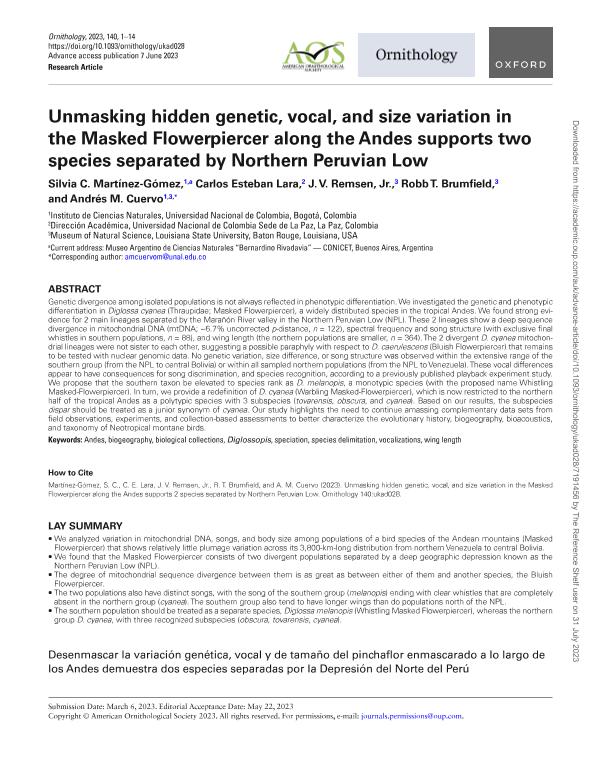
La divergencia genética entre poblaciones aisladas no siempre se refleja en diferencias fenotípicas. Investigamos la diferenciación genética y fenotípica en Diglossa cyanea (Thraupidae), una especie común de los Andes tropicales. Encontramos dos linajes principales separados por el cañón del río Marañón en la Depresión del Norte del Perú (DNP). Estos dos linajes tienen una profunda divergencia en ADN mitocondrial (~6.7% de distancia p no corregida, n = 122), en el rango de frecuencia y estructura del canto (con silbidos finales exclusivos en las poblaciones del sur, n = 88), y en la longitud del ala (las poblaciones del norte son más pequeñas, n = 364). Los dos linajes mitocondriales divergentes en D. cyanea no resultaron grupos hermanos entre sí, sugiriendo una posible parafilia con respecto a D. caerulescens, que debe ser puesta a prueba con datos genómicos nucleares. No encontramos variación genética, diferencias de tamaño o estructura del canto entre las poblaciones del grupo del sur (desde la DNP hasta Bolivia), como tampoco entre las poblaciones del norte muestreadas (desde la DNP hasta Venezuela). Estas diferencias vocales parecen tener consecuencias en la discriminación de cantos y el reconocimiento entre especies de acuerdo con un estudio basado en experimentos de playback previamente publicado. Proponemos que la subespecie del sur sea elevada al rango de especie como D. melanopis, una especie monotípica. A su vez, redefinimos a D. cyanea, que ahora se restringe a la mitad norte de los Andes tropicales como una especie politípica con tres subespecies (tovarensis, obscura y cyanea). De acuerdo con los resultados, la subespecie dispar debe tratarse como un sinónimo de cyanea. Nuestro estudio demuestra la necesidad de seguir acumulando conjuntos complementarios de datos a partir de observaciones de campo, experimentos y evaluaciones basadas en colecciones para caracterizar mejor la historia evolutiva, la biogeografía, la bioacústica y la taxonomía de las aves montanas neotropicales. Genetic divergence among isolated populations is not always reflected in phenotypic differentiation. We investigated the genetic and phenotypic differentiation in Diglossa cyanea (Thraupidae; Masked Flowerpiercer), a widely distributed species in the tropical Andes. We found strong evidence for 2 main lineages separated by the Marañón River valley in the Northern Peruvian Low (NPL). These 2 lineages show a deep sequence divergence in mitochondrial DNA (mtDNA; ~6.7% uncorrected p-distance, n = 122), spectral frequency and song structure (with exclusive final whistles in southern populations, n = 88), and wing length (the northern populations are smaller, n = 364). The 2 divergent D. cyanea mitochondrial lineages were not sister to each other, suggesting a possible paraphyly with respect to D. caerulescens (Bluish Flowerpiercer) that remains to be tested with nuclear genomic data. No genetic variation, size difference, or song structure was observed within the extensive range of the southern group (from the NPL to central Bolivia) or within all sampled northern populations (from the NPL to Venezuela). These vocal differences appear to have consequences for song discrimination, and species recognition, according to a previously published playback experiment study. We propose that the southern taxon be elevated to species rank as D. melanopis, a monotypic species (with the proposed name Whistling Masked-Flowerpiercer). In turn, we provide a redefinition of D. cyanea (Warbling Masked-Flowerpiercer), which is now restricted to the northern half of the tropical Andes as a polytypic species with 3 subspecies (tovarensis, obscura, and cyanea). Based on our results, the subspecies dispar should be treated as a junior synonym of cyanea. Our study highlights the need to continue amassing complementary data sets from field observations, experiments, and collection-based assessments to better characterize the evolutionary history, biogeography, bioacoustics, and taxonomy of Neotropical montane birds.
Unmasking hidden genetic, vocal, and size variation in the Masked Flowerpiercer along the Andes supports two species separated by Northern Peruvian Low
Martínez Gómez, Silvia Catalina ; Lara, Carlos Esteban; Remsen, J. V.; Brumfield, Robb T.; Cuervo, Andrés M.
; Lara, Carlos Esteban; Remsen, J. V.; Brumfield, Robb T.; Cuervo, Andrés M.
Fecha de publicación:
25/10/2023
Editorial:
Oxford University Press
Revista:
Auk
ISSN:
0004-8038
Idioma:
Inglés
Tipo de recurso:
Artículo publicado
Clasificación temática:
Resumen
Archivos asociados

Tamaño:
1.870Mb
Formato:
PDF
Licencia
 Excepto donde se diga explícitamente, este item se publica bajo la siguiente descripción:
Creative Commons Attribution-NonCommercial-ShareAlike 2.5 Unported (CC BY-NC-SA 2.5)
Excepto donde se diga explícitamente, este item se publica bajo la siguiente descripción:
Creative Commons Attribution-NonCommercial-ShareAlike 2.5 Unported (CC BY-NC-SA 2.5)
Identificadores
Colecciones
Articulos(MACNBR)
Articulos de MUSEO ARG.DE CS.NAT "BERNARDINO RIVADAVIA"
Articulos de MUSEO ARG.DE CS.NAT "BERNARDINO RIVADAVIA"
Citación
Martínez Gómez, Silvia Catalina; Lara, Carlos Esteban; Remsen, J. V.; Brumfield, Robb T.; Cuervo, Andrés M.; Unmasking hidden genetic, vocal, and size variation in the Masked Flowerpiercer along the Andes supports two species separated by Northern Peruvian Low; Oxford University Press; Auk; 140; 4; 25-10-2023; 1-14
Compartir


Altmétricas