Artículo
Nanofiltration of partial oxidation products and copper from catalyzed wet peroxidation of phenol

Fecha de publicación:
21/01/2013
Editorial:
Elsevier Science
Revista:
Desalination
ISSN:
0011-9164
Idioma:
Inglés
Tipo de recurso:
Artículo publicado
Clasificación temática:
Resumen
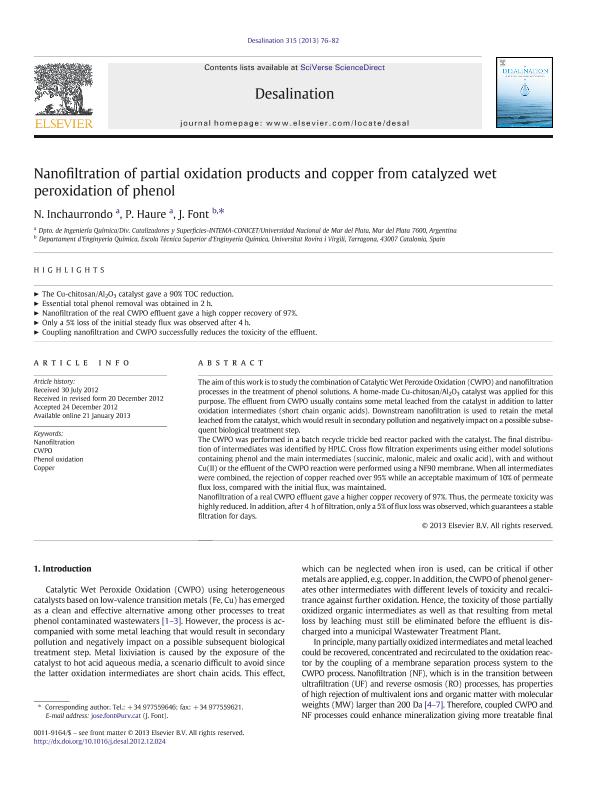
The aim of this work is to study the combination of Catalytic Wet Peroxide Oxidation (CWPO) and nanofiltration processes in the treatment of phenol solutions. A home-made Cu-chitosan/Al2O3 catalyst was applied for this purpose. The effluent from CWPO usually contains some metal leached from the catalyst in addition to latter oxidation intermediates (short chain organic acids). Downstream nanofiltration is used to retain the metal leached from the catalyst, which would result in secondary pollution and negatively impact on a possible subsequent biological treatment step. The CWPO was performed in a batch recycle trickle bed reactor packed with the catalyst. The final distribution of intermediates was identified by HPLC. Cross flow filtration experiments using either model solutions containing phenol and the main intermediates (succinic, malonic, maleic and oxalic acid), with and without Cu(II) or the effluent of the CWPO reaction were performed using a NF90 membrane. When all intermediates were combined, the rejection of copper reached over 95% while an acceptable maximum of 10% of permeate flux loss, compared with the initial flux, was maintained. Nanofiltration of a real CWPO effluent gave a higher copper recovery of 97%. Thus, the permeate toxicity was highly reduced. In addition, after 4 h of filtration, only a 5% of flux loss was observed, which guarantees a stable filtration for days.
Palabras clave:
COPPER
,
CWPO
,
NANOFILTRATION
,
PHENOL OXIDATION
Archivos asociados

Tamaño:
747.2Kb
Formato:
PDF
Licencia
 Excepto donde se diga explícitamente, este item se publica bajo la siguiente descripción:
Creative Commons Attribution-NonCommercial-ShareAlike 2.5 Unported (CC BY-NC-SA 2.5)
Excepto donde se diga explícitamente, este item se publica bajo la siguiente descripción:
Creative Commons Attribution-NonCommercial-ShareAlike 2.5 Unported (CC BY-NC-SA 2.5)
Identificadores
Colecciones
Articulos(CCT - MAR DEL PLATA)
Articulos de CTRO.CIENTIFICO TECNOL.CONICET - MAR DEL PLATA
Articulos de CTRO.CIENTIFICO TECNOL.CONICET - MAR DEL PLATA
Articulos(INTEMA)
Articulos de INST.DE INV.EN CIENCIA Y TECNOL.MATERIALES (I)
Articulos de INST.DE INV.EN CIENCIA Y TECNOL.MATERIALES (I)
Citación
Inchaurrondo, Natalia Soledad; Font, J.; Haure, Patricia Monica; Nanofiltration of partial oxidation products and copper from catalyzed wet peroxidation of phenol; Elsevier Science; Desalination; 315; 21-1-2013; 76-82
Compartir


Altmétricas