Mostrar el registro sencillo del ítem
dc.contributor.author
Mateos, Melina Valeria
dc.contributor.author
Tenconi, Paula Estefania
dc.contributor.author
Bermudez, Vicente
dc.contributor.author
Oresti, Gerardo Martin
dc.contributor.author
Salvador, Gabriela Alejandra
dc.contributor.author
Giusto, Norma Maria
dc.date.available
2025-01-09T17:42:08Z
dc.date.issued
2018
dc.identifier.citation
The phospholipase D pathway modulates the inflammatory response of retinal pigment epithelium cells exposed to high glucose concentrations; 2018 Annual Meeting of the Association for Research in Vision and Ophthalmology (ARVO); Hawaii; Estados Unidos; 2018; 1-1
dc.identifier.issn
0146-0404
dc.identifier.uri
http://hdl.handle.net/11336/252204
dc.description.abstract
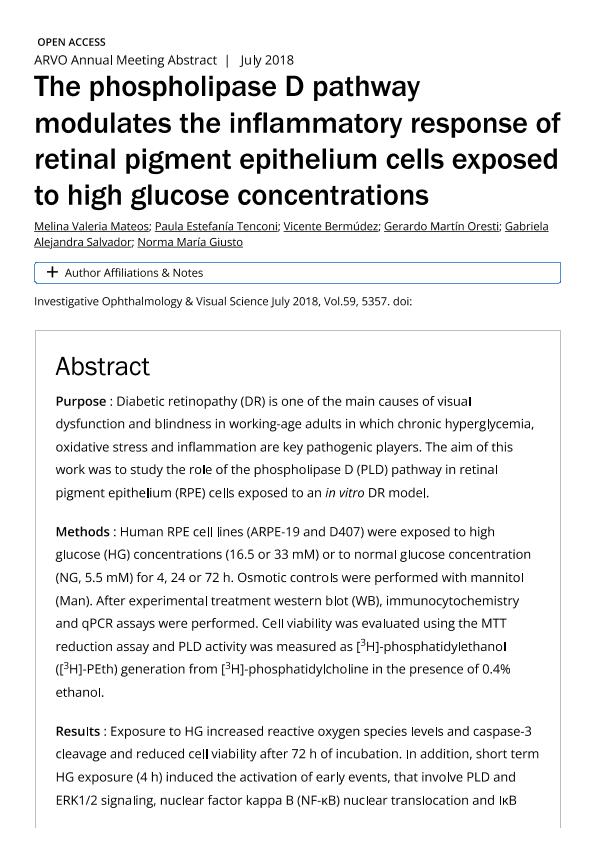
Purpose: Diabetic retinopathy (DR) is one of the main causes of visual dysfunction and blindness in working-age adults in which chronic hyperglycemia, oxidative stress and inflammation are key pathogenic players. The aim of this work was to study the role of the phospholipase D (PLD) pathway in retinal pigment epithelium (RPE) cells exposed to an in vitro DR model. Methods: Human RPE cell lines (ARPE-19 and D407) were exposed to high glucose (HG) concentrations (16.5 or 33 mM) or to normal glucose concentration (NG, 5.5 mM) for 4, 24 or 72 h. Osmotic controls were performed with mannitol (Man). After experimental treatment western blot (WB), immunocytochemistry and qPCR assays were performed. Cell viability was evaluated using the MTT reduction assay and PLD activity was measured as [3H]-phosphatidylethanol ([3H]-PEth) generation from [3H]-phosphatidylcholine in the presence of 0.4% ethanol. Results: Exposure to HG increased reactive oxygen species levels and caspase-3 cleavage and reduced cell viability after 72 h of incubation. In addition, short term HG exposure (4 h) induced the activation of early events, that involve PLD and ERK1/2 signaling, nuclear factor kappa B (NF-κB) nuclear translocation and IκB phosphorylation. An increment in pro-inflammatory interleukins (IL-6 and IL-8) and cyclooxygenase-2 (COX-2) mRNA levels was observed after 24 h of HG exposure. The effect of selective pharmacological PLD1 (VU0359595) and PLD2 (VU0285655-1) inhibitors demonstrated that ERK1/2 and NF-κB activation were downstream events of both PLD isoforms. The increment in IL-6 and COX-2 mRNA levels induced by HG was reduced to control levels in cells pre-incubated with both PLD inhibitors. Furthermore, the inhibition of PLD1, PLD2, the MEK/ERK pathway (with U0126) and COX-2 (with celecoxib) prevented the loss of cell viability induced by HG. Conclusions : Our results demonstrate that HG exposure induces PLD activation in RPE cells, leading to ERK1/2 activation, IκB degradation, NF-κB nuclear translocation and expression of pro-inflammatory ILs and COX-2 and reduced cell viability. Our findings are the first evidence that classical PLDs participate in the inflammatory response of RPE cells exposed to HG and leads us to postulate these signaling enzymes as potential therapeutic targets for DR treatment
dc.format
application/pdf
dc.language.iso
eng
dc.publisher
Investigative Ophthalmology & Visual Science
dc.rights
info:eu-repo/semantics/openAccess
dc.rights.uri
https://creativecommons.org/licenses/by-nc-sa/2.5/ar/
dc.subject
RETINAL PIGMENT EPITHELIUM
dc.subject
DIABETIC RETINOPATHY
dc.subject
PHOSPHOLIPASE D
dc.subject
INFLAMMATION
dc.subject.classification
Bioquímica y Biología Molecular
dc.subject.classification
Ciencias Biológicas
dc.subject.classification
CIENCIAS NATURALES Y EXACTAS
dc.title
The phospholipase D pathway modulates the inflammatory response of retinal pigment epithelium cells exposed to high glucose concentrations
dc.type
info:eu-repo/semantics/publishedVersion
dc.type
info:eu-repo/semantics/conferenceObject
dc.type
info:ar-repo/semantics/documento de conferencia
dc.date.updated
2024-12-26T13:20:39Z
dc.identifier.eissn
1552-5783
dc.journal.volume
59
dc.journal.number
9
dc.journal.pagination
1-1
dc.journal.pais
Estados Unidos
dc.journal.ciudad
Maryland
dc.description.fil
Fil: Mateos, Melina Valeria. Consejo Nacional de Investigaciones Científicas y Técnicas. Centro Científico Tecnológico Conicet - Bahía Blanca. Instituto de Investigaciones Bioquímicas de Bahía Blanca. Universidad Nacional del Sur. Instituto de Investigaciones Bioquímicas de Bahía Blanca; Argentina. Universidad Nacional del Sur. Departamento de Biología, Bioquímica y Farmacia; Argentina
dc.description.fil
Fil: Tenconi, Paula Estefania. Consejo Nacional de Investigaciones Científicas y Técnicas. Centro Científico Tecnológico Conicet - Bahía Blanca. Instituto de Investigaciones Bioquímicas de Bahía Blanca. Universidad Nacional del Sur. Instituto de Investigaciones Bioquímicas de Bahía Blanca; Argentina. Universidad Nacional del Sur. Departamento de Biología, Bioquímica y Farmacia; Argentina
dc.description.fil
Fil: Bermudez, Vicente. Consejo Nacional de Investigaciones Científicas y Técnicas. Centro Científico Tecnológico Conicet - Bahía Blanca. Instituto de Investigaciones Bioquímicas de Bahía Blanca. Universidad Nacional del Sur. Instituto de Investigaciones Bioquímicas de Bahía Blanca; Argentina
dc.description.fil
Fil: Oresti, Gerardo Martin. Consejo Nacional de Investigaciones Científicas y Técnicas. Centro Científico Tecnológico Conicet - Bahía Blanca. Instituto de Investigaciones Bioquímicas de Bahía Blanca. Universidad Nacional del Sur. Instituto de Investigaciones Bioquímicas de Bahía Blanca; Argentina. Universidad Nacional del Sur. Departamento de Biología, Bioquímica y Farmacia; Argentina
dc.description.fil
Fil: Salvador, Gabriela Alejandra. Consejo Nacional de Investigaciones Científicas y Técnicas. Centro Científico Tecnológico Conicet - Bahía Blanca. Instituto de Investigaciones Bioquímicas de Bahía Blanca. Universidad Nacional del Sur. Instituto de Investigaciones Bioquímicas de Bahía Blanca; Argentina. Universidad Nacional del Sur. Departamento de Biología, Bioquímica y Farmacia; Argentina
dc.description.fil
Fil: Giusto, Norma Maria. Consejo Nacional de Investigaciones Científicas y Técnicas. Centro Científico Tecnológico Conicet - Bahía Blanca. Instituto de Investigaciones Bioquímicas de Bahía Blanca. Universidad Nacional del Sur. Instituto de Investigaciones Bioquímicas de Bahía Blanca; Argentina. Universidad Nacional del Sur. Departamento de Biología, Bioquímica y Farmacia; Argentina
dc.relation.alternativeid
info:eu-repo/semantics/altIdentifier/url/https://iovs.arvojournals.org/article.aspx?articleid=2692736&resultClick=1
dc.conicet.rol
Autor
dc.conicet.rol
Autor
dc.conicet.rol
Autor
dc.conicet.rol
Autor
dc.conicet.rol
Autor
dc.conicet.rol
Autor
dc.coverage
Internacional
dc.type.subtype
Congreso
dc.description.nombreEvento
2018 Annual Meeting of the Association for Research in Vision and Ophthalmology (ARVO)
dc.date.evento
2018-04-29
dc.description.ciudadEvento
Hawaii
dc.description.paisEvento
Estados Unidos
dc.type.publicacion
Journal
dc.description.institucionOrganizadora
Association for Research in Vision and Ophthalmology
dc.source.revista
Investigative Ophthalmology & Visual Science
dc.date.eventoHasta
2018-05-03
dc.type
Congreso
Archivos asociados

Tamaño:
140.0Kb
Formato:
PDF