Mostrar el registro sencillo del ítem
dc.contributor.author
Lippok, Denis
dc.contributor.author
Beck, Stephan G.
dc.contributor.author
Renison, Daniel
dc.contributor.author
Gallegos, Silvia C.
dc.contributor.author
Saavedra, Francisco V.
dc.contributor.author
Hensen, Isabell
dc.contributor.author
Schleuning, Matthias
dc.date.available
2017-09-22T17:47:49Z
dc.date.issued
2013-02
dc.identifier.citation
Lippok, Denis; Beck, Stephan G.; Renison, Daniel; Gallegos, Silvia C.; Saavedra, Francisco V.; et al.; Forest recovery of areas deforested by fire increases with elevation in the tropical Andes; Elsevier Science; Forest Ecology and Management; 295; 2-2013; 69-76
dc.identifier.issn
0378-1127
dc.identifier.uri
http://hdl.handle.net/11336/24947
dc.description.abstract
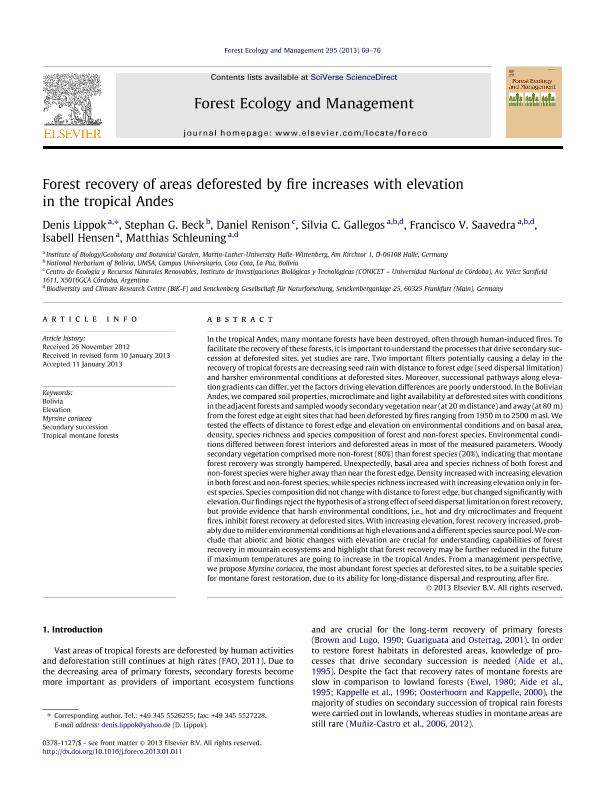
In the tropical Andes, many montane forests have been destroyed, often through human-induced fires. To facilitate the recovery of these forests, it is important to understand the processes that drive secondary succession at deforested sites, yet studies are rare. Two important filters potentially causing a delay in the recovery of tropical forests are decreasing seed rain with distance to forest edge (seed dispersal limitation) and harsher environmental conditions at deforested sites. Moreover, successional pathways along elevation gradients can differ, yet the factors driving elevation differences are poorly understood. In the Bolivian Andes, we compared soil properties, microclimate and light availability at deforested sites with conditions in the adjacent forests and sampled woody secondary vegetation near (at 20 m distance) and away (at 80 m) from the forest edge at eight sites that had been deforested by fires ranging from 1950 m to 2500 m asl. We tested the effects of distance to forest edge and elevation on environmental conditions and on basal area, density, species richness and species composition of forest and non-forest species. Environmental conditions differed between forest interiors and deforested areas in most of the measured parameters. Woody secondary vegetation comprised more non-forest (80%) than forest species (20%), indicating that montane forest recovery was strongly hampered. Unexpectedly, basal area and species richness of both forest and non-forest species were higher away than near the forest edge. Density increased with increasing elevation in both forest and non-forest species, while species richness increased with increasing elevation only in forest species. Species composition did not change with distance to forest edge, but changed significantly with elevation. Our findings reject the hypothesis of a strong effect of seed dispersal limitation on forest recovery, but provide evidence that harsh environmental conditions, i.e., hot and dry microclimates and frequent fires, inhibit forest recovery at deforested sites. With increasing elevation, forest recovery increased, probably due to milder environmental conditions at high elevations and a different species source pool. We conclude that abiotic and biotic changes with elevation are crucial for understanding capabilities of forest recovery in mountain ecosystems and highlight that forest recovery may be further reduced in the future if maximum temperatures are going to increase in the tropical Andes. From a management perspective, we propose Myrsine coriacea, the most abundant forest species at deforested sites, to be a suitable species for montane forest restoration, due to its ability for long-distance dispersal and resprouting after fire.
dc.format
application/pdf
dc.language.iso
eng
dc.publisher
Elsevier Science
dc.rights
info:eu-repo/semantics/openAccess
dc.rights.uri
https://creativecommons.org/licenses/by-nc-nd/2.5/ar/
dc.subject
Andes
dc.subject
Elevation
dc.subject
Environmental Conditions
dc.subject
Secondary Succession
dc.subject.classification
Bioquímica y Biología Molecular
dc.subject.classification
Ciencias Biológicas
dc.subject.classification
CIENCIAS NATURALES Y EXACTAS
dc.title
Forest recovery of areas deforested by fire increases with elevation in the tropical Andes
dc.type
info:eu-repo/semantics/article
dc.type
info:ar-repo/semantics/artículo
dc.type
info:eu-repo/semantics/publishedVersion
dc.date.updated
2017-09-21T19:04:33Z
dc.journal.volume
295
dc.journal.pagination
69-76
dc.journal.pais
Países Bajos
dc.journal.ciudad
Amsterdam
dc.description.fil
Fil: Lippok, Denis. Martin-Luther University Halle-Wittenberg; Alemania
dc.description.fil
Fil: Beck, Stephan G.. Herbario Nacional; Bolivia
dc.description.fil
Fil: Renison, Daniel. Consejo Nacional de Investigaciones Científicas y Técnicas. Centro Científico Tecnológico Conicet - Córdoba. Instituto de Investigaciones Biológicas y Tecnológicas. Universidad Nacional de Córdoba. Facultad de Ciencias Exactas, Físicas y Naturales. Instituto de Investigaciones Biológicas y Tecnológicas; Argentina
dc.description.fil
Fil: Gallegos, Silvia C.. Martin-Luther University Halle-Wittenberg; Alemania. Herbario Nacional; Bolivia. Biodiversity and Climate Research Centre; Alemania
dc.description.fil
Fil: Saavedra, Francisco V.. Martin-Luther University Halle-Wittenberg; Alemania. Herbario Nacional; Bolivia. Biodiversity and Climate Research Centre; Alemania
dc.description.fil
Fil: Hensen, Isabell. Martin-Luther University Halle-Wittenberg; Alemania
dc.description.fil
Fil: Schleuning, Matthias. Martin-Luther University Halle-Wittenberg; Alemania. Biodiversity and Climate Research Centre; Alemania
dc.journal.title
Forest Ecology and Management
dc.relation.alternativeid
info:eu-repo/semantics/altIdentifier/doi/http://dx.doi.org/10.1016/j.foreco.2013.01.011
dc.relation.alternativeid
info:eu-repo/semantics/altIdentifier/url/http://www.sciencedirect.com/science/article/pii/S0378112713000388
Archivos asociados

Tamaño:
252.0Kb
Formato:
PDF