Evento
Daylighting analisis in gynaecological obstetrics emergency rooms

Tipo del evento:
Conferencia
Nombre del evento:
Daylight in Sustainable Urban Design Conference
Fecha del evento:
11/03/2023
Institución Organizadora:
ETH Zürich;
Título del Libro:
Posters of the Daylight in Sustainable Urban Design Conference
Editorial:
ETH Zürich
Idioma:
Inglés
Clasificación temática:
Resumen
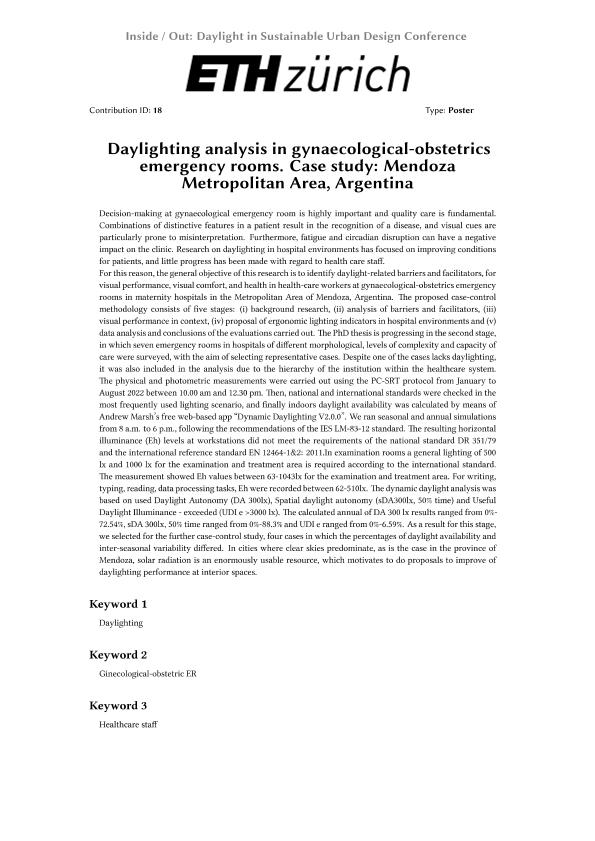
Decision-making at gynaecological emergency room is highly important and quality care is fundamental. Combinations of distinctive features in a patient result in the recognition of a disease, and visual cues are particularly prone to misinterpretation. Furthermore, fatigue and circadian disruption can have a negative impact on the clinic. Research on daylighting in hospital environments has focused on improving conditions for patients, and little progress has been made with regard to health care staff.For this reason, the general objective of this research is to identify daylight-related barriers and facilitators, for visual performance, visual comfort, and health in health-care workers at gynaecological-obstetrics emergency rooms in maternity hospitals in the Metropolitan Area of Mendoza, Argentina. The proposed case-control methodology consists of five stages: (i) background research, (ii) analysis of barriers and facilitators, (iii) visual performance in context, (iv) proposal of ergonomic lighting indicators in hospital environments and (v) data analysis and conclusions of the evaluations carried out. The PhD thesis is progressing in the second stage, in which seven emergency rooms in hospitals of different morphological, levels of complexity and capacity of care were surveyed, with the aim of selecting representative cases. Despite one of the cases lacks daylighting, it was also included in the analysis due to the hierarchy of the institution within the healthcare system. The physical and photometric measurements were carried out using the PC-SRT protocol from January to August 2022 between 10.00 am and 12.30 pm. Then, national and international standards were checked in the most frequently used lighting scenario, and finally indoors daylight availability was calculated by means of Andrew Marsh’s free web-based app "Dynamic Daylighting V2.0.0”. We ran seasonal and annual simulations from 8 a.m. to 6 p.m., following the recommendations of the IES LM-83-12 standard. The resulting horizontal illuminance (Eh) levels at workstations did not meet the requirements of the national standard DR 351/79 and the international reference standard EN 12464-1&2: 2011.In examination rooms a general lighting of 500 lx and 1000 lx for the examination and treatment area is required according to the international standard. The measurement showed Eh values between 63-1043lx for the examination and treatment area. For writing, typing, reading, data processing tasks, Eh were recorded between 62-510lx. The dynamic daylight analysis was based on used Daylight Autonomy (DA 300lx), Spatial daylight autonomy (sDA300lx, 50% time) and Useful Daylight Illuminance - exceeded (UDI e >3000 lx). The calculated annual of DA 300 lx results ranged from 0%-72.54%, sDA 300lx, 50% time ranged from 0%-88.3% and UDI e ranged from 0%-6.59%. As a result for this stage, we selected for the further case-control study, four cases in which the percentages of daylight availability and inter-seasonal variability differed. In cities where clear skies predominate, as is the case in the province of Mendoza, solar radiation is an enormously usable resource, which motivates to do proposals to improve of daylighting performance at interior spaces.
Palabras clave:
DAYLIGHTING
,
GYNAECOLOGICAL
,
GYNAECOLOGICAL OBSTETRICS EMERGENCY ROOMS
Archivos asociados

Tamaño:
39.77Kb
Formato:
PDF
Licencia
 Excepto donde se diga explícitamente, este item se publica bajo la siguiente descripción:
Creative Commons Attribution-NonCommercial-ShareAlike 2.5 Unported (CC BY-NC-SA 2.5)
Excepto donde se diga explícitamente, este item se publica bajo la siguiente descripción:
Creative Commons Attribution-NonCommercial-ShareAlike 2.5 Unported (CC BY-NC-SA 2.5)
Identificadores
Colecciones
Eventos(INAHE)
Eventos de INSTITUTO DE AMBIENTE, HABITAT Y ENERGIA
Eventos de INSTITUTO DE AMBIENTE, HABITAT Y ENERGIA
Citación
Daylighting analisis in gynaecological obstetrics emergency rooms; Daylight in Sustainable Urban Design Conference; Zürich; Suiza; 2023; 1-2
Compartir

