Artículo
Targeting Tumor Antigens to Secreted Membrane Vesicles In vivo Induces Efficient Antitumor Immune Responses
Zeelenberg, Ingrid S.; Ostrowski, Matias ; Krumeich, Sophie; Bobrie, Angélique; Jancic, Carolina Cristina
; Boissonnas, Alexandre; Delcayre, Alain; Le Pecq, Jean-Bernard; Combadière, Béhazine; Amigorena, Sebastian; Théry, Clotilde
; Krumeich, Sophie; Bobrie, Angélique; Jancic, Carolina Cristina
; Boissonnas, Alexandre; Delcayre, Alain; Le Pecq, Jean-Bernard; Combadière, Béhazine; Amigorena, Sebastian; Théry, Clotilde
; Krumeich, Sophie; Bobrie, Angélique; Jancic, Carolina Cristina
; Boissonnas, Alexandre; Delcayre, Alain; Le Pecq, Jean-Bernard; Combadière, Béhazine; Amigorena, Sebastian; Théry, Clotilde
Fecha de publicación:
02/2008
Editorial:
American Association for Cancer Research
Revista:
Cancer Research
ISSN:
0008-5472
Idioma:
Inglés
Tipo de recurso:
Artículo publicado
Clasificación temática:
Resumen
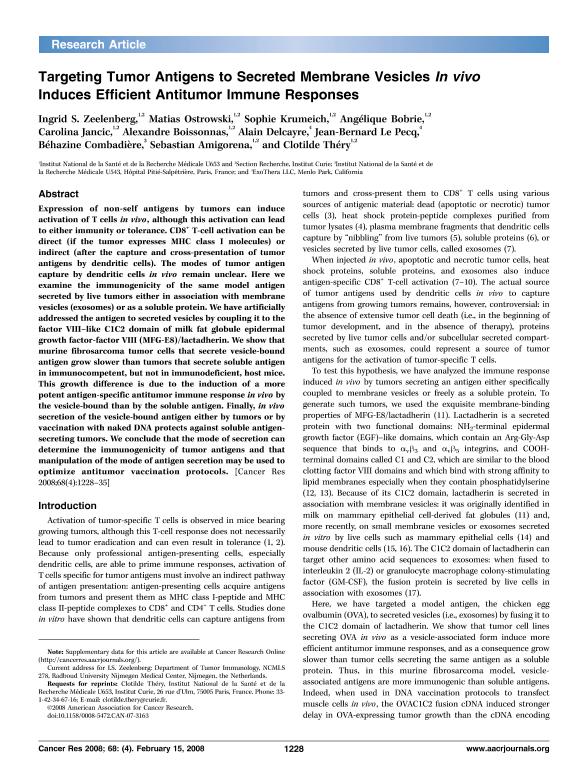
Expression of non-self antigens by tumors can induce activation of T cells in vivo, although this activation can lead to either immunity or tolerance. CD8+ T-cell activation can be direct (if the tumor expresses MHC class I molecules) or indirect (after the capture and cross-presentation of tumor antigens by dendritic cells). The modes of tumor antigen capture by dendritic cells in vivo remain unclear. Here we examine the immunogenicity of the same model antigen secreted by live tumors either in association with membrane vesicles (exosomes) or as a soluble protein. We have artificially addressed the antigen to secreted vesicles by coupling it to the factor VIII–like C1C2 domain of milk fat globule epidermal growth factor-factor VIII (MFG-E8)/lactadherin. We show that murine fibrosarcoma tumor cells that secrete vesicle-bound antigen grow slower than tumors that secrete soluble antigen in immunocompetent, but not in immunodeficient, host mice. This growth difference is due to the induction of a more potent antigen-specific antitumor immune response in vivo by the vesicle-bound than by the soluble antigen. Finally, in vivo secretion of the vesicle-bound antigen either by tumors or by vaccination with naked DNA protects against soluble antigensecreting tumors. We conclude that the mode of secretion can determine the immunogenicity of tumor antigens and that manipulation of the mode of antigen secretion may be used to optimize antitumor vaccination protocols.
Palabras clave:
TUMOR ANTIGENS
,
IMMUNE RESPONSE
,
VESICLE-BOUND ANTIGENS
Archivos asociados

Tamaño:
331.4Kb
Formato:
PDF
Licencia
 Excepto donde se diga explícitamente, este item se publica bajo la siguiente descripción:
Creative Commons Attribution-NonCommercial-ShareAlike 2.5 Unported (CC BY-NC-SA 2.5)
Excepto donde se diga explícitamente, este item se publica bajo la siguiente descripción:
Creative Commons Attribution-NonCommercial-ShareAlike 2.5 Unported (CC BY-NC-SA 2.5)
Identificadores
Colecciones
Articulos(SEDE CENTRAL)
Articulos de SEDE CENTRAL
Articulos de SEDE CENTRAL
Citación
Zeelenberg, Ingrid S.; Ostrowski, Matias; Krumeich, Sophie; Bobrie, Angélique; Jancic, Carolina Cristina; et al.; Targeting Tumor Antigens to Secreted Membrane Vesicles In vivo Induces Efficient Antitumor Immune Responses; American Association for Cancer Research; Cancer Research; 68; 4; 2-2008; 1228-1235
Compartir


Altmétricas