Artículo
On the phytoplankton bloom in coastal waters of southern King George Island (Antarctica) in January 2010: An exceptional feature?
Schloss, Irene Ruth ; Wasilowska, A; Dumont, D; Almandoz, Gaston Osvaldo
; Hernando, Marcelo Pablo
; Michaud Tremblay, C. A; Saravia, L.; Rzepecki, M.; Monien, P.; Monien, D.; Kopczynska, E. E.; Bers, A.V.; Ferreyra, G. A.
; Wasilowska, A; Dumont, D; Almandoz, Gaston Osvaldo
; Hernando, Marcelo Pablo
; Michaud Tremblay, C. A; Saravia, L.; Rzepecki, M.; Monien, P.; Monien, D.; Kopczynska, E. E.; Bers, A.V.; Ferreyra, G. A.
; Wasilowska, A; Dumont, D; Almandoz, Gaston Osvaldo
; Hernando, Marcelo Pablo
; Michaud Tremblay, C. A; Saravia, L.; Rzepecki, M.; Monien, P.; Monien, D.; Kopczynska, E. E.; Bers, A.V.; Ferreyra, G. A.
Fecha de publicación:
01/2014
Editorial:
Amer Soc Limnology Oceanography
Revista:
Limnology and Oceanography
ISSN:
0024-3590
Idioma:
Inglés
Tipo de recurso:
Artículo publicado
Clasificación temática:
Resumen
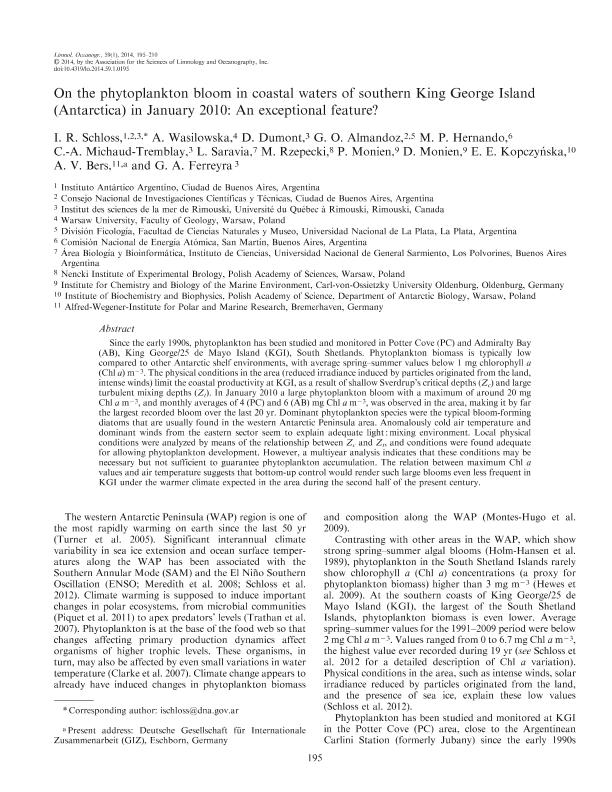
Since the early 1990s, phytoplankton has been studied and monitored in Potter Cove (PC) and Admiralty Bay (AB), King George/25 de Mayo Island (KGI), South Shetlands. Phytoplankton biomass is typically low compared to other Antarctic shelf environments, with average spring—summer values below 1 mg chlorophyll a (Chl a) m−3. The physical conditions in the area (reduced irradiance induced by particles originated from the land, intense winds) limit the coastal productivity at KGI, as a result of shallow Sverdrup's critical depths (Zc) and large turbulent mixing depths (Zt). In January 2010 a large phytoplankton bloom with a maximum of around 20 mg Chl a m−3, and monthly averages of 4 (PC) and 6 (AB) mg Chl a m−3, was observed in the area, making it by far the largest recorded bloom over the last 20 yr. Dominant phytoplankton species were the typical bloom-forming diatoms that are usually found in the western Antarctic Peninsula area. Anomalously cold air temperature and dominant winds from the eastern sector seem to explain adequate light : mixing environment. Local physical conditions were analyzed by means of the relationship between Zc and Zt, and conditions were found adequate for allowing phytoplankton development. However, a multiyear analysis indicates that these conditions may be necessary but not sufficient to guarantee phytoplankton accumulation. The relation between maximum Chl a values and air temperature suggests that bottom-up control would render such large blooms even less frequent in KGI under the warmer climate expected in the area during the second half of the present century.
Palabras clave:
Climate Change
Archivos asociados

Tamaño:
929.5Kb
Formato:
PDF
Licencia
 Excepto donde se diga explícitamente, este item se publica bajo la siguiente descripción:
Creative Commons Attribution-NonCommercial-ShareAlike 2.5 Unported (CC BY-NC-SA 2.5)
Excepto donde se diga explícitamente, este item se publica bajo la siguiente descripción:
Creative Commons Attribution-NonCommercial-ShareAlike 2.5 Unported (CC BY-NC-SA 2.5)
Identificadores
Colecciones
Articulos(CCT - LA PLATA)
Articulos de CTRO.CIENTIFICO TECNOL.CONICET - LA PLATA
Articulos de CTRO.CIENTIFICO TECNOL.CONICET - LA PLATA
Citación
Schloss, Irene Ruth; Wasilowska, A; Dumont, D; Almandoz, Gaston Osvaldo; Hernando, Marcelo Pablo; et al.; On the phytoplankton bloom in coastal waters of southern King George Island (Antarctica) in January 2010: An exceptional feature?; Amer Soc Limnology Oceanography; Limnology and Oceanography; 59; 1; 1-2014; 195-210
Compartir


Altmétricas