Artículo
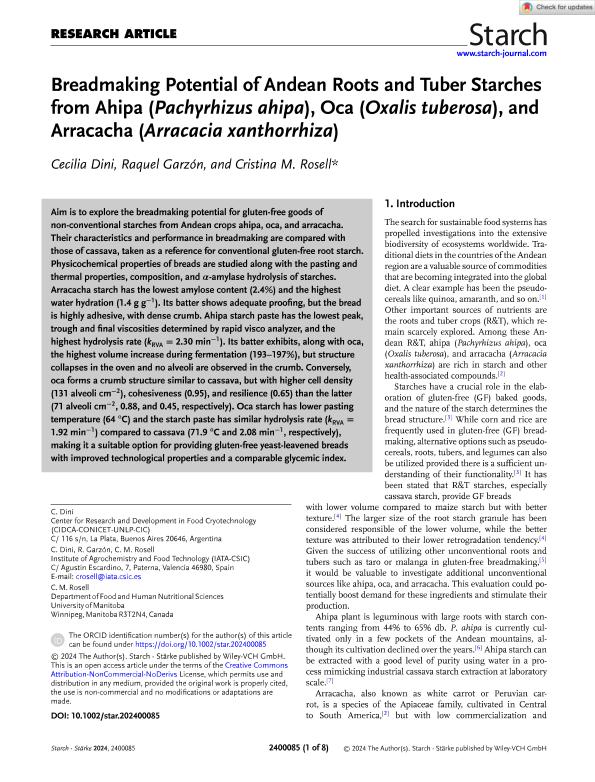
Breadmaking Potential of Andean Roots and Tuber Starches from Ahipa ( Pachyrhizus ahipa ), Oca ( Oxalis tuberosa ), and Arracacha ( Arracacia xanthorrhiza )

Fecha de publicación:
08/2024
Editorial:
Wiley VCH Verlag
Revista:
Starch/starke
ISSN:
0038-9056
Idioma:
Inglés
Tipo de recurso:
Artículo publicado
Clasificación temática:
Resumen
Aim is to explore the breadmaking potential for gluten-free goods of non-conventional starches from Andean crops ahipa, oca, and arracacha. Their characteristics and performance in breadmaking are compared with those of cassava, taken as a reference for conventional gluten-free root starch. Physicochemical properties of breads are studied along with the pasting and thermal properties, composition, and α-amylase hydrolysis of starches. Arracacha starch has the lowest amylose content (2.4%) and the highest water hydration (1.4 g g−1). Its batter shows adequate proofing, but the bread is highly adhesive, with dense crumb. Ahipa starch paste has the lowest peak, trough and final viscosities determined by rapid visco analyzer, and the highest hydrolysis rate (kRVA = 2.30 min−1). Its batter exhibits, along with oca, the highest volume increase during fermentation (193–197%), but structure collapses in the oven and no alveoli are observed in the crumb. Conversely, oca forms a crumb structure similar to cassava, but with higher cell density (131 alveoli cm−2), cohesiveness (0.95), and resilience (0.65) than the latter (71 alveoli cm−2, 0.88, and 0.45, respectively). Oca starch has lower pasting temperature (64 °C) and the starch paste has similar hydrolysis rate (kRVA = 1.92 min−1) compared to cassava (71.9 °C and 2.08 min−1, respectively), making it a suitable option for providing gluten-free yeast-leavened breads with improved technological properties and a comparable glycemic index.
Palabras clave:
Amylose
,
Bread
,
DSC
,
Hydrolysis
,
Viscosity
Archivos asociados

Tamaño:
1.901Mb
Formato:
PDF
Licencia
 Excepto donde se diga explícitamente, este item se publica bajo la siguiente descripción:
Creative Commons Attribution-NonCommercial-ShareAlike 2.5 Unported (CC BY-NC-SA 2.5)
Excepto donde se diga explícitamente, este item se publica bajo la siguiente descripción:
Creative Commons Attribution-NonCommercial-ShareAlike 2.5 Unported (CC BY-NC-SA 2.5)
Identificadores
Colecciones
Articulos(CIDCA)
Articulos de CENTRO DE INV EN CRIOTECNOLOGIA DE ALIMENTOS (I)
Articulos de CENTRO DE INV EN CRIOTECNOLOGIA DE ALIMENTOS (I)
Citación
Dini, Cecilia; Garzón, Raquel; Rosell, Cristina M.; Breadmaking Potential of Andean Roots and Tuber Starches from Ahipa ( Pachyrhizus ahipa ), Oca ( Oxalis tuberosa ), and Arracacha ( Arracacia xanthorrhiza ); Wiley VCH Verlag; Starch/starke; s/n; 8-2024; 1-8
Compartir


Altmétricas