Mostrar el registro sencillo del ítem
dc.contributor.author
Guédron, Stéphane
dc.contributor.author
Roy, Clément
dc.contributor.author
Sarret, Géraldine
dc.contributor.author
Tolu, Julie
dc.contributor.author
Ledru, Marie Pierre
dc.contributor.author
Campillo, Sylvain
dc.contributor.author
Bureau, Sarah
dc.contributor.author
Develle, Anne Lise
dc.contributor.author
Guiguet Covex, Charline
dc.contributor.author
Alves, Eduardo Queiroz
dc.contributor.author
Boudin, Mathieu
dc.contributor.author
Joffre, Richard
dc.contributor.author
Cruz, Pablo
dc.date.available
2024-11-05T14:22:38Z
dc.date.issued
2024-08-15
dc.identifier.citation
Guédron, Stéphane; Roy, Clément; Sarret, Géraldine; Tolu, Julie; Ledru, Marie Pierre; et al.; Pre-hispanic wetland irrigation and metallurgy in the South Andean Altiplano (Intersalar Region, Bolivia, XIVth and XVth century CE); Pergamon-Elsevier Science Ltd; Quaternary Science Reviews; 338; 108826; 15-8-2024; 11
dc.identifier.issn
0277-3791
dc.identifier.uri
http://hdl.handle.net/11336/247331
dc.description.abstract
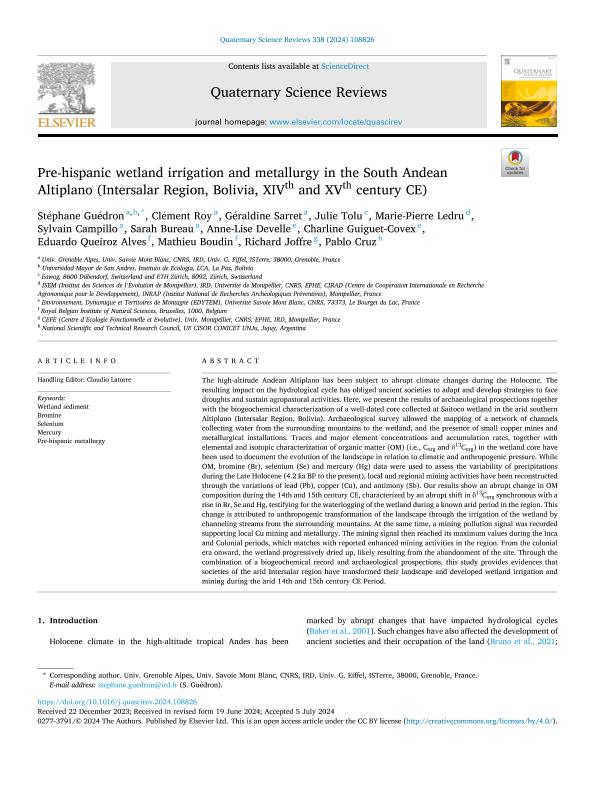
The high-altitude Andean Altiplano has been subject to abrupt climate changes during the Holocene. The resulting impact on the hydrological cycle has obliged ancient societies to adapt and develop strategies to face droughts and sustain agropastoral activities. Here, we present the results of archaeological prospections together with the biogeochemical characterization of a well-dated core collected at Saitoco wetland in the arid southern Altiplano (Intersalar Region, Bolivia). Archaeological survey allowed the mapping of a network of channels collecting water from the surrounding mountains to the wetland, and the presence of small copper mines and metallurgical installations. Traces and major element concentrations and accumulation rates, together with elemental and isotopic characterization of organic matter (OM) (i.e., Corg and δ13Corg) in the wetland core have been used to document the evolution of the landscape in relation to climatic and anthropogenic pressure. While OM, bromine (Br), selenium (Se) and mercury (Hg) data were used to assess the variability of precipitations during the Late Holocene (4.2 ka BP to the present), local and regional mining activities have been reconstructed through the variations of lead (Pb), copper (Cu), and antimony (Sb). Our results show an abrupt change in OM composition during the 14th and 15th century CE, characterized by an abrupt shift in δ13Corg synchronous with a rise in Br, Se and Hg, testifying for the waterlogging of the wetland during a known arid period in the region. This change is attributed to anthropogenic transformation of the landscape through the irrigation of the wetland by channeling streams from the surrounding mountains. At the same time, a mining pollution signal was recorded supporting local Cu mining and metallurgy. The mining signal then reached its maximum values during the Inca and Colonial periods, which matches with reported enhanced mining activities in the region. From the colonial era onward, the wetland progressively dried up, likely resulting from the abandonment of the site. Through the combination of a biogeochemical record and archaeological prospections, this study provides evidences that societies of the arid Intersalar region have transformed their landscape and developed wetland irrigation and mining during the arid 14th and 15th century CE Period.
dc.format
application/pdf
dc.language.iso
eng
dc.publisher
Pergamon-Elsevier Science Ltd
dc.rights
info:eu-repo/semantics/openAccess
dc.rights.uri
https://creativecommons.org/licenses/by/2.5/ar/
dc.subject
WETLAND SEDIMENT
dc.subject
BROMINE
dc.subject
SELENIUM
dc.subject
MERCURY
dc.subject
PRE-HISPANIC METALLURGY
dc.subject.classification
Otras Ciencias de la Tierra y relacionadas con el Medio Ambiente
dc.subject.classification
Ciencias de la Tierra y relacionadas con el Medio Ambiente
dc.subject.classification
CIENCIAS NATURALES Y EXACTAS
dc.title
Pre-hispanic wetland irrigation and metallurgy in the South Andean Altiplano (Intersalar Region, Bolivia, XIVth and XVth century CE)
dc.type
info:eu-repo/semantics/article
dc.type
info:ar-repo/semantics/artículo
dc.type
info:eu-repo/semantics/publishedVersion
dc.date.updated
2024-10-29T10:44:24Z
dc.identifier.eissn
1873-457X
dc.journal.volume
338
dc.journal.number
108826
dc.journal.pagination
11
dc.journal.pais
Estados Unidos
dc.journal.ciudad
Philadelphia
dc.description.fil
Fil: Guédron, Stéphane. Universite Grenoble Alpes; Francia
dc.description.fil
Fil: Roy, Clément. Universite Grenoble Alpes; Francia
dc.description.fil
Fil: Sarret, Géraldine. Universite Grenoble Alpes; Francia
dc.description.fil
Fil: Tolu, Julie. Eidgenossische Technische Hochschule zurich (eth Zurich);
dc.description.fil
Fil: Ledru, Marie Pierre. Institut National de Recherches Archéologiques Préventives; Francia
dc.description.fil
Fil: Campillo, Sylvain. Universite Grenoble Alpes; Francia
dc.description.fil
Fil: Bureau, Sarah. Universite Grenoble Alpes; Francia
dc.description.fil
Fil: Develle, Anne Lise. Universite Grenoble Alpes; Francia
dc.description.fil
Fil: Guiguet Covex, Charline. Universite Grenoble Alpes; Francia
dc.description.fil
Fil: Alves, Eduardo Queiroz. Royal Belgian Institute of Natural Sciences; Bélgica
dc.description.fil
Fil: Boudin, Mathieu. Royal Belgian Institute of Natural Sciences; Bélgica
dc.description.fil
Fil: Joffre, Richard. Centre National de la Recherche Scientifique; Francia
dc.description.fil
Fil: Cruz, Pablo. Consejo Nacional de Investigaciones Científicas y Técnicas. Centro Científico Tecnológico Conicet - Salta. Unidad Ejecutora en Ciencias Sociales Regionales y Humanidades. Universidad Nacional de Jujuy. Unidad Ejecutora en Ciencias Sociales Regionales y Humanidades; Argentina
dc.journal.title
Quaternary Science Reviews
dc.relation.alternativeid
info:eu-repo/semantics/altIdentifier/url/https://linkinghub.elsevier.com/retrieve/pii/S0277379124003275
dc.relation.alternativeid
info:eu-repo/semantics/altIdentifier/doi/http://dx.doi.org/10.1016/j.quascirev.2024.108826
Archivos asociados

Tamaño:
9.878Mb
Formato:
PDF