Evento
Understanding the main drug entry route in liver flukes: In-vivo closantel accumulation in fasciola hepatica
Ceballos, Laura ; Cantón, Candela
; Moreno Torrejon, Laura
; Fairweather, Ian; Lanusse, Carlos Edmundo
; Alvarez, Luis Ignacio
; Cantón, Candela
; Moreno Torrejon, Laura
; Fairweather, Ian; Lanusse, Carlos Edmundo
; Alvarez, Luis Ignacio
; Cantón, Candela
; Moreno Torrejon, Laura
; Fairweather, Ian; Lanusse, Carlos Edmundo
; Alvarez, Luis Ignacio
Tipo del evento:
Congreso
Nombre del evento:
XVIII Congresso Brasileiro de Parasitologia Veterinária
Fecha del evento:
21/10/2014
Institución Organizadora:
Associação Brasileira de Parasitologia Veterinária;
Título del Libro:
Anais XVIII Congresso Brasileiro de Parasitologia Veterinária
Editorial:
Associação Brasileira de Parasitologia Veterinária
Idioma:
Inglés
Clasificación temática:
Resumen
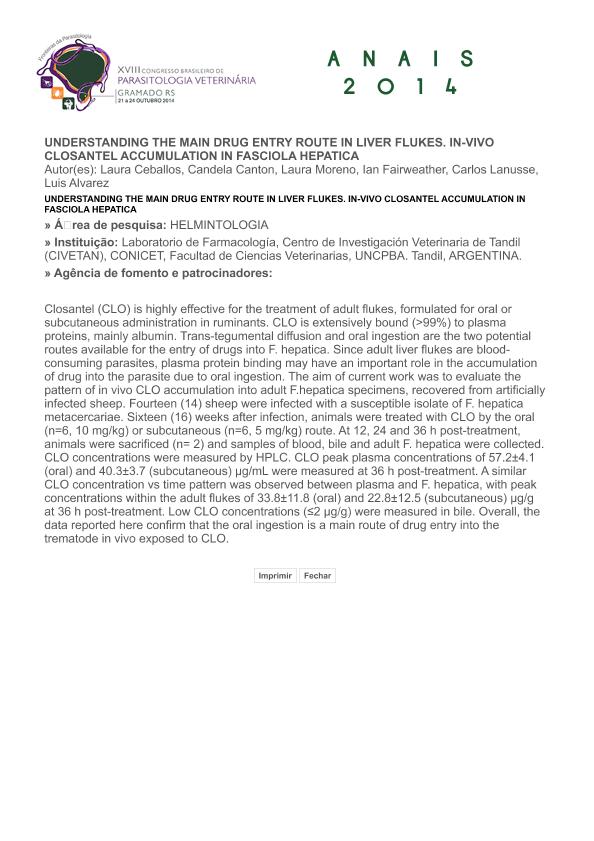
Closantel (CLO) is highly effective for the treatment of adult flukes, formulated for oral or subcutaneous administration in ruminants. CLO is extensively bound (>99%) to plasma proteins, mainly albumin. Trans-tegumental diffusion and oral ingestion are the two potential routes available for the entry of drugs into F. hepatica. Since adult liver flukes are blood-consuming parasites, plasma protein binding may have an important role in the accumulation of drug into the parasite due to oral ingestion. The aim of current work was to evaluate the pattern of in vivo CLO accumulation into adult F.hepatica specimens, recovered from artificially infected sheep. Fourteen (14) sheep were infected with a susceptible isolate of F. hepatica metacercariae. Sixteen (16) weeks after infection, animals were treated with CLO by the oral (n=6, 10 mg/kg) or subcutaneous (n=6, 5 mg/kg) route. At 12, 24 and 36 h post-treatment, animals were sacrificed (n= 2) and samples of blood, bile and adult F. hepatica were collected. CLO concentrations were measured by HPLC. CLO peak plasma concentrations of 57.2±4.1 (oral) and 40.3±3.7 (subcutaneous) µg/mL were measured at 36 h post-treatment. A similar CLO concentration vs time pattern was observed between plasma and F. hepatica, with peak concentrations within the adult flukes of 33.8±11.8 (oral) and 22.8±12.5 (subcutaneous) µg/g at 36 h post-treatment. Low CLO concentrations (≤2 µg/g) were measured in bile. Overall, the data reported here confirm that the oral ingestion is a main route of drug entry into the trematode in vivo exposed to CLO.
Palabras clave:
Liver flukes
,
Fasciola Hepática
,
Accumulation
,
Closantel
Archivos asociados

Tamaño:
82.63Kb
Formato:
PDF
Licencia
 Excepto donde se diga explícitamente, este item se publica bajo la siguiente descripción:
Creative Commons Attribution-NonCommercial-ShareAlike 2.5 Unported (CC BY-NC-SA 2.5)
Excepto donde se diga explícitamente, este item se publica bajo la siguiente descripción:
Creative Commons Attribution-NonCommercial-ShareAlike 2.5 Unported (CC BY-NC-SA 2.5)
Identificadores
Colecciones
Eventos(CIVETAN)
Eventos de CENTRO DE INVESTIGACION VETERINARIA DE TANDIL
Eventos de CENTRO DE INVESTIGACION VETERINARIA DE TANDIL
Citación
Understanding the main drug entry route in liver flukes: In-vivo closantel accumulation in fasciola hepatica; XVIII Congresso Brasileiro de Parasitologia Veterinária; Gramado; Brasil; 2014; 1
Compartir

