Mostrar el registro sencillo del ítem
dc.contributor.author
Salinas, Vanesa Anabella
dc.contributor.author
Cordone, Georgina Florencia
dc.contributor.author
Marina, Tomas Ignacio
dc.contributor.author
Momo, Fernando Roberto
dc.date.available
2024-10-08T17:29:40Z
dc.date.issued
2024-01
dc.identifier.citation
Salinas, Vanesa Anabella; Cordone, Georgina Florencia; Marina, Tomas Ignacio; Momo, Fernando Roberto; Estimating the Impact of Biodiversity Loss in a Marine Antarctic Food Web; Multidisciplinary Digital Publishing Institute; Diversity; 16; 1; 1-2024; 1-18
dc.identifier.uri
http://hdl.handle.net/11336/245672
dc.description.abstract
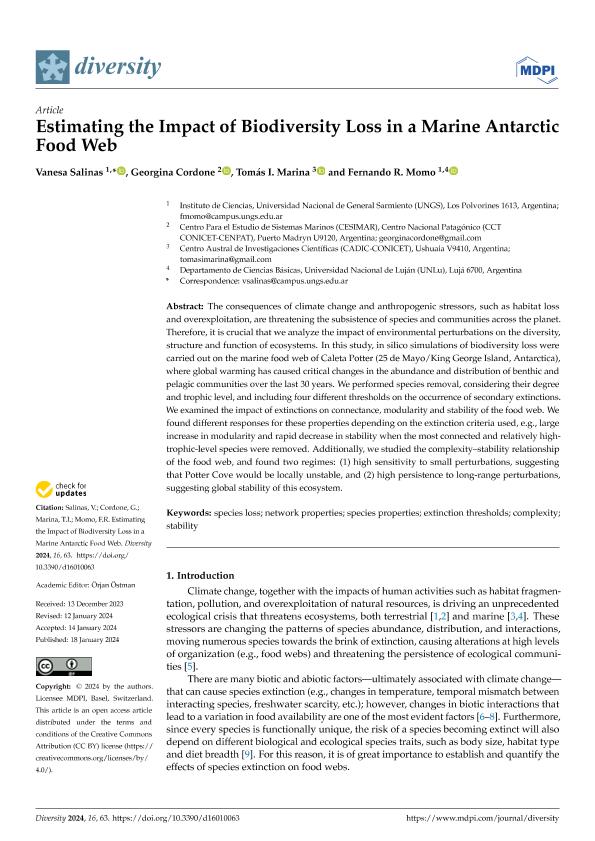
The consequences of climate change and anthropogenic stressors, such as habitat loss and overexploitation, are threatening the subsistence of species and communities across the planet. Therefore, it is crucial that we analyze the impact of environmental perturbations on the diversity, structure and function of ecosystems. In this study, in silico simulations of biodiversity loss were carried out on the marine food web of Caleta Potter (25 de Mayo/King George Island, Antarctica), where global warming has caused critical changes in the abundance and distribution of benthic and pelagic communities over the last 30 years. We performed species removal, considering their degree and trophic level, and including four different thresholds on the occurrence of secondary extinctions. We examined the impact of extinctions on connectance, modularity and stability of the food web. We found different responses for these properties depending on the extinction criteria used, e.g., large increase in modularity and rapid decrease in stability when the most connected and relatively high-trophic-level species were removed. Additionally, we studied the complexity–stability relationship of the food web, and found two regimes: (1) high sensitivity to small perturbations, suggesting that Potter Cove would be locally unstable, and (2) high persistence to long-range perturbations, suggesting global stability of this ecosystem.
dc.format
application/pdf
dc.language.iso
eng
dc.publisher
Multidisciplinary Digital Publishing Institute
dc.rights
info:eu-repo/semantics/openAccess
dc.rights.uri
https://creativecommons.org/licenses/by/2.5/ar/
dc.subject
COMPLEXITY
dc.subject
EXTINCTION THRESHOLDS
dc.subject
NETWORK PROPERTIES
dc.subject
SPECIES LOSS
dc.subject
SPECIES PROPERTIES
dc.subject
STABILITY
dc.subject.classification
Ecología
dc.subject.classification
Ciencias Biológicas
dc.subject.classification
CIENCIAS NATURALES Y EXACTAS
dc.subject.classification
Biología Marina, Limnología
dc.subject.classification
Ciencias Biológicas
dc.subject.classification
CIENCIAS NATURALES Y EXACTAS
dc.title
Estimating the Impact of Biodiversity Loss in a Marine Antarctic Food Web
dc.type
info:eu-repo/semantics/article
dc.type
info:ar-repo/semantics/artículo
dc.type
info:eu-repo/semantics/publishedVersion
dc.date.updated
2024-04-08T14:23:03Z
dc.identifier.eissn
1424-2818
dc.journal.volume
16
dc.journal.number
1
dc.journal.pagination
1-18
dc.journal.pais
Suiza
dc.journal.ciudad
Basilea
dc.description.fil
Fil: Salinas, Vanesa Anabella. Consejo Nacional de Investigaciones Científicas y Técnicas; Argentina. Universidad Nacional de General Sarmiento. Instituto de Ciencias. Área de Biología y Bioinformática; Argentina
dc.description.fil
Fil: Cordone, Georgina Florencia. Consejo Nacional de Investigaciones Científicas y Técnicas. Centro Científico Tecnológico Conicet - Centro Nacional Patagónico. Centro para el Estudio de Sistemas Marinos; Argentina
dc.description.fil
Fil: Marina, Tomas Ignacio. Consejo Nacional de Investigaciones Científicas y Técnicas. Centro Austral de Investigaciones Científicas; Argentina
dc.description.fil
Fil: Momo, Fernando Roberto. Universidad Nacional de Luján; Argentina
dc.journal.title
Diversity
dc.relation.alternativeid
info:eu-repo/semantics/altIdentifier/url/https://www.mdpi.com/1424-2818/16/1/63
dc.relation.alternativeid
info:eu-repo/semantics/altIdentifier/doi/https://doi.org/10.3390/d16010063
Archivos asociados

Tamaño:
8.305Mb
Formato:
PDF