Artículo
Life cycle analysis of ethanol obtained from lignocellulosic biomass: A case study of a native perennial grass from Argentina

Fecha de publicación:
12/2024
Editorial:
Elsevier
Revista:
Cleaner and Circular Bioeconomy
ISSN:
2772-8013
Idioma:
Inglés
Tipo de recurso:
Artículo publicado
Clasificación temática:
Resumen
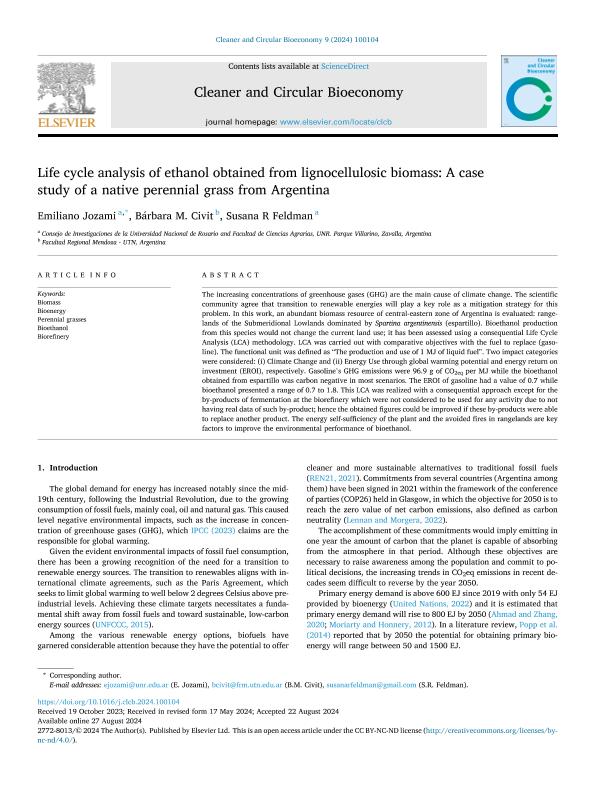
The increasing concentrations of greenhouse gases (GHG) are the main cause of climate change. The scientific community agree that transition to renewable energies will play a key role as a mitigation strategy for this problem. In this work, an abundant biomass resource of central-eastern zone of Argentina is evaluated: rangelands of the Submeridional Lowlands dominated by Spartina argentinensis (espartillo). Bioethanol production from this species would not change the current land use; it has been assessed using a consequential Life Cycle Analysis (LCA) methodology. LCA was carried out with comparative objectives with the fuel to replace (gasoline). The functional unit was defined as “The production and use of 1 MJ of liquid fuel”. Two impact categories were considered: (i) Climate Change and (ii) Energy Use through global warming potential and energy return on investment (EROI), respectively. Gasoline´s GHG emissions were 96.9 g of CO2eq per MJ while the bioethanol obtained from espartillo was carbon negative in most scenarios. The EROI of gasoline had a value of 0.7 while bioethanol presented a range of 0.7 to 1.8. This LCA was realized with a consequential approach except for the by-products of fermentation at the biorefinery which were not considered to be used for any activity due to not having real data of such by-product; hence the obtained figures could be improved if these by-products were able to replace another product. The energy self-sufficiency of the plant and the avoided fires in rangelands are key factors to improve the environmental performance of bioethanol.
Palabras clave:
BIOMASS
,
BIOENERGY
,
PERENNIAL GRASSES
,
BIOETHANOL
,
BIOREFINERY
Archivos asociados

Tamaño:
2.712Mb
Formato:
PDF
Licencia
 Excepto donde se diga explícitamente, este item se publica bajo la siguiente descripción:
Atribución-NoComercial-SinDerivadas 2.5 Argentina (CC BY-NC-ND 2.5 AR)
Excepto donde se diga explícitamente, este item se publica bajo la siguiente descripción:
Atribución-NoComercial-SinDerivadas 2.5 Argentina (CC BY-NC-ND 2.5 AR)
Identificadores
Colecciones
Articulos(CCT - MENDOZA)
Articulos de CTRO.CIENTIFICO TECNOL.CONICET - MENDOZA
Articulos de CTRO.CIENTIFICO TECNOL.CONICET - MENDOZA
Citación
Jozami, Emiliano; Civit, Bárbara María; Feldman, Susana Raquel; Life cycle analysis of ethanol obtained from lignocellulosic biomass: A case study of a native perennial grass from Argentina; Elsevier; Cleaner and Circular Bioeconomy; 9; 12-2024; 1-8
Compartir


Altmétricas