Artículo
Symbiotic stars in X-rays IV. XMM-Newton, Swift, and TESS observations
de Jesus Lima, Isabel; Luna, Gerardo Juan Manuel ; Mukai, K.; Oliveira, A. S.; Sokoloski, J. L.; Walter, F. M.; Palivanas, N.; Nuñez, Natalia Edith
; Souza, R. R.; Araujo, R. A. N.
; Mukai, K.; Oliveira, A. S.; Sokoloski, J. L.; Walter, F. M.; Palivanas, N.; Nuñez, Natalia Edith
; Souza, R. R.; Araujo, R. A. N.
; Mukai, K.; Oliveira, A. S.; Sokoloski, J. L.; Walter, F. M.; Palivanas, N.; Nuñez, Natalia Edith
; Souza, R. R.; Araujo, R. A. N.
Fecha de publicación:
09/2024
Editorial:
EDP Sciences
Revista:
Astronomy and Astrophysics
ISSN:
0004-6361
Idioma:
Inglés
Tipo de recurso:
Artículo publicado
Clasificación temática:
Resumen
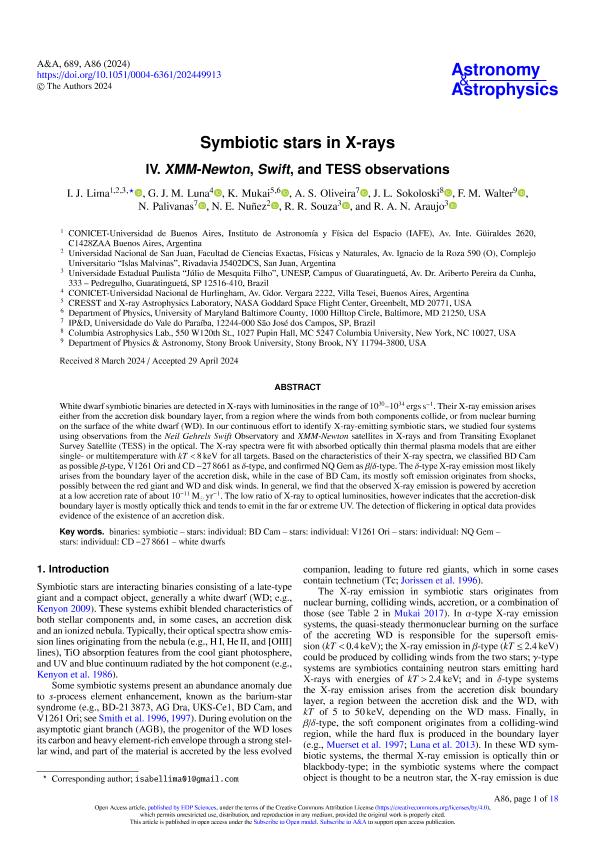
White dwarf symbiotic binaries are detected in X-rays with luminosities in the range of 1030–1034 ergs s−1. Their X-ray emission ariseseither from the accretion disk boundary layer, from a region where the winds from both components collide, or from nuclear burningon the surface of the white dwarf (WD). In our continuous effort to identify X-ray-emitting symbiotic stars, we studied four systemsusing observations from the Neil Gehrels Swift Observatory and XMM-Newton satellites in X-rays and from Transiting ExoplanetSurvey Satellite (TESS) in the optical. The X-ray spectra were fit with absorbed optically thin thermal plasma models that are eithersingle- or multitemperature with kT < 8 keV for all targets. Based on the characteristics of their X-ray spectra, we classified BD Camas possible β-type, V1261 Ori and CD −27 8661 as δ-type, and confirmed NQ Gem as β/δ-type. The δ-type X-ray emission most likelyarises from the boundary layer of the accretion disk, while in the case of BD Cam, its mostly soft emission originates from shocks,possibly between the red giant and WD and disk winds. In general, we find that the observed X-ray emission is powered by accretionat a low accretion rate of about 10−11 M yr−1. The low ratio of X-ray to optical luminosities, however indicates that the accretion-diskboundary layer is mostly optically thick and tends to emit in the far or extreme UV. The detection of flickering in optical data providesevidence of the existence of an accretion disk.
Archivos asociados

Tamaño:
5.550Mb
Formato:
PDF
Licencia
 Excepto donde se diga explícitamente, este item se publica bajo la siguiente descripción:
Creative Commons Attribution 2.5 Unported (CC BY 2.5)
Excepto donde se diga explícitamente, este item se publica bajo la siguiente descripción:
Creative Commons Attribution 2.5 Unported (CC BY 2.5)
Identificadores
Colecciones
Articulos(SEDE CENTRAL)
Articulos de SEDE CENTRAL
Articulos de SEDE CENTRAL
Citación
de Jesus Lima, Isabel; Luna, Gerardo Juan Manuel; Mukai, K.; Oliveira, A. S.; Sokoloski, J. L.; et al.; Symbiotic stars in X-rays IV. XMM-Newton, Swift, and TESS observations; EDP Sciences; Astronomy and Astrophysics; 689; 9-2024; 1-18
Compartir


Altmétricas