Artículo
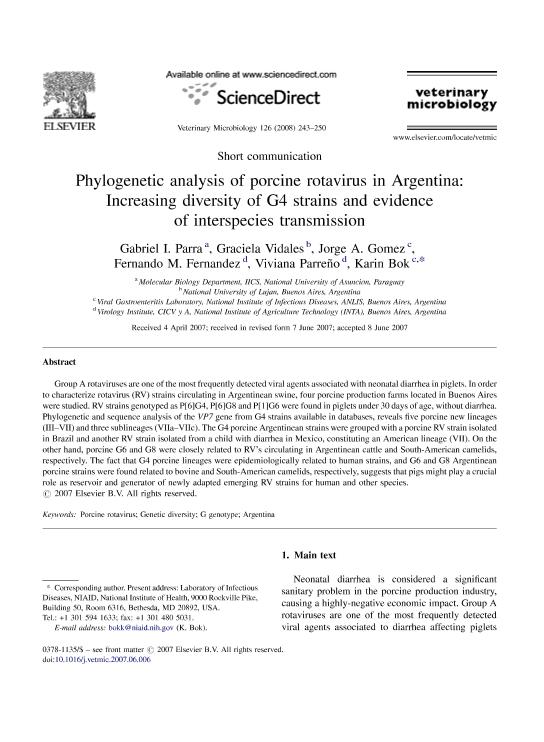
Phylogenetic analysis of porcine rotavirus in Argentina: Increasing diversity of G4 strains and evidence of interspecies transmission
Parra, Gabriel I.; Vidales, Graciela Elba; Gomez, Jorge A.; Fernandez, Fernando M.; Parreño, Gladys Viviana ; Bok, Karin
; Bok, Karin
Fecha de publicación:
01/2008
Editorial:
Elsevier Science
Revista:
Veterinary Microbiology
ISSN:
0378-1135
Idioma:
Inglés
Tipo de recurso:
Artículo publicado
Clasificación temática:
Resumen
Group A rotaviruses are one of the most frequently detected viral agents associated with neonatal diarrhea in piglets. In order to characterize rotavirus (RV) strains circulating in Argentinean swine, four porcine production farms located in Buenos Aires were studied. RV strains genotyped as P[6]G4, P[6]G8 and P[1]G6 were found in piglets under 30 days of age, without diarrhea. Phylogenetic and sequence analysis of the VP7 gene from G4 strains available in databases, reveals five porcine new lineages (III-VII) and three sublineages (VIIa-VIIc). The G4 porcine Argentinean strains were grouped with a porcine RV strain isolated in Brazil and another RV strain isolated from a child with diarrhea in Mexico, constituting an American lineage (VII). On the other hand, porcine G6 and G8 were closely related to RV´s circulating in Argentinean cattle and South-American camelids, respectively. The fact that G4 porcine lineages were epidemiologically related to human strains, and G6 and G8 Argentinean porcine strains were found related to bovine and South-American camelids, respectively, suggests that pigs might play a crucial role as reservoir and generator of newly adapted emerging RV strains for human and other species.
Palabras clave:
Rotaviruses
,
Argentinean
,
swine
,
strains
,
Rotaviruses
,
Argentinean
,
strains
Archivos asociados

Tamaño:
525.5Kb
Formato:
PDF
Licencia
 Excepto donde se diga explícitamente, este item se publica bajo la siguiente descripción:
Creative Commons Attribution-NonCommercial-ShareAlike 2.5 Unported (CC BY-NC-SA 2.5)
Excepto donde se diga explícitamente, este item se publica bajo la siguiente descripción:
Creative Commons Attribution-NonCommercial-ShareAlike 2.5 Unported (CC BY-NC-SA 2.5)
Identificadores
Colecciones
Articulos(SEDE CENTRAL)
Articulos de SEDE CENTRAL
Articulos de SEDE CENTRAL
Citación
Parra, Gabriel I.; Vidales, Graciela Elba; Gomez, Jorge A.; Fernandez, Fernando M.; Parreño, Gladys Viviana; et al.; Phylogenetic analysis of porcine rotavirus in Argentina: Increasing diversity of G4 strains and evidence of interspecies transmission; Elsevier Science; Veterinary Microbiology; 126; 1-3; 1-2008; 243-250
Compartir


Altmétricas