Artículo
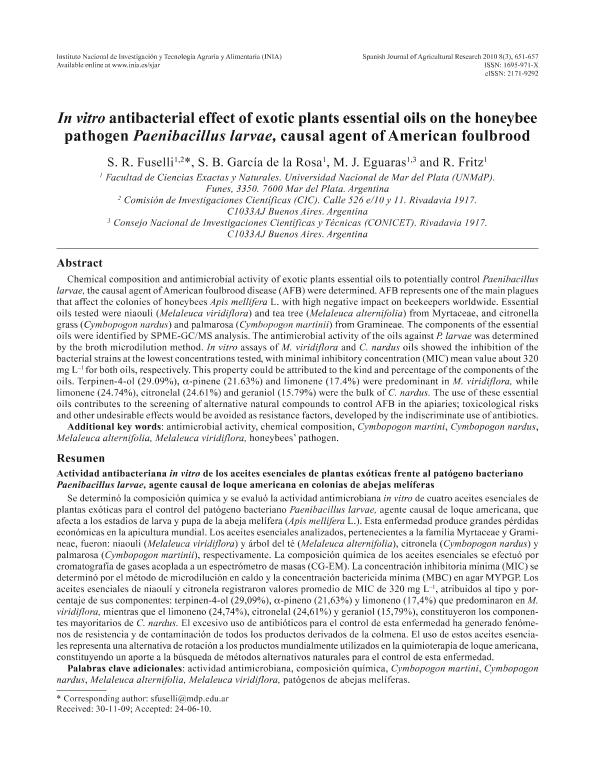
Chemical composition and antimicrobial activity of exotic plants essential oils to potentially control Paenibacillus larvae, the causal agent of American foulbrood disease (AFB) were determined. AFB represents one of the main plagues that affect the colonies of honeybees Apis mellifera L. with high negative impact on beekeepers worldwide. Essential oils tested were niaouli (Melaleuca viridiflora) and tea tree (Melaleuca alternifolia) from Myrtaceae, and citronella grass (Cymbopogon nardus) and palmarosa (Cymbopogon martinii) from Gramineae. The components of the essential oils were identified by SPME-GC/MS analysis. The antimicrobial activity of the oils against P. larvae was determined by the broth microdilution method. In vitro assays of M. viridiflora and C. nardus oils showed the inhibition of the bacterial strains at the lowest concentrations tested, with minimal inhibitory concentration (MIC) mean value about 320 mg L–1 for both oils, respectively. This property could be attributed to the kind and percentage of the components of the oils. Terpinen-4-ol (29.09%), á-pinene (21.63%) and limonene (17.4%) were predominant in M. viridiflora, while limonene (24.74%), citronelal (24.61%) and geraniol (15.79%) were the bulk of C. nardus. The use of these essential oils contributes to the screening of alternative natural compounds to control AFB in the apiaries; toxicological risks and other undesirable effects would be avoided as resistance factors, developed by the indiscriminate use of antibiotics. Additional key words: antimicrobial activity, chemical composition, Cymbopogon martini, Cymbopogon nardus, Melaleuca alternifolia, Melaleuca viridiflora, honeybees’ pathogen. Se determinó la composición química y se evaluó la actividad antimicrobiana in vitro de cuatro aceites esenciales de plantas exóticas para el control del patógeno bacteriano Paenibacillus larvae, agente causal de loque americana, que afecta a los estadios de larva y pupa de la abeja melífera (Apis mellifera L.). Esta enfermedad produce grandes pérdidas económicas en la apicultura mundial. Los aceites esenciales analizados, pertenecientes a la familia Myrtaceae y Gramineae, fueron: niaouli (Melaleuca viridiflora) y árbol del té (Melaleuca alternifolia), citronela (Cymbopogon nardus) y palmarosa (Cymbopogon martinii), respectivamente. La composición química de los aceites esenciales se efectuó por cromatografía de gases acoplada a un espectrómetro de masas (CG-EM). La concentración inhibitoria mínima (MIC) se determinó por el método de microdilución en caldo y la concentración bactericida mínima (MBC) en agar MYPGP. Los aceites esenciales de niaoulí y citronela registraron valores promedio de MIC de 320 mg L–1, atribuidos al tipo y porcentaje de sus componentes: terpinen-4-ol (29,09%), α-pineno (21,63%) y limoneno (17,4%) que predominaron en M. viridiflora, mientras que el limoneno (24,74%), citronelal (24,61%) y geraniol (15,79%), constituyeron los componentes mayoritarios de C. nardus. El excesivo uso de antibióticos para el control de esta enfermedad ha generado fenómenos de resistencia y de contaminación de todos los productos derivados de la colmena. El uso de estos aceites esenciales representa una alternativa de rotación a los productos mundialmente utilizados en la quimioterapia de loque americana, constituyendo un aporte a la búsqueda de métodos alternativos naturales para el control de esta enfermedad.
In vitro antibacterial effect of exotic plants essential oils on the honeybee pathogen Paenibacillus larvae, causal agent of American foulbrood
Título:
Actividad antibacteriana in vitro de los aceites esenciales de plantas exóticas frente al patógeno bacteriano Paenibacillus larvae, agente causal de loque americana en colonias de abejas melíferas

Fecha de publicación:
09/2010
Editorial:
Spanish National Institute for Agriculture and Food Research and Technology
Revista:
Spanish Journal Of Agricultural Research
ISSN:
2171-9292
e-ISSN:
1695-971X
Idioma:
Inglés
Tipo de recurso:
Artículo publicado
Clasificación temática:
Resumen
Palabras clave:
ESSENTIAL OIL
,
CONTROL
,
PAENIBACILLUS
Archivos asociados

Tamaño:
65.85Kb
Formato:
PDF
Licencia
 Excepto donde se diga explícitamente, este item se publica bajo la siguiente descripción:
Creative Commons Attribution 2.5 Unported (CC BY 2.5)
Excepto donde se diga explícitamente, este item se publica bajo la siguiente descripción:
Creative Commons Attribution 2.5 Unported (CC BY 2.5)
Identificadores
Colecciones
Articulos(CCT - MAR DEL PLATA)
Articulos de CTRO.CIENTIFICO TECNOL.CONICET - MAR DEL PLATA
Articulos de CTRO.CIENTIFICO TECNOL.CONICET - MAR DEL PLATA
Citación
Fuselli, S.; García de la Rosa, Susana Beatriz; Eguaras, Martin Javier; Fritz, R.; In vitro antibacterial effect of exotic plants essential oils on the honeybee pathogen Paenibacillus larvae, causal agent of American foulbrood; Spanish National Institute for Agriculture and Food Research and Technology; Spanish Journal Of Agricultural Research; 8; 3; 9-2010; 651-657
Compartir


Altmétricas