Artículo
Photophysics of anthracene–indole systems in unilamellar vesicles of DMPC and POPC: Exciplex formation and temperature effects

Fecha de publicación:
11/2006
Editorial:
Elsevier Science SA
Revista:
Journal of Photochemistry and Photobiology B: Biology
ISSN:
1011-1344
Idioma:
Inglés
Tipo de recurso:
Artículo publicado
Clasificación temática:
Resumen
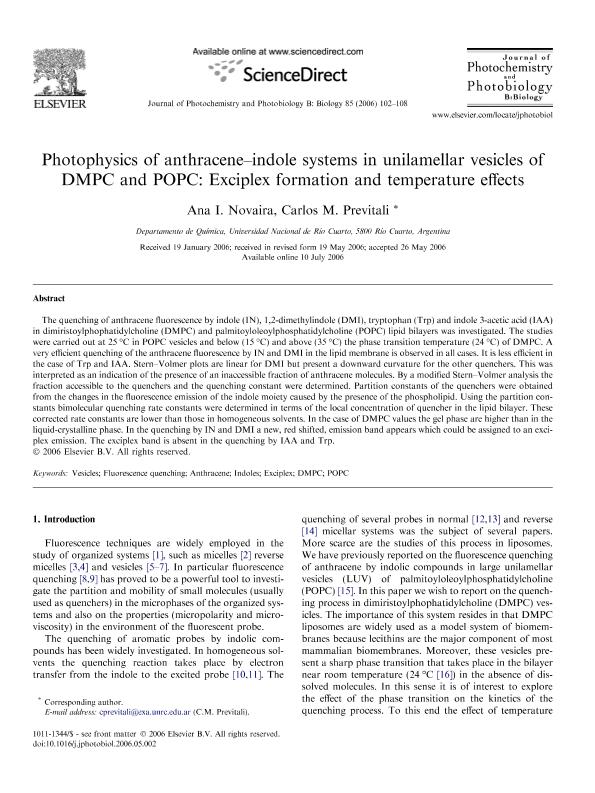
The quenching of anthracene fluorescence by indole (IN), 1,2-dimethylindole (DMI), tryptophan (Trp) and indole 3-acetic acid (IAA) in dimiristoylphophatidylcholine (DMPC) and palmitoyloleoylphosphatidylcholine (POPC) lipid bilayers was investigated. The studies were carried out at 25 ºC in POPC vesicles and below (15 C) and above (35 C) the phase transition temperature (24 ºC) of DMPC. A very efficient quenching of the anthracene fluorescence by IN and DMI in the lipid membrane is observed in all cases. It is less efficient in the case of Trp and IAA. Stern–Volmer plots are linear for DMI but present a downward curvature for the other quenchers. This was interpreted as an indication of the presence of an inaccessible fraction of anthracene molecules. By a modified Stern–Volmer analysis the fraction accessible to the quenchers and the quenching constant were determined. Partition constants of the quenchers were obtained from the changes in the fluorescence emission of the indole moiety caused by the presence of the phospholipid. Using the partition constants bimolecular quenching rate constants were determined in terms of the local concentration of quencher in the lipid bilayer. These corrected rate constants are lower than those in homogeneous solvents. In the case of DMPC values the gel phase are higher than in the liquid-crystalline phase. In the quenching by IN and DMI a new, red shifted, emission band appears which could be assigned to an exciplex emission. The exciplex band is absent in the quenching by IAA and Trp.
Palabras clave:
Vesicles
,
Fluorescence quenching
,
Anthracene
,
Indoles
,
Exciplex
,
DMPC
,
POPC
Archivos asociados

Tamaño:
223.2Kb
Formato:
PDF
Licencia
 Excepto donde se diga explícitamente, este item se publica bajo la siguiente descripción:
Creative Commons Attribution-NonCommercial-ShareAlike 2.5 Unported (CC BY-NC-SA 2.5)
Excepto donde se diga explícitamente, este item se publica bajo la siguiente descripción:
Creative Commons Attribution-NonCommercial-ShareAlike 2.5 Unported (CC BY-NC-SA 2.5)
Identificadores
Colecciones
Articulos(CCT - CORDOBA)
Articulos de CTRO.CIENTIFICO TECNOL.CONICET - CORDOBA
Articulos de CTRO.CIENTIFICO TECNOL.CONICET - CORDOBA
Citación
Novaira, Ana Ines; Previtali, Carlos Mario; Photophysics of anthracene–indole systems in unilamellar vesicles of DMPC and POPC: Exciplex formation and temperature effects; Elsevier Science SA; Journal of Photochemistry and Photobiology B: Biology; 85; 2; 11-2006; 102-108
Compartir


Altmétricas