Mostrar el registro sencillo del ítem
dc.contributor.author
Hernando, Marcelo Pablo
dc.contributor.author
Cogo Pagella, Joaquín
dc.contributor.author
Cervino, Claudio Osvaldo
dc.date.available
2024-08-27T12:31:59Z
dc.date.issued
2024-04
dc.identifier.citation
Hernando, Marcelo Pablo; Cogo Pagella, Joaquín; Cervino, Claudio Osvaldo; The effects of endogenous melatonin on brain tissue oxidative stress induced by photoperiodic alterations and iron overloading in rats; ST-Bio-Life LLC; Melatonin Research; 7; 1; 4-2024; 103-119
dc.identifier.issn
2641-0281
dc.identifier.uri
http://hdl.handle.net/11336/243177
dc.description.abstract
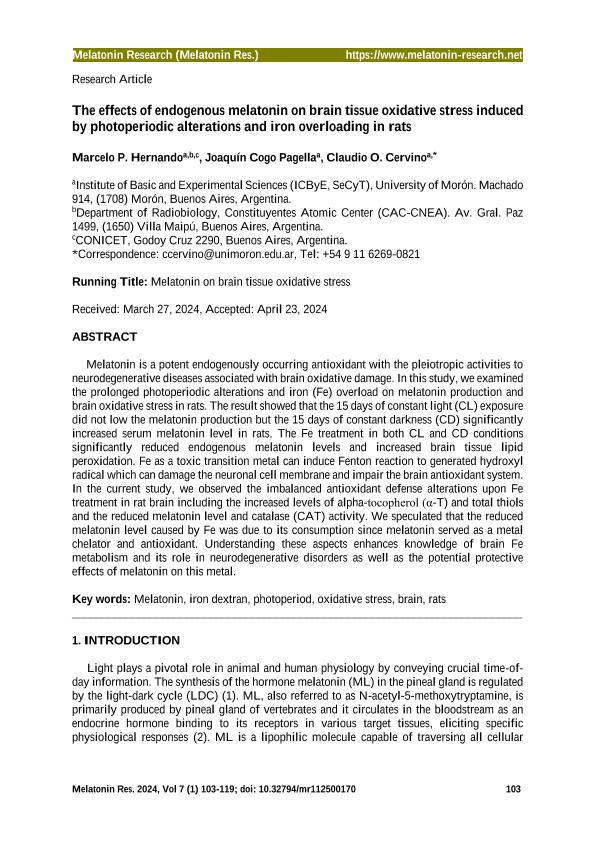
Melatonin is a potent endogenously occurring antioxidant with the pleiotropic activities to neurodegenerative diseases associated with brain oxidative damage. In this study, we examined the prolonged photoperiodic alterations and iron (Fe) overload on melatonin production and brain oxidative stress in rats. The result showed that the 15 days of constant light (CL) exposure did not low the melatonin production but the 15 days of constant darkness (CD) significantly increased serum melatonin level in rats. The Fe treatment in both CL and CD conditions significantly reduced endogenous melatonin levels and increased brain tissue lipid peroxidation. Fe as a toxic transition metal can induce Fenton reaction to generated hydroxyl radical which can damage the neuronal cell membrane and impair the brain antioxidant system. In the current study, we observed the imbalanced antioxidant defense alterations upon Fe treatment in rat brain including the increased levels of alpha-tocopherol (α-T) and total thiols and the reduced melatonin level and catalase (CAT) activity. We speculated that the reduced melatonin level caused by Fe was due to its consumption since melatonin served as a metal chelator and antioxidant. Understanding these aspects enhances knowledge of brain Fe metabolism and its role in neurodegenerative disorders as well as the potential protective effects of melatonin on this metal.
dc.format
application/pdf
dc.language.iso
eng
dc.publisher
ST-Bio-Life LLC
dc.rights
info:eu-repo/semantics/openAccess
dc.rights.uri
https://creativecommons.org/licenses/by/2.5/ar/
dc.subject
MELATONIN
dc.subject
IRON DEXTRAN
dc.subject
OXIDANT/ANTIOXIDANT
dc.subject
BRAIN
dc.subject
RATS
dc.subject.classification
Neurociencias
dc.subject.classification
Medicina Básica
dc.subject.classification
CIENCIAS MÉDICAS Y DE LA SALUD
dc.subject.classification
Fisiología
dc.subject.classification
Medicina Básica
dc.subject.classification
CIENCIAS MÉDICAS Y DE LA SALUD
dc.title
The effects of endogenous melatonin on brain tissue oxidative stress induced by photoperiodic alterations and iron overloading in rats
dc.type
info:eu-repo/semantics/article
dc.type
info:ar-repo/semantics/artículo
dc.type
info:eu-repo/semantics/publishedVersion
dc.date.updated
2024-08-26T14:54:48Z
dc.journal.volume
7
dc.journal.number
1
dc.journal.pagination
103-119
dc.journal.pais
Estados Unidos
dc.description.fil
Fil: Hernando, Marcelo Pablo. Universidad de Moron. Secretaria de Ciencia y Tecnologia. Instituto de Fisiologia y Neurociencias.; Argentina. Consejo Nacional de Investigaciones Científicas y Técnicas; Argentina
dc.description.fil
Fil: Cogo Pagella, Joaquín. Universidad de Moron. Secretaria de Ciencia y Tecnologia. Instituto de Fisiologia y Neurociencias.; Argentina
dc.description.fil
Fil: Cervino, Claudio Osvaldo. Universidad de Moron. Secretaria de Ciencia y Tecnologia. Instituto de Fisiologia y Neurociencias.; Argentina
dc.journal.title
Melatonin Research
dc.relation.alternativeid
info:eu-repo/semantics/altIdentifier/url/https://www.melatonin-research.net/index.php/MR/article/view/262
dc.relation.alternativeid
info:eu-repo/semantics/altIdentifier/doi/http://dx.doi.org/10.32794/mr112500170
Archivos asociados

Tamaño:
451.1Kb
Formato:
PDF