Artículo
Lipase of Candida albicans induces activation of NADPH oxidase and L-arginine pathways on resting and activated macrophages

Fecha de publicación:
09/2009
Editorial:
Elsevier Inc
Revista:
Biochemical and Biophysical Research Communications
ISSN:
0006-291X
Idioma:
Inglés
Tipo de recurso:
Artículo publicado
Clasificación temática:
Resumen
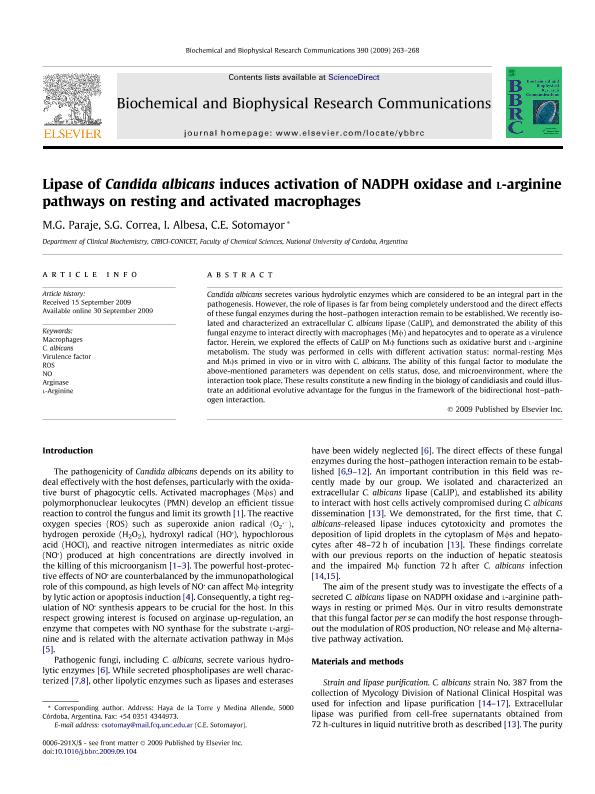
Candida albicans secretes various hydrolytic enzymes which are considered to be an integral part in the pathogenesis. However, the role of lipases is far from being completely understood and the direct effects of these fungal enzymes during the host-pathogen interaction remain to be established. We recently isolated and characterized an extracellular C. albicans lipase (CaLIP), and demonstrated the ability of this fungal enzyme to interact directly with macrophages (Mvarphi) and hepatocytes and to operate as a virulence factor. Herein, we explored the effects of CaLIP on Mvarphi functions such as oxidative burst and l-arginine metabolism. The study was performed in cells with different activation status: normal-resting Mvarphis and Mvarphis primed in vivo or in vitro with C. albicans. The ability of this fungal factor to modulate the above-mentioned parameters was dependent on cells status, dose, and microenvironment, where the interaction took place. These results constitute a new finding in the biology of candidiasis and could illustrate an additional evolutive advantage for the fungus in the framework of the bidirectional host-pathogen interaction.
Palabras clave:
Macrophages
,
Candida Albicans
,
Virulence Factor
,
Ros
Archivos asociados

Tamaño:
327.2Kb
Formato:
PDF
Licencia
 Excepto donde se diga explícitamente, este item se publica bajo la siguiente descripción:
Atribución-NoComercial-SinDerivadas 2.5 Argentina (CC BY-NC-ND 2.5 AR)
Excepto donde se diga explícitamente, este item se publica bajo la siguiente descripción:
Atribución-NoComercial-SinDerivadas 2.5 Argentina (CC BY-NC-ND 2.5 AR)
Identificadores
Colecciones
Articulos(CIBICI)
Articulos de CENTRO DE INV.EN BIOQUI.CLINICA E INMUNOLOGIA
Articulos de CENTRO DE INV.EN BIOQUI.CLINICA E INMUNOLOGIA
Articulos(IMBIV)
Articulos de INST.MULTIDISCIPL.DE BIOLOGIA VEGETAL (P)
Articulos de INST.MULTIDISCIPL.DE BIOLOGIA VEGETAL (P)
Citación
Paraje, María Gabriela; Correa, Silvia Graciela; Albesa, Inés; Sotomayor, Claudia Elena; Lipase of Candida albicans induces activation of NADPH oxidase and L-arginine pathways on resting and activated macrophages; Elsevier Inc; Biochemical and Biophysical Research Communications; 390; 2; 9-2009; 263-268
Compartir


Altmétricas