Artículo
Molecular mechanisms underlying SARS-CoV-2 hepatotropism and liver damage

Fecha de publicación:
01/2024
Editorial:
Baishideng Publishing Group
Revista:
World Journal of Hepatology
ISSN:
1948-5182
Idioma:
Inglés
Tipo de recurso:
Artículo publicado
Clasificación temática:
Resumen
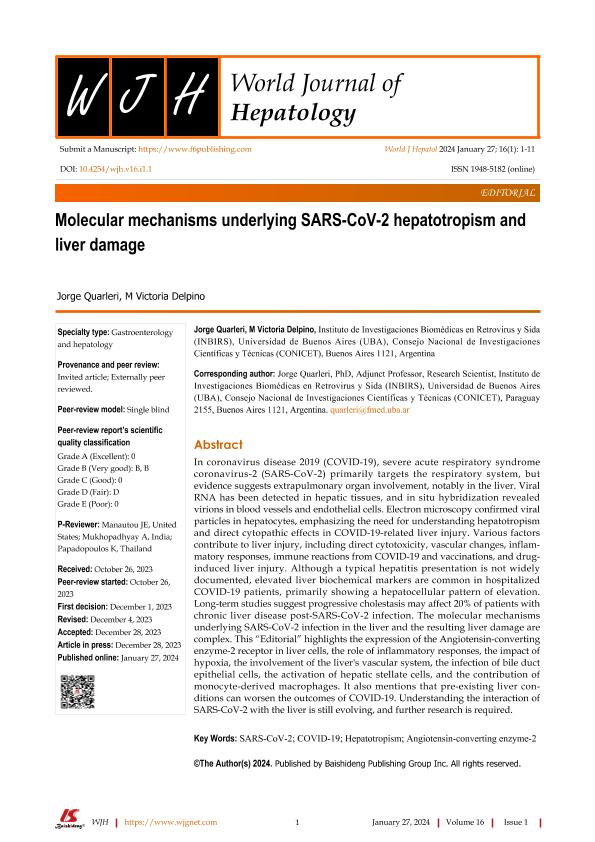
In coronavirus disease 2019 (COVID-19), severe acute respiratory syndrome coronavirus-2 (SARS-CoV-2) primarily targets the respiratory system, but evidence suggests extrapulmonary organ involvement, notably in the liver. Viral RNA has been detected in hepatic tissues, and in situ hybridization revealed virions in blood vessels and endothelial cells. Electron microscopy confirmed viral particles in hepatocytes, emphasizing the need for understanding hepatotropism and direct cytopathic effects in COVID-19-related liver injury. Various factors contribute to liver injury, including direct cytotoxicity, vascular changes, inflammatory responses, immune reactions from COVID-19 and vaccinations, and druginduced liver injury. Although a typical hepatitis presentation is not widely documented, elevated liver biochemical markers are common in hospitalized COVID-19 patients, primarily showing a hepatocellular pattern of elevation. Long-term studies suggest progressive cholestasis may affect 20% of patients with chronic liver disease post-SARS-CoV-2 infection. The molecular mechanisms underlying SARS-CoV-2 infection in the liver and the resulting liver damage are complex. This “Editorial” highlights the expression of the Angiotensin-converting enzyme-2 receptor in liver cells, the role of inflammatory responses, the impact of hypoxia, the involvement of the liver's vascular system, the infection of bile duct epithelial cells, the activation of hepatic stellate cells, and the contribution of monocyte-derived macrophages. It also mentions that pre-existing liver conditions can worsen the outcomes of COVID-19. Understanding the interaction of SARS-CoV-2 with the liver is still evolving, and further research is required.
Palabras clave:
SARS-CoV-2
,
LIVER
,
COVID-19
Archivos asociados

Tamaño:
1.177Mb
Formato:
PDF
Licencia
 Excepto donde se diga explícitamente, este item se publica bajo la siguiente descripción:
Creative Commons Attribution-NonCommercial-ShareAlike 2.5 Unported (CC BY-NC-SA 2.5)
Excepto donde se diga explícitamente, este item se publica bajo la siguiente descripción:
Creative Commons Attribution-NonCommercial-ShareAlike 2.5 Unported (CC BY-NC-SA 2.5)
Identificadores
Colecciones
Articulos(INBIRS)
Articulos de INSTITUTO DE INVESTIGACIONES BIOMEDICAS EN RETROVIRUS Y SIDA
Articulos de INSTITUTO DE INVESTIGACIONES BIOMEDICAS EN RETROVIRUS Y SIDA
Citación
Quarleri, Jorge Fabian; Delpino, María Victoria; Molecular mechanisms underlying SARS-CoV-2 hepatotropism and liver damage; Baishideng Publishing Group; World Journal of Hepatology; 16; 1; 1-2024; 1-11
Compartir


Altmétricas