Artículo
A quantitative philology of introspection
Diuk, Carlos G.; Fernandez Slezak, Diego ; Rascovsky, Ivan; Sigman, Mariano
; Cecchi, Guillermo Alberto
; Rascovsky, Ivan; Sigman, Mariano
; Cecchi, Guillermo Alberto
; Rascovsky, Ivan; Sigman, Mariano
; Cecchi, Guillermo Alberto
Fecha de publicación:
09/2012
Editorial:
Frontiers Media
Revista:
Frontiers in Integrative Neuroscience
ISSN:
1662-5145
Idioma:
Inglés
Tipo de recurso:
Artículo publicado
Clasificación temática:
Resumen
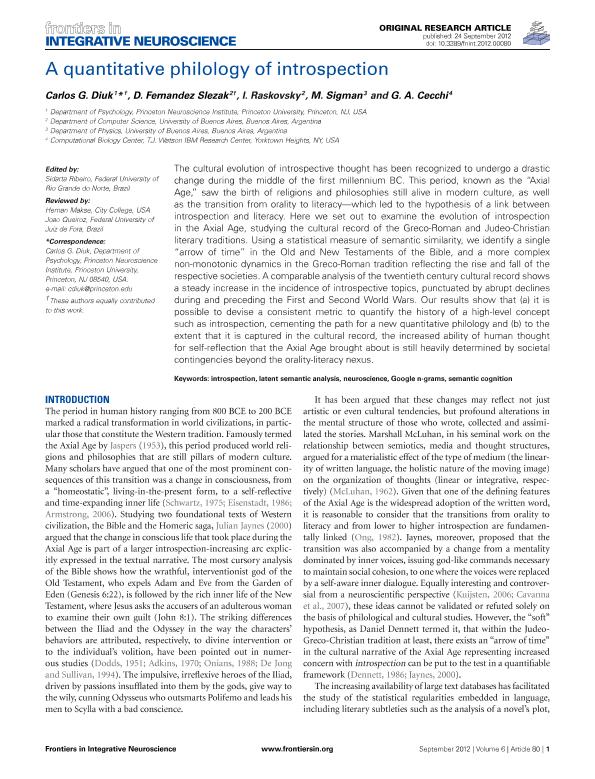
The cultural evolution of introspective thought has been recognized to undergo a drastic change during the middle of the first millennium BC. This period, known as the “Axial Age,” saw the birth of religions and philosophies still alive in modern culture, as well as the transition from orality to literacy—which led to the hypothesis of a link between introspection and literacy. Here we set out to examine the evolution of introspection in the Axial Age, studying the cultural record of the Greco-Roman and Judeo-Christian literary traditions. Using a statistical measure of semantic similarity, we identify a single “arrow of time” in the Old and New Testaments of the Bible, and a more complex non-monotonic dynamics in the Greco-Roman tradition reflecting the rise and fall of the respective societies. A comparable analysis of the twentieth century cultural record shows a steady increase in the incidence of introspective topics, punctuated by abrupt declines during and preceding the First and Second World Wars. Our results show that (a) it is possible to devise a consistent metric to quantify the history of a high-level concept such as introspection, cementing the path for a new quantitative philology and (b) to the extent that it is captured in the cultural record, the increased ability of human thought for self-reflection that the Axial Age brought about is still heavily determined by societal contingencies beyond the orality-literacy nexus.
Palabras clave:
INTROSPECTION
,
NEUROSCIENCE
,
SEMANTIC COGNITION
Archivos asociados

Tamaño:
1.182Mb
Formato:
PDF
Licencia
 Excepto donde se diga explícitamente, este item se publica bajo la siguiente descripción:
Creative Commons Attribution-NonCommercial-ShareAlike 2.5 Unported (CC BY-NC-SA 2.5)
Excepto donde se diga explícitamente, este item se publica bajo la siguiente descripción:
Creative Commons Attribution-NonCommercial-ShareAlike 2.5 Unported (CC BY-NC-SA 2.5)
Identificadores
Colecciones
Articulos(IFIBA)
Articulos de INST.DE FISICA DE BUENOS AIRES
Articulos de INST.DE FISICA DE BUENOS AIRES
Articulos(OCA CIUDAD UNIVERSITARIA)
Articulos de OFICINA DE COORDINACION ADMINISTRATIVA CIUDAD UNIVERSITARIA
Articulos de OFICINA DE COORDINACION ADMINISTRATIVA CIUDAD UNIVERSITARIA
Citación
Diuk, Carlos G.; Fernandez Slezak, Diego; Rascovsky, Ivan; Sigman, Mariano; Cecchi, Guillermo Alberto; A quantitative philology of introspection; Frontiers Media; Frontiers in Integrative Neuroscience; 6; 9-2012; 1-12
Compartir


Altmétricas