Artículo
Helminth communities in the burrowing toad, Rhinella fernandezae, from Northeastern Argentina

Fecha de publicación:
12/2013
Editorial:
Versita
Revista:
Biologia
ISSN:
0006-3088
Idioma:
Inglés
Tipo de recurso:
Artículo publicado
Clasificación temática:
Resumen
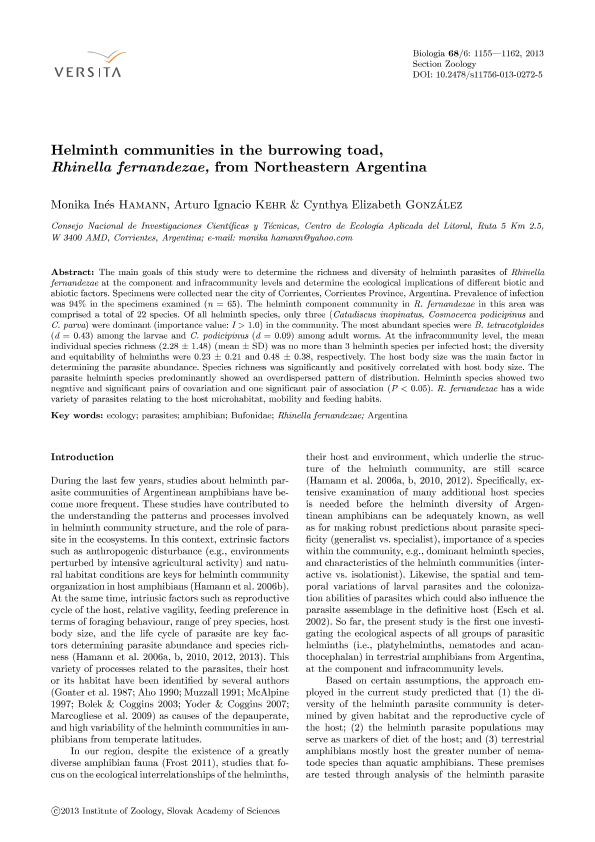
The main goals of this study were to determine the richness and diversity of helminth parasites of Rhinella fernandezae at the component and infracommunity levels and determine the ecological implications of different biotic and abiotic factors. Specimens were collected near the city of Corrientes, Corrientes Province, Argentina. Prevalence of infection was 94% in the specimens examined (n = 65). The helminth component community in R. fernandezae in this area was comprised a total of 22 species. Of all helminth species, only three (Catadiscus inopinatus, Cosmocerca podicipinus and C. parva) were dominant (importance value: I > 1.0) in the community. The most abundant species were B. tetracotyloides (d = 0.43) among the larvae and C. podicipinus (d = 0.09) among adult worms. At the infracommunity level, the mean individual species richness (2.28 ± 1.48) (mean±SD) was no more than 3 helminth species per infected host; the diversity and equitability of helminths were 0.23 ± 0.21 and 0.48 ± 0.38, respectively. The host body size was the main factor in determining the parasite abundance. Species richness was significantly and positively correlated with host body size. The parasite helminth species predominantly showed an overdispersed pattern of distribution. Helminth species showed two negative and significant pairs of covariation and one significant pair of association (P 0.05). R. fernandezae has a wide variety of parasites relating to the host microhabitat, mobility and feeding habits.
Palabras clave:
AMPHIBIAN
,
ARGENTINA
,
BUFONIDAE
,
ECOLOGY
,
PARASITES
,
RHINELLA FERNANDEZAE
Archivos asociados

Tamaño:
205.3Kb
Formato:
PDF
Licencia
 Excepto donde se diga explícitamente, este item se publica bajo la siguiente descripción:
Atribución-NoComercial-SinDerivadas 2.5 Argentina (CC BY-NC-ND 2.5 AR)
Excepto donde se diga explícitamente, este item se publica bajo la siguiente descripción:
Atribución-NoComercial-SinDerivadas 2.5 Argentina (CC BY-NC-ND 2.5 AR)
Identificadores
Colecciones
Articulos(CECOAL)
Articulos de CENTRO DE ECOLOGIA APLICADA DEL LITORAL (I)
Articulos de CENTRO DE ECOLOGIA APLICADA DEL LITORAL (I)
Citación
Hamann, Monika Ines; Kehr, Arturo Ignacio; Gonzalez, Cynthya Elizabeth; Helminth communities in the burrowing toad, Rhinella fernandezae, from Northeastern Argentina; Versita; Biologia; 68; 6; 12-2013; 1155-1162
Compartir


Altmétricas