Artículo
First endangered huemul deer (Hippocamelus bisulcus) confirmed with iodine deficiency: A case report

Fecha de publicación:
07/2024
Editorial:
Gnoscience Group
Revista:
Case Reports and Reviews
ISSN:
2583-892X
Idioma:
Inglés
Tipo de recurso:
Artículo publicado
Clasificación temática:
Resumen
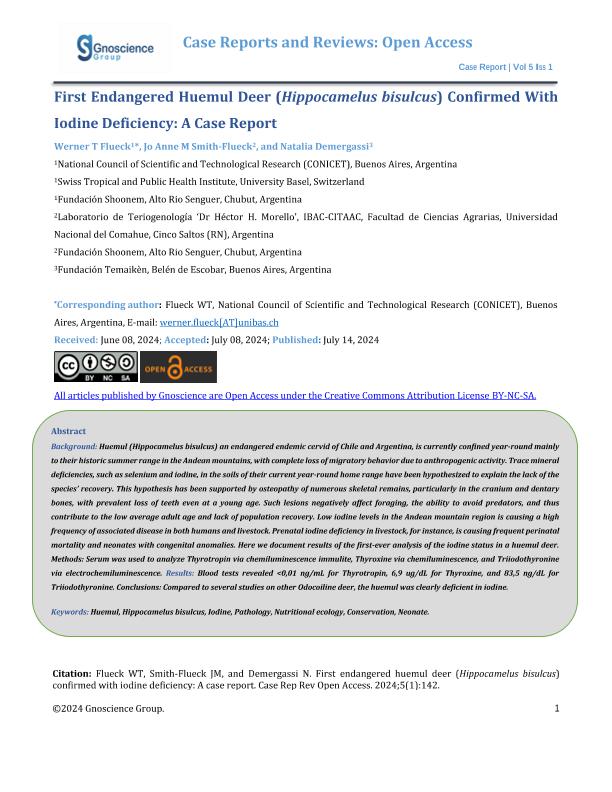
Background: Huemul (Hippocamelus bisulcus) an endangered endemic cervid of Chile and Argentina, is currently confined year-round mainly to their historic summer range in the Andean mountains, with complete loss of migratory behavior due to anthropogenic activity. Trace mineral deficiencies, such as selenium and iodine, in the soils of their current year-round home range have been hypothesized to explain the lack of the species’ recovery. This hypothesis has been supported by osteopathy of numerous skeletal remains, particularly in the cranium and dentary bones, with prevalent loss of teeth even at a young age. Such lesions negatively affect foraging, the ability to avoid predators, and thus contribute to the low average adult age and lack of population recovery. Low iodine levels in the Andean mountain region is causing a high frequency of associated disease in both humans and livestock. Prenatal iodine deficiency in livestock, for instance, is causing frequent perinatal mortality and neonates with congenital anomalies. Here we document results of the first-ever analysis of the iodine status in a huemul deer. Methods: Serum was used to analyze Thyrotropin via chemiluminescence immulite, Thyroxine via chemiluminescence, and Triiodothyronine via electrochemiluminescence. Results: Blood tests revealed <0,01 ng/mL for Thyrotropin, 6,9 ug/dL for Thyroxine, and 83,5 ng/dL for Triiodothyronine. Conclusions: Compared to several studies on other Odocoiline deer, the huemul was clearly deficient in iodine.
Palabras clave:
huemul
,
Hippocamelus bisulcus
,
Iodine
,
Nutritional ecology
,
conservation biology
Archivos asociados

Tamaño:
1.189Mb
Formato:
PDF
Licencia
 Excepto donde se diga explícitamente, este item se publica bajo la siguiente descripción:
Creative Commons Attribution-NonCommercial-ShareAlike 2.5 Unported (CC BY-NC-SA 2.5)
Excepto donde se diga explícitamente, este item se publica bajo la siguiente descripción:
Creative Commons Attribution-NonCommercial-ShareAlike 2.5 Unported (CC BY-NC-SA 2.5)
Identificadores
Colecciones
Articulos(CCT - PATAGONIA NORTE)
Articulos de CTRO.CIENTIFICO TECNOL.CONICET - PATAGONIA NORTE
Articulos de CTRO.CIENTIFICO TECNOL.CONICET - PATAGONIA NORTE
Citación
Fluck, Werner Thomas; Smith Flueck, Jo Anne M.; Demergassi, Natalia; First endangered huemul deer (Hippocamelus bisulcus) confirmed with iodine deficiency: A case report; Gnoscience Group; Case Reports and Reviews; 5; 142; 7-2024; 1-9
Compartir

