Artículo
Role of Guanidyl Moiety in the Insertion of Arginine and N α -Benzoyl- l -argininate Ethyl Ester Chloride in Lipid Membranes
Fonseca, A. C.; Frías, M. A.; Bouchet, Ana María ; Jarmelo, S.; Simoes, P. N.; Fausto, R.; Gil, M. H.; Lairion, Fabiana Norma; Disalvo, Edgardo Anibal
; Jarmelo, S.; Simoes, P. N.; Fausto, R.; Gil, M. H.; Lairion, Fabiana Norma; Disalvo, Edgardo Anibal
Fecha de publicación:
03/2010
Editorial:
American Chemical Society
Revista:
Journal of Physical Chemistry B
ISSN:
1520-6106
Idioma:
Inglés
Tipo de recurso:
Artículo publicado
Clasificación temática:
Resumen
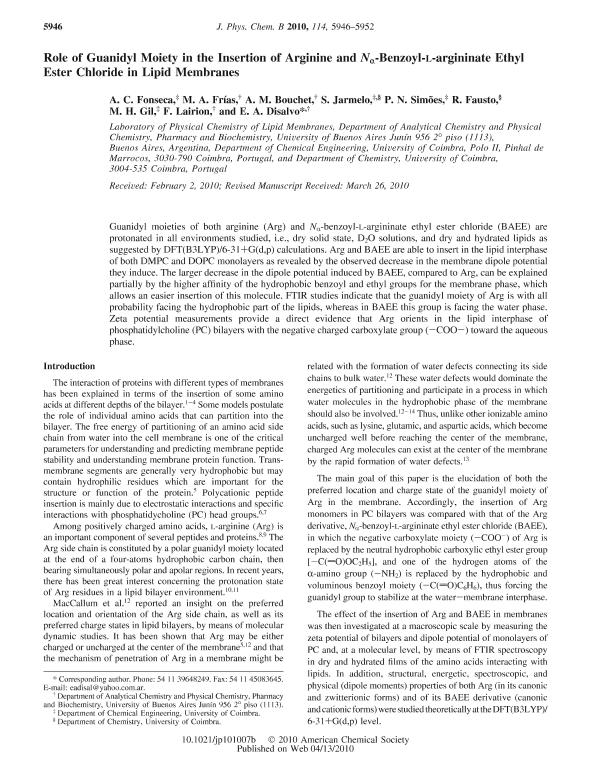
Guanidyl moieties of both arginine (Arg) and NR-benzoyl-L-argininate ethyl ester chloride (BAEE) are protonated in all environments studied, i.e., dry solid state, D2O solutions, and dry and hydrated lipids as suggested by DFT(B3LYP)/6-31+G(d,p) calculations. Arg and BAEE are able to insert in the lipid interphase of both DMPC and DOPC monolayers as revealed by the observed decrease in the membrane dipole potential they induce. The larger decrease in the dipole potential induced by BAEE, compared to Arg, can be explained partially by the higher affinity of the hydrophobic benzoyl and ethyl groups for the membrane phase, which allows an easier insertion of this molecule. FTIR studies indicate that the guanidyl moiety of Arg is with all probability facing the hydrophobic part of the lipids, whereas in BAEE this group is facing the water phase. Zeta potential measurements provide a direct evidence that Arg orients in the lipid interphase of phosphatidylcholine (PC) bilayers with the negative charged carboxylate group (-COO-) toward the aqueous phase.
Palabras clave:
ARGININE
,
BAEE
,
LIPID INTERPHASES
,
ZETA POTENTIAL
Archivos asociados

Tamaño:
1.217Mb
Formato:
PDF
Licencia
 Excepto donde se diga explícitamente, este item se publica bajo la siguiente descripción:
Creative Commons Attribution-NonCommercial-ShareAlike 2.5 Unported (CC BY-NC-SA 2.5)
Excepto donde se diga explícitamente, este item se publica bajo la siguiente descripción:
Creative Commons Attribution-NonCommercial-ShareAlike 2.5 Unported (CC BY-NC-SA 2.5)
Identificadores
Colecciones
Articulos(SEDE CENTRAL)
Articulos de SEDE CENTRAL
Articulos de SEDE CENTRAL
Citación
Fonseca, A. C.; Frías, M. A.; Bouchet, Ana María; Jarmelo, S.; Simoes, P. N.; et al.; Role of Guanidyl Moiety in the Insertion of Arginine and N α -Benzoyl- l -argininate Ethyl Ester Chloride in Lipid Membranes; American Chemical Society; Journal of Physical Chemistry B; 114; 17; 3-2010; 5946-5952
Compartir


Altmétricas