Artículo
High-resolution radio imaging of the two particle-accelerating colliding-wind binaries HD 167971 and HD 168112

Fecha de publicación:
01/2024
Editorial:
EDP Sciences
Revista:
Astronomy and Astrophysics
ISSN:
0004-6361
Idioma:
Inglés
Tipo de recurso:
Artículo publicado
Clasificación temática:
Resumen
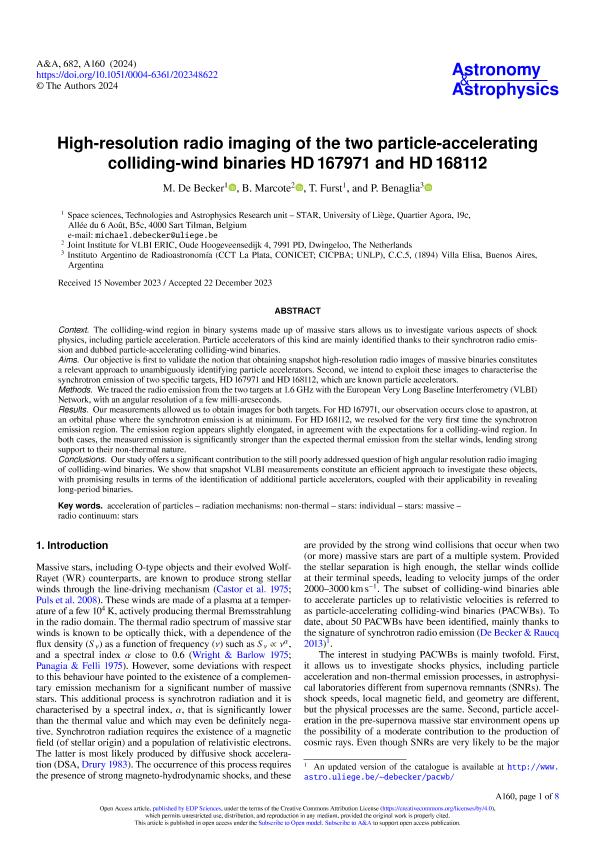
Context. The colliding-wind region in binary systems made up of massive stars allows us to investigate various aspects of shock physics, including particle acceleration. Particle accelerators of this kind are mainly identified thanks to their synchrotron radio emission and dubbed particle-accelerating colliding-wind binaries.Aims: Our objective is first to validate the notion that obtaining snapshot high-resolution radio images of massive binaries constitutes a relevant approach to unambiguously identifying particle accelerators. Second, we intend to exploit these images to characterise the synchrotron emission of two specific targets, HD 167971 and HD 168112, which are known particle accelerators.Methods: We traced the radio emission from the two targets at 1.6 GHz with the European Very Long Baseline Interferometry (VLBI) Network, with an angular resolution of a few milli-arcseconds.Results: Our measurements allowed us to obtain images for both targets. For HD 167971, our observation occurs close to apastron, at an orbital phase where the synchrotron emission is at minimum. For HD 168112, we resolved for the very first time the synchrotron emission region. The emission region appears slightly elongated, in agreement with the expectations for a colliding-wind region. In both cases, the measured emission is significantly stronger than the expected thermal emission from the stellar winds, lending strong support to their non-thermal nature.Conclusions: Our study offers a significant contribution to the still poorly addressed question of high angular resolution radio imaging of colliding-wind binaries. We show that snapshot VLBI measurements constitute an efficient approach to investigate these objects, with promising results in terms of the identification of additional particle accelerators, coupled with their applicability in revealing long-period binaries.
Archivos asociados

Tamaño:
673.3Kb
Formato:
PDF
Licencia
 Excepto donde se diga explícitamente, este item se publica bajo la siguiente descripción:
Creative Commons Attribution-NonCommercial-ShareAlike 2.5 Unported (CC BY-NC-SA 2.5)
Excepto donde se diga explícitamente, este item se publica bajo la siguiente descripción:
Creative Commons Attribution-NonCommercial-ShareAlike 2.5 Unported (CC BY-NC-SA 2.5)
Identificadores
Colecciones
Articulos(IAR)
Articulos de INST.ARG.DE RADIOASTRONOMIA (I)
Articulos de INST.ARG.DE RADIOASTRONOMIA (I)
Citación
De Becker, M.; Marcote, Benito; Furst, T.; Benaglia, Paula; High-resolution radio imaging of the two particle-accelerating colliding-wind binaries HD 167971 and HD 168112; EDP Sciences; Astronomy and Astrophysics; 682; A160; 1-2024; 1-8
Compartir


Altmétricas