Artículo
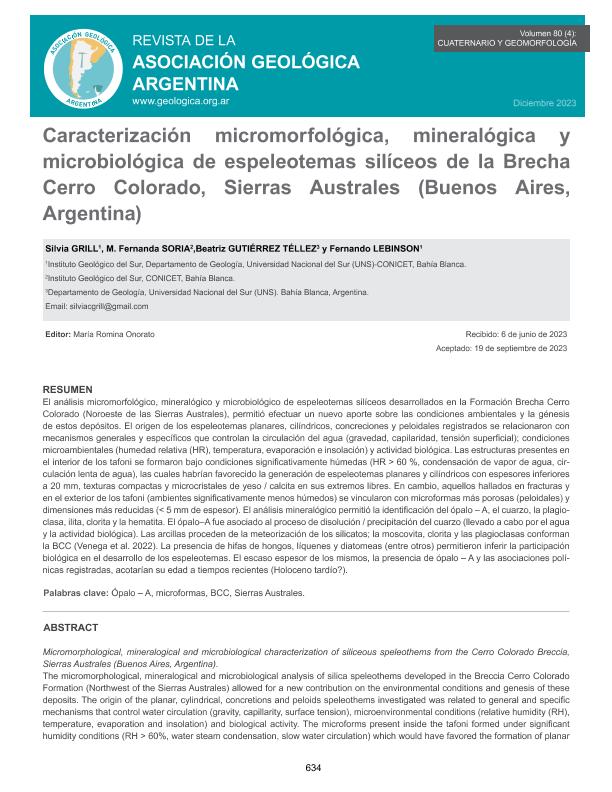
El análisis micromorfológico, mineralógico y microbiológico de espeleotemas silíceos desarrollados en la Formación Brecha Cerro Colorado (Noroeste de las Sierras Australes), permitió efectuar un nuevo aporte sobre las condiciones ambientales y la génesis de estos depósitos. El origen de los espeleotemas planares, cilíndricos, concreciones y peloidales registrados se relacionaron con mecanismos generales y específicos que controlan la circulación del agua (gravedad, capilaridad, tensión superficial); condiciones microambientales (humedad relativa (HR), temperatura, evaporación e insolación) y actividad biológica. Las estructuras presentes en el interior de los tafoni se formaron bajo condiciones significativamente húmedas (HR > 60 %, condensación de vapor de agua, circulación lenta de agua), las cuales habrían favorecido la generación de espeleotemas planares y cilíndricos con espesores inferiores a 20 mm, texturas compactas y microcristales de yeso / calcita en sus extremos libres. En cambio, aquellos hallados en fracturas y en el exterior de los tafoni (ambientes significativamente menos húmedos) se vincularon con microformas más porosas (peloidales) y dimensiones más reducidas (< 5 mm de espesor). El análisis mineralógico permitió la identificación del ópalo – A, el cuarzo, la plagioclasa, ilita, clorita y la hematita. El ópalo–A fue asociado al proceso de disolución / precipitación del cuarzo (llevado a cabo por el agua y la actividad biológica). Las arcillas proceden de la meteorización de los silicatos; la moscovita, clorita y las plagioclasas conforman la BCC (Venega et al. 2022). La presencia de hifas de hongos, líquenes y diatomeas (entre otros) permitieron inferir la participación biológica en el desarrollo de los espeleotemas. El escaso espesor de los mismos, la presencia de ópalo – A y las asociaciones polínicas registradas, acotarían su edad a tiempos recientes (Holoceno tardío?). The micromorphological, mineralogical, and microbiological analysis of silica speleothems developed in the BCC (Northwest of the Sierras Australes) allowed for a new contribution on the environmental conditions and genesis of these deposits. The origin of the 11 types (15 subtypes) of recorded speleothems was related to general and specific mechanisms that control water circulation (gravity, capillarity, surface tension), microenvironmental conditions (relative humidity (RH), condensation, temperature, evaporation, and insolation), and biological activity. The speleothems present inside the tafoni showed markedly humid conditions (RH > 60%, condensation, slow water circulation), which would have particularly favored the formation of flowstones and stalactites/stalagmites with thicknesses less than 20 mm, compact textures, and gypsum/calcite trichites at their free ends. On the other hand, those found in fractures and outside the tafoni (drier environments) were associated with more porous microforms (gours, boxwork, and peloidales) and smaller dimensions (< 5 mm thickness). Opal-A was associated with the dissolution/precipitation process of quartz (carried out by water and biological activity). Clays would be the product of weathering of silicates; muscovite, chlorite, and plagioclases that are part of the BCC. The presence of microorganisms (palynomorphs, diatoms, and phytoliths) allowed for inferring biological involvement in the development of the speleothems. The thin thickness of the speleothems, the presence of opal-A, and the recorded pollen associations limited their age to recent times (Late Holocene?).
Caracterización micromorfológica, mineralógica y microbiológica de espeleotemas silíceos de la Brecha Cerro Colorado, Sierras Australes (Buenos Aires, Argentina)
Título:
Micromorphological, mineralogical and microbiological characterization of siliceous speleothems from the Cerro Colorado Breccia, Sierras Australes (Buenos Aires, Argentina)

Fecha de publicación:
12/2023
Editorial:
Asociación Geológica Argentina
Revista:
Revista de la Asociación Geológica Argentina
ISSN:
1853-7138
e-ISSN:
1851-8249
Idioma:
Español
Tipo de recurso:
Artículo publicado
Clasificación temática:
Resumen
Palabras clave:
OPALO-A
,
MICROFORMAS
,
BRECHA CERRO COLORADO
,
SIERRAS AUSTRALES
Archivos asociados

Tamaño:
3.089Mb
Formato:
PDF
Licencia
 Excepto donde se diga explícitamente, este item se publica bajo la siguiente descripción:
Creative Commons Attribution-NonCommercial-ShareAlike 2.5 Unported (CC BY-NC-SA 2.5)
Excepto donde se diga explícitamente, este item se publica bajo la siguiente descripción:
Creative Commons Attribution-NonCommercial-ShareAlike 2.5 Unported (CC BY-NC-SA 2.5)
Identificadores
Colecciones
Articulos(INGEOSUR)
Articulos de INST.GEOLOGICO DEL SUR
Articulos de INST.GEOLOGICO DEL SUR
Citación
Grill, Silvia; Soria, Maria Fernanda; Gutierrez Tellez, Beatriz Monica; Lebinson, Fernando Oscar; Caracterización micromorfológica, mineralógica y microbiológica de espeleotemas silíceos de la Brecha Cerro Colorado, Sierras Australes (Buenos Aires, Argentina); Asociación Geológica Argentina; Revista de la Asociación Geológica Argentina; 80; 4; 12-2023; 1-17
Compartir

