Artículo
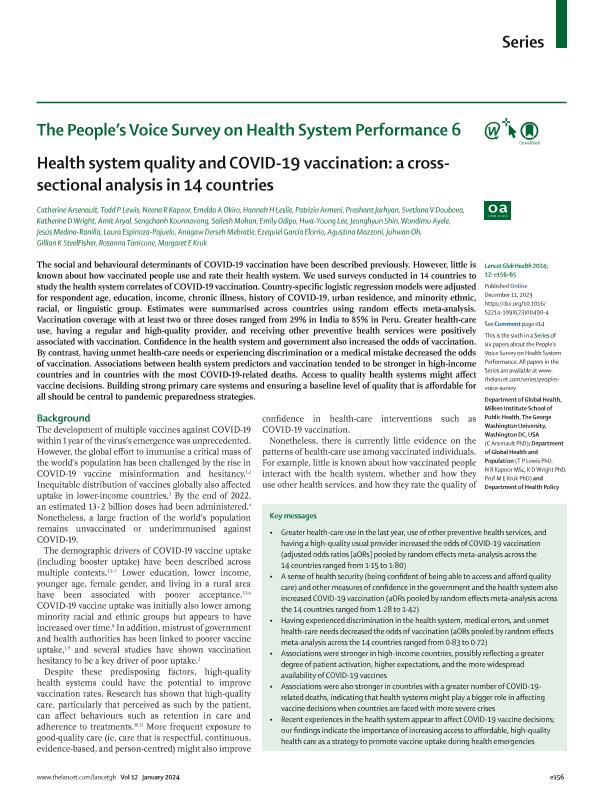
Health system quality and COVID-19 vaccination: a cross-sectional analysis in 14 countries
Arsenault, Catherine; Lewis, Todd P.; Kapoor, Neena R.; Okiro, Emelda A.; Leslie, Hannah H.; Armeni, Patrizio; Jarhyan, Prashant; Doubova, Svetlana V.; Wright, Katherine D.; Aryal, Amit; Kounnavong, Sengchanh; Mohan, Sailesh; Odipo, Emily; Lee, Hwa Young; Shin, Jeonghyun; Ayele, Wondimu; Medina-Ranilla, Jesús; Espinoza-Pajuelo, Laura; Derseh Mebratie, Anagaw; Garcia Elorrio, Ezequiel
Fecha de publicación:
05/2024
Editorial:
Elsevier
Revista:
The Lancet Global Health
ISSN:
2214-109X
Idioma:
Inglés
Tipo de recurso:
Artículo publicado
Clasificación temática:
Resumen
The social and behavioural determinants of COVID-19 vaccination have been described previously. However, little is known about how vaccinated people use and rate their health system. We used surveys conducted in 14 countries to study the health system correlates of COVID-19 vaccination. Country-specific logistic regression models were adjusted for respondent age, education, income, chronic illness, history of COVID-19, urban residence, and minority ethnic, racial, or linguistic group. Estimates were summarised across countries using random effects meta-analysis. Vaccination coverage with at least two or three doses ranged from 29% in India to 85% in Peru. Greater health-care use, having a regular and high-quality provider, and receiving other preventive health services were positively associated with vaccination. Confidence in the health system and government also increased the odds of vaccination. By contrast, having unmet health-care needs or experiencing discrimination or a medical mistake decreased the odds of vaccination. Associations between health system predictors and vaccination tended to be stronger in high-income countries and in countries with the most COVID-19-related deaths. Access to quality health systems might affect vaccine decisions. Building strong primary care systems and ensuring a baseline level of quality that is affordable for all should be central to pandemic preparedness strategies.
Palabras clave:
Calidad de atencion
Archivos asociados

Tamaño:
1.855Mb
Formato:
PDF
Licencia
 Excepto donde se diga explícitamente, este item se publica bajo la siguiente descripción:
Creative Commons Attribution 2.5 Unported (CC BY 2.5)
Excepto donde se diga explícitamente, este item se publica bajo la siguiente descripción:
Creative Commons Attribution 2.5 Unported (CC BY 2.5)
Identificadores
Colecciones
Articulos(SEDE CENTRAL)
Articulos de SEDE CENTRAL
Articulos de SEDE CENTRAL
Citación
Arsenault, Catherine; Lewis, Todd P.; Kapoor, Neena R.; Okiro, Emelda A.; Leslie, Hannah H.; et al.; Health system quality and COVID-19 vaccination: a cross-sectional analysis in 14 countries; Elsevier; The Lancet Global Health; 12; 1; 5-2024; e156-e165
Compartir


Altmétricas