Mostrar el registro sencillo del ítem
dc.contributor.author
Barton, Alejandro
dc.contributor.author
Sesin, Pablo Ezequiel
dc.contributor.author
Diambra, Luis Anibal
dc.date.available
2024-07-04T12:29:20Z
dc.date.issued
2024-05
dc.identifier.citation
Barton, Alejandro; Sesin, Pablo Ezequiel; Diambra, Luis Anibal; Simplifications and approximations in a single-gene circuit modeling; Nature; Scientific Reports; 14; 1; 5-2024; 1-11
dc.identifier.issn
2045-2322
dc.identifier.uri
http://hdl.handle.net/11336/239063
dc.description.abstract
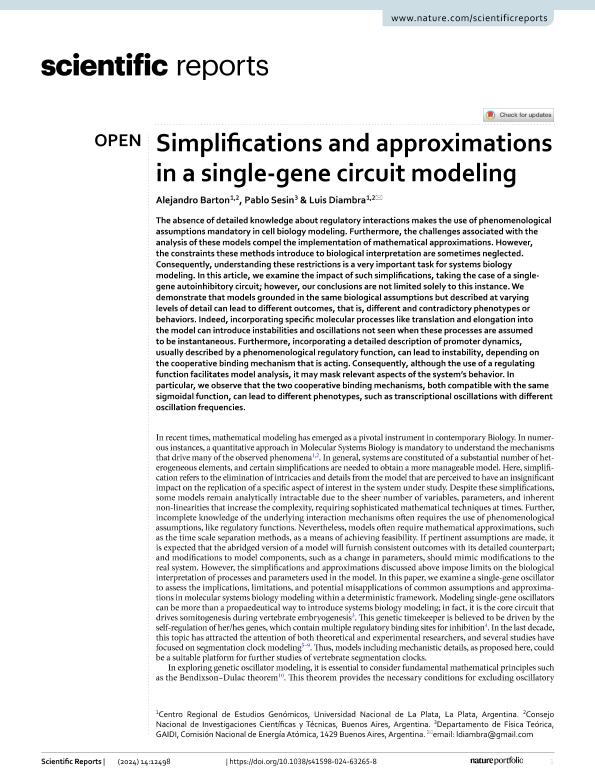
The absence of detailed knowledge about regulatory interactions makes the use of phenomenological assumptions mandatory in cell biology modeling. Furthermore, the challenges associated with the analysis of these models compel the implementation of mathematical approximations. However, the constraints these methods introduce to biological interpretation are sometimes neglected. Consequently, understanding these restrictions is a very important task for systems biology modeling. In this article, we examine the impact of such simplifications, taking the case of a single-gene autoinhibitory circuit; however, our conclusions are not limited solely to this instance. We demonstrate that models grounded in the same biological assumptions but described at varying levels of detail can lead to different outcomes, that is, different and contradictory phenotypes or behaviors. Indeed, incorporating specific molecular processes like translation and elongation into the model can introduce instabilities and oscillations not seen when these processes are assumed to be instantaneous. Furthermore, incorporating a detailed description of promoter dynamics, usually described by a phenomenological regulatory function, can lead to instability, depending on the cooperative binding mechanism that is acting. Consequently, although the use of a regulating function facilitates model analysis, it may mask relevant aspects of the system’s behavior. In particular, we observe that the two cooperative binding mechanisms, both compatible with the same sigmoidal function, can lead to different phenotypes, such as transcriptional oscillations with different oscillation frequencies.
dc.format
application/pdf
dc.language.iso
eng
dc.publisher
Nature
dc.rights
info:eu-repo/semantics/openAccess
dc.rights.uri
https://creativecommons.org/licenses/by/2.5/ar/
dc.subject
GENE CIRCUITS
dc.subject
SYSTEMS BIOLOGY
dc.subject
OSCILLATORY BEHAVIOR
dc.subject
MATHEMATICAL MODELING
dc.subject.classification
Otras Ciencias Naturales y Exactas
dc.subject.classification
Otras Ciencias Naturales y Exactas
dc.subject.classification
CIENCIAS NATURALES Y EXACTAS
dc.subject.classification
Biología
dc.subject.classification
Ciencias Biológicas
dc.subject.classification
CIENCIAS NATURALES Y EXACTAS
dc.title
Simplifications and approximations in a single-gene circuit modeling
dc.type
info:eu-repo/semantics/article
dc.type
info:ar-repo/semantics/artículo
dc.type
info:eu-repo/semantics/publishedVersion
dc.date.updated
2024-07-04T11:38:34Z
dc.journal.volume
14
dc.journal.number
1
dc.journal.pagination
1-11
dc.journal.pais
Reino Unido
dc.description.fil
Fil: Barton, Alejandro. Universidad Nacional de La Plata. Centro Regional de Estudios Genómicos; Argentina. Consejo Nacional de Investigaciones Científicas y Técnicas. Centro Científico Tecnológico Conicet - La Plata; Argentina
dc.description.fil
Fil: Sesin, Pablo Ezequiel. Comisión Nacional de Energía Atómica; Argentina. Consejo Nacional de Investigaciones Científicas y Técnicas; Argentina
dc.description.fil
Fil: Diambra, Luis Anibal. Universidad Nacional de La Plata. Centro Regional de Estudios Genómicos; Argentina. Consejo Nacional de Investigaciones Científicas y Técnicas. Centro Científico Tecnológico Conicet - La Plata; Argentina
dc.journal.title
Scientific Reports
dc.relation.alternativeid
info:eu-repo/semantics/altIdentifier/url/https://www.nature.com/articles/s41598-024-63265-8
dc.relation.alternativeid
info:eu-repo/semantics/altIdentifier/doi/http://dx.doi.org/10.1038/s41598-024-63265-8
Archivos asociados

Tamaño:
1.856Mb
Formato:
PDF