Artículo
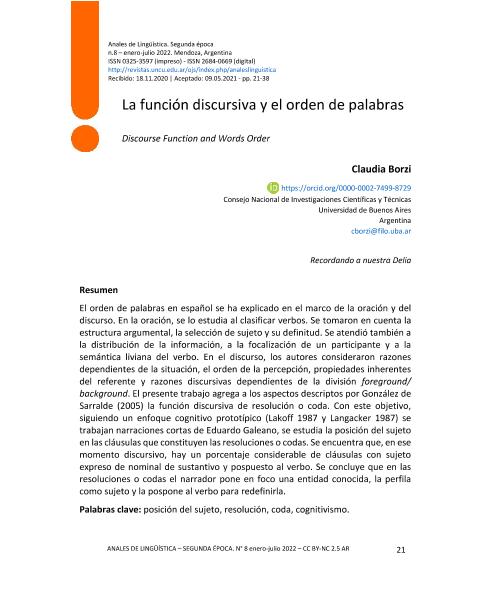
El orden de palabras en español se ha explicado en el marco de la oración y del discurso. En la oración, se lo estudia al clasificar verbos. Se tomaron en cuenta la estructura argumental, la selección de sujeto y su definitud. Se atendió también a la distribución de la información, a la focalización de un participante y a la semántica liviana del verbo. En el discurso, los autores consideraron razones dependientes de la situación, el orden de la percepción, propiedades inherentes del referente y razones discursivas dependientes de la división foreground/ background. El presente trabajo agrega a los aspectos descriptos por González de Sarralde (2005) la función discursiva de resolución o coda. Con este objetivo, siguiendo un enfoque cognitivo prototípico (Lakoff 1987 y Langacker 1987) se trabajan narraciones cortas de Eduardo Galeano, se estudia la posición del sujeto en las cláusulas que constituyen las resoluciones o codas. Se encuentra que, en ese momento discursivo, hay un porcentaje considerable de cláusulas con sujeto expreso de nominal de sustantivo y pospuesto al verbo. Se concluye que en las resoluciones o codas el narrador pone en foco una entidad conocida, la perfila como sujeto y la pospone al verbo para redefinirla. The word order in Spanish has been explained within the framework of the sentence and the discourse. In the sentence it was studied to classify verbs. The argument structure, the subject selection and its definiteness were considered. The distribution of information, the focusing process and the light semantics of the verb were also taken into account. In the discourse, the authors studied the situation, the order of perception, the referent’s inherent features, and postulated discourse reasons dependent on the foreground/ background division. This work adds to the aspects described by González de Sarralde (2005) the discourse function of resolution or coda. With this objective, from a prototypical cognitive approach (Lakoff 1987 and Langacker 1987), in short stories written by Eduardo Galeano, we analyze the subject position in the clauses that constituteresolutions or codas. The study shows a remarkable percentage of clauses in which the subject is represented by a noun phrase and it is also postponed to the verb. It is concluded that in the resolutions or codas the narrator focuses on a known entity, profiles it as a subject, and postpones it to the verb to re-define it.
La función discursiva y el orden de palabras
Título:
Discourse Function and Words Order

Fecha de publicación:
06/2023
Editorial:
Universidad Nacional de Cuyo
Revista:
Anales de Lingüística
ISSN:
0325-3597
e-ISSN:
2684-0669
Idioma:
Español
Tipo de recurso:
Artículo publicado
Clasificación temática:
Resumen
Palabras clave:
SINTAXIS
,
POSICIÓN
,
SUJETO
,
RESOLUCIÓN
Archivos asociados

Tamaño:
344.7Kb
Formato:
PDF
Licencia
 Excepto donde se diga explícitamente, este item se publica bajo la siguiente descripción:
Creative Commons Attribution 2.5 Unported (CC BY 2.5)
Excepto donde se diga explícitamente, este item se publica bajo la siguiente descripción:
Creative Commons Attribution 2.5 Unported (CC BY 2.5)
Identificadores
Colecciones
Articulos(SEDE CENTRAL)
Articulos de SEDE CENTRAL
Articulos de SEDE CENTRAL
Citación
Borzi, Claudia Beatriz; La función discursiva y el orden de palabras; Universidad Nacional de Cuyo; Anales de Lingüística; 8; 6-2023; 21-38
Compartir

