Mostrar el registro sencillo del ítem
dc.contributor.author
Mufarrege, Eduardo Federico
dc.contributor.author
Peña, Lucía Carolina
dc.contributor.author
Echeverrigaray, Marina
dc.date.available
2024-07-04T11:13:17Z
dc.date.issued
2023-10
dc.identifier.citation
Mufarrege, Eduardo Federico; Peña, Lucía Carolina; Echeverrigaray, Marina ; Biobetter Versions of Recombinant Human IFN-α2b for the Treatment of Viral Infections; Gavin Publishers; Infectious Diseases Diagnosis & Treatment; 7; 3; 10-2023; 1-2
dc.identifier.issn
2577-1515
dc.identifier.uri
http://hdl.handle.net/11336/239015
dc.description.abstract
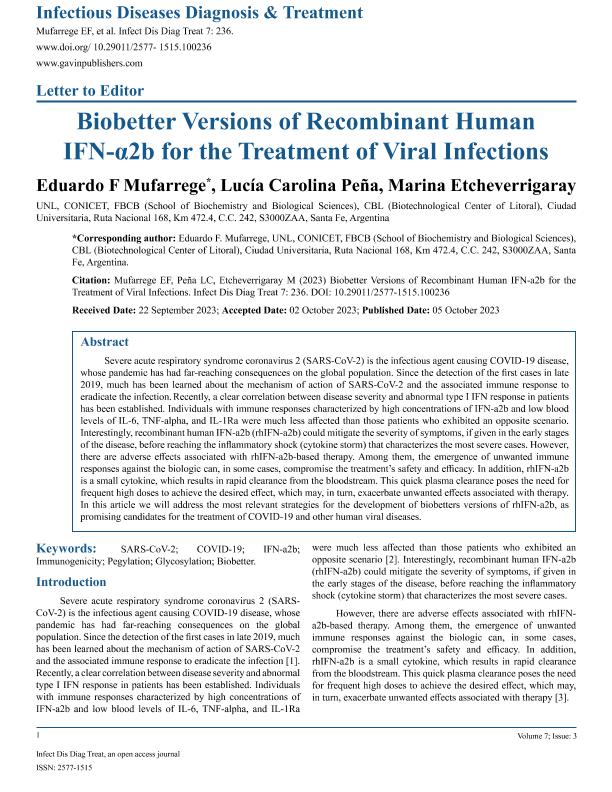
Severe acute respiratory syndrome coronavirus 2 (SARS-CoV-2) is the infectious agent causing COVID-19 disease, whose pandemic has had far-reaching consequences on the global population. Since the detection of the first cases in late 2019, much has been learned about the mechanism of action of SARS-CoV-2 and the associated immune response to eradicate the infection. Recently, a clear correlation between disease severity and abnormal type I IFN response in patients has been established. Individuals with immune responses characterized by high concentrations of IFN-a2b and low blood levels of IL-6, TNF-alpha, and IL-1Ra were much less affected than those patients who exhibited an opposite scenario. Interestingly, recombinant human IFN-a2b (rhIFN-a2b) could mitigate the severity of symptoms, if given in the early stages of the disease, before reaching the inflammatory shock (cytokine storm) that characterizes the most severe cases. However, there are adverse effects associated with rhIFN-a2b-based therapy. Among them, the emergence of unwanted immune responses against the biologic can, in some cases, compromise the treatment’s safety and efficacy. In addition, rhIFN-a2b is a small cytokine, which results in rapid clearance from the bloodstream. This quick plasma clearance poses the need for frequent high doses to achieve the desired effect, which may, in turn, exacerbate unwanted effects associated with therapy.In this article we will address the most relevant strategies for the development of biobetters versions of rhIFN-a2b, as promising candidates for the treatment of COVID-19 and other human viral diseases.
dc.format
application/pdf
dc.language.iso
eng
dc.publisher
Gavin Publishers
dc.rights
info:eu-repo/semantics/openAccess
dc.rights.uri
https://creativecommons.org/licenses/by-nc-sa/2.5/ar/
dc.subject
SARS-COV-2
dc.subject
COVID-19
dc.subject
IFN-A2B
dc.subject
IMMUNOGENICITY
dc.subject
PEGYLATION
dc.subject
GLYCOSYLATION
dc.subject
BIOBETTER
dc.subject.classification
Otras Biotecnologías de la Salud
dc.subject.classification
Biotecnología de la Salud
dc.subject.classification
CIENCIAS MÉDICAS Y DE LA SALUD
dc.title
Biobetter Versions of Recombinant Human IFN-α2b for the Treatment of Viral Infections
dc.type
info:eu-repo/semantics/article
dc.type
info:ar-repo/semantics/artículo
dc.type
info:eu-repo/semantics/publishedVersion
dc.date.updated
2024-07-02T11:02:49Z
dc.journal.volume
7
dc.journal.number
3
dc.journal.pagination
1-2
dc.journal.pais
Australia
dc.journal.ciudad
Melbourne
dc.description.fil
Fil: Mufarrege, Eduardo Federico. Universidad Nacional del Litoral. Facultad de Bioquímica y Ciencias Biológicas. Laboratorio de Cultivos Celulares; Argentina. Consejo Nacional de Investigaciones Científicas y Técnicas. Centro Científico Tecnológico Conicet - Santa Fe; Argentina
dc.description.fil
Fil: Peña, Lucía Carolina. Universidad Nacional del Litoral. Facultad de Bioquímica y Ciencias Biológicas. Laboratorio de Cultivos Celulares; Argentina. Consejo Nacional de Investigaciones Científicas y Técnicas. Centro Científico Tecnológico Conicet - Santa Fe; Argentina
dc.description.fil
Fil: Echeverrigaray, Marina. Universidad Nacional del Litoral. Facultad de Bioquímica y Ciencias Biológicas. Laboratorio de Cultivos Celulares; Argentina
dc.journal.title
Infectious Diseases Diagnosis & Treatment
dc.relation.alternativeid
info:eu-repo/semantics/altIdentifier/doi/http://dx.doi.org/10.29011/2577-1515.100236
Archivos asociados

Tamaño:
397.0Kb
Formato:
PDF