Artículo
Wild insects and honey bees are equally important to crop yields in a global analysis
Reilly, James; Bartomeus, Ignasi; Simpson, Dylan; Allen Perkins, Alfonso; Garibaldi, Lucas Alejandro ; Winfree, Rachael
; Winfree, Rachael
Fecha de publicación:
17/04/2024
Editorial:
Wiley Blackwell Publishing, Inc
Revista:
Global Ecology and Biogeography
ISSN:
1466-822X
e-ISSN:
1466-8238
Idioma:
Inglés
Tipo de recurso:
Artículo publicado
Clasificación temática:
Resumen
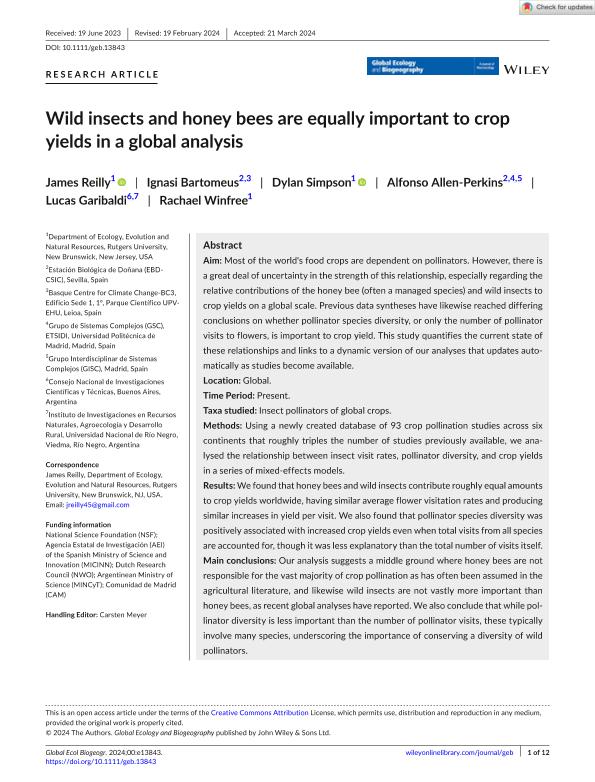
Aim: Most of the world´s food crops are dependent on pollinators. However, there is a great deal of uncertainty in the strength of this relationship, especially regarding the relative contributions of the honey bee (often a managed species) and wild insects to crop yields on a global scale. Previous data syntheses have likewise reached differing conclusions on whether pollinator species diversity, or only the number of pollinator visits to flowers, is important to crop yield. This study quantifies the current state of these relationships and links to a dynamic version of our analyses that updates automatically as studies become available.Location: Global. Time Period: Present.Taxa studied: Insect pollinators of global crops. Methods: Using a newly created database of 93 crop pollination studies across six continents that roughly triples the number of studies previously available, we analysed the relationship between insect visit rates, pollinator diversity, and crop yields in a series of mixed-effects models. Results: We found that honey bees and wild insects contribute roughly equal amounts to crop yields worldwide, having similar average flower visitation rates and producing similar increases in yield per visit. We also found that pollinator species diversity was positively associated with increased crop yields even when total visits from all species are accounted for, though it was less explanatory than the total number of visits itself. Main conclusions: Our analysis suggests a middle ground where honey bees are not responsible for the vast majority of crop pollination as has often been assumed in the agricultural literature, and like wise wild insects are not vastly more important than honey bees, as recent global analyses have reported. We also conclude that while pollinator diversity is less important than the number of pollinator visits, these typically involve many species, underscoring the importance of conserving a diversity of wild pollinators.
Palabras clave:
ABUNDANCE
,
BIODIVERSITY
,
CROP YIELD
,
HONEY BEE
,
POLLINATION
,
WILD INSECTS
Archivos asociados

Tamaño:
5.096Mb
Formato:
PDF
Licencia
 Excepto donde se diga explícitamente, este item se publica bajo la siguiente descripción:
Creative Commons Attribution 2.5 Unported (CC BY 2.5)
Excepto donde se diga explícitamente, este item se publica bajo la siguiente descripción:
Creative Commons Attribution 2.5 Unported (CC BY 2.5)
Identificadores
Colecciones
Articulos (IRNAD)
Articulos de INSTITUTO DE INVESTIGACIONES EN RECURSOS NATURALES, AGROECOLOGIA Y DESARROLLO RURAL
Articulos de INSTITUTO DE INVESTIGACIONES EN RECURSOS NATURALES, AGROECOLOGIA Y DESARROLLO RURAL
Citación
Reilly, James; Bartomeus, Ignasi; Simpson, Dylan; Allen Perkins, Alfonso; Garibaldi, Lucas Alejandro; et al.; Wild insects and honey bees are equally important to crop yields in a global analysis; Wiley Blackwell Publishing, Inc; Global Ecology and Biogeography; 33; 7; 17-4-2024; 1-12
Compartir


Altmétricas