Artículo
Use of phytoplankton assemblages to assess the quality of coastal waters of a transitional ecosystem: Río de la Plata estuary

Fecha de publicación:
03/2016
Editorial:
Elsevier
Revista:
Continental Shelf Research
ISSN:
0278-4343
Idioma:
Inglés
Tipo de recurso:
Artículo publicado
Clasificación temática:
Resumen
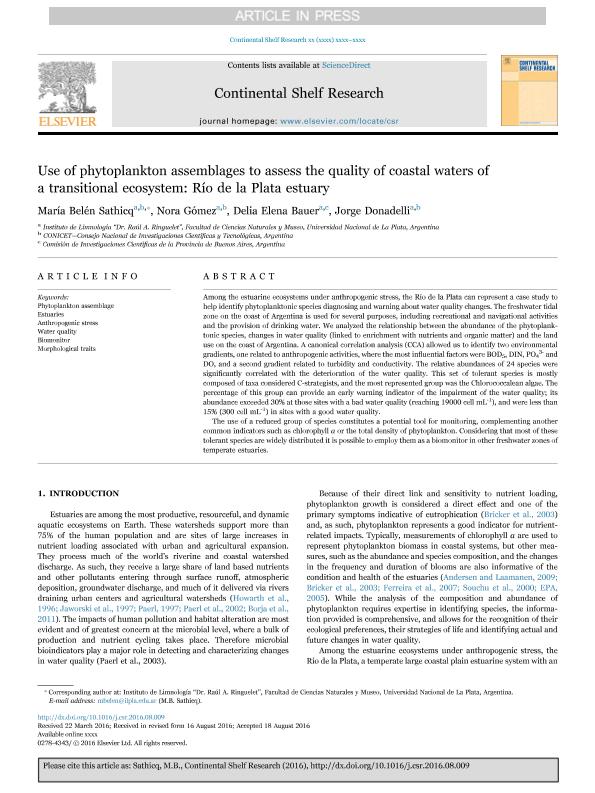
Among the estuarine ecosystems under anthropogenic stress, the Río de la Plata can represent a case study to help identify phytoplanktonic species diagnosing and warning about water quality changes. The freshwater tidal zone on the coast of Argentina is used for several purposes, including recreational and navigational activities and the provision of drinking water. We analyzed the relationship between the abundance of the phytoplanktonic species, changes in water quality (linked to enrichment with nutrients and organic matter) and the land use on the coast of Argentina. A canonical correlation analysis (CCA) allowed us to identify two environmental gradients, one related to anthropogenic activities, where the most influential factors were BOD5, DIN, PO4 3- and DO, and a second gradient related to turbidity and conductivity. The relative abundances of 24 species were significantly correlated with the deterioration of the water quality. This set of tolerant species is mostly composed of taxa considered C-strategists, and the most represented group was the Chlorococcalean algae. The percentage of this group can provide an early warning indicator of the impairment of the water quality; its abundance exceeded 30% at those sites with a bad water quality (reaching 19000 cell mL-1), and were less than 15% (300 cell mL-1) in sites with a good water quality.The use of a reduced group of species constitutes a potential tool for monitoring, complementing another common indicators such as chlorophyll . a or the total density of phytoplankton. Considering that most of these tolerant species are widely distributed it is possible to employ them as a biomonitor in other freshwater zones of temperate estuaries.
Archivos asociados

Tamaño:
873.2Kb
Formato:
PDF
Licencia
 Excepto donde se diga explícitamente, este item se publica bajo la siguiente descripción:
Creative Commons Attribution-NonCommercial-ShareAlike 2.5 Unported (CC BY-NC-SA 2.5)
Excepto donde se diga explícitamente, este item se publica bajo la siguiente descripción:
Creative Commons Attribution-NonCommercial-ShareAlike 2.5 Unported (CC BY-NC-SA 2.5)
Identificadores
Colecciones
Articulos(ILPLA)
Articulos de INST.DE LIMNOLOGIA "DR. RAUL A. RINGUELET"
Articulos de INST.DE LIMNOLOGIA "DR. RAUL A. RINGUELET"
Citación
Sathicq, María Belén; Gomez, Nora; Bauer, Delia Elena; Donadelli, Jorge Luis; Use of phytoplankton assemblages to assess the quality of coastal waters of a transitional ecosystem: Río de la Plata estuary; Elsevier; Continental Shelf Research; 3-2016; 1-8
Compartir


Altmétricas