Artículo
First-year sea ice leads to an increase in dimethyl sulfide-induced particle formation in the Antarctic Peninsula
Jang, Eunho; Park, Ki-Tae; Yoon, Young Jun; Kim, Kitae; Gim, Yeontae; Chung, Hyun Young; Lee, Kitack; Choi, Jinhee; Park, Jiyeon; Park, Sang-Jong; Koo, Ja-Ho; Fernandez, Rafael Pedro ; Saiz López, Alfonso
; Saiz López, Alfonso
Fecha de publicación:
10/01/2022
Editorial:
Elsevier
Revista:
Science of the Total Environment
ISSN:
0048-9697
e-ISSN:
1879-1026
Idioma:
Inglés
Tipo de recurso:
Artículo publicado
Clasificación temática:
Resumen
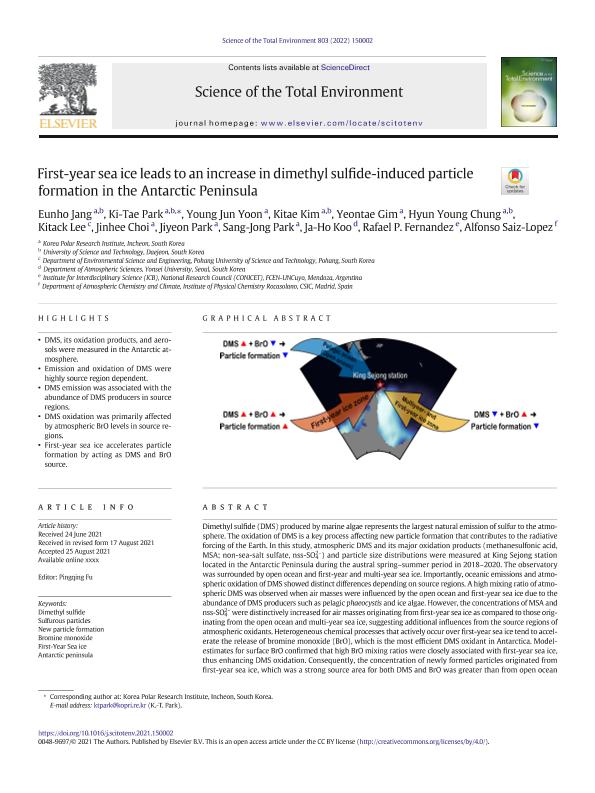
Dimethyl sulfide (DMS) produced by marine algae represents the largest natural emission of sulfur to the atmosphere. The oxidation of DMS is a key process affecting new particle formation that contributes to the radiative forcing of the Earth. In this study, atmospheric DMS and its major oxidation products (methanesulfonic acid, MSA; non-sea-salt sulfate, nss-SO42?) and particle size distributions were measured at King Sejong station located in the Antarctic Peninsula during the austral spring?summer period in 2018?2020. The observatory was surrounded by open ocean and first-year and multi-year sea ice. Importantly, oceanic emissions and atmospheric oxidation of DMS showed distinct differences depending on source regions. A high mixing ratio of atmospheric DMS was observed when air masses were influenced by the open ocean and first-year sea ice due to the abundance of DMS producers such as pelagic phaeocystis and ice algae. However, the concentrations of MSA and nss-SO42? were distinctively increased for air masses originating from first-year sea ice as compared to those originating from the open ocean and multi-year sea ice, suggesting additional influences from the source regions of atmospheric oxidants. Heterogeneous chemical processes that actively occur over first-year sea ice tend to accelerate the release of bromine monoxide (BrO), which is the most efficient DMS oxidant in Antarctica. Model-estimates for surface BrO confirmed that high BrO mixing ratios were closely associated with first-year sea ice, thus enhancing DMS oxidation. Consequently, the concentration of newly formed particles originated from first-year sea ice, which was a strong source area for both DMS and BrO was greater than from open ocean (high DMS but low BrO). These results indicate that first-year sea ice plays an important yet overlooked role in DMS-induced new particle formation in polar environments, where warming-induced sea ice changes are pronounced.
Palabras clave:
DMS
,
New Particle Formation
,
Bromine Chemistry
,
Antarctic Peninsula
Archivos asociados

Tamaño:
1.389Mb
Formato:
PDF
Licencia
 Excepto donde se diga explícitamente, este item se publica bajo la siguiente descripción:
Creative Commons Attribution 2.5 Unported (CC BY 2.5)
Excepto donde se diga explícitamente, este item se publica bajo la siguiente descripción:
Creative Commons Attribution 2.5 Unported (CC BY 2.5)
Identificadores
Colecciones
Articulos(ICB)
Articulos de INSTITUTO INTERDISCIPLINARIO DE CIENCIAS BASICAS
Articulos de INSTITUTO INTERDISCIPLINARIO DE CIENCIAS BASICAS
Citación
Jang, Eunho; Park, Ki-Tae; Yoon, Young Jun; Kim, Kitae; Gim, Yeontae; et al.; First-year sea ice leads to an increase in dimethyl sulfide-induced particle formation in the Antarctic Peninsula; Elsevier; Science of the Total Environment; 803; 10-1-2022; 1-9
Compartir


Altmétricas