Mostrar el registro sencillo del ítem
dc.contributor.author
Clarke, Elaine B.
dc.contributor.author
McCauley, James B.
dc.contributor.author
Lutz, Amy
dc.contributor.author
Gotelli, Marina María
dc.contributor.author
Sheinkopf, Stephen J.
dc.contributor.author
Lord, Catherine
dc.date.available
2024-03-27T12:23:54Z
dc.date.issued
2024-01
dc.identifier.citation
Clarke, Elaine B.; McCauley, James B.; Lutz, Amy; Gotelli, Marina María; Sheinkopf, Stephen J.; et al.; Understanding profound autism: implications for stigma and supports; Frontiers Media; Frontiers in Psychiatry; 15; 1-2024; 1-15
dc.identifier.uri
http://hdl.handle.net/11336/231675
dc.description.abstract
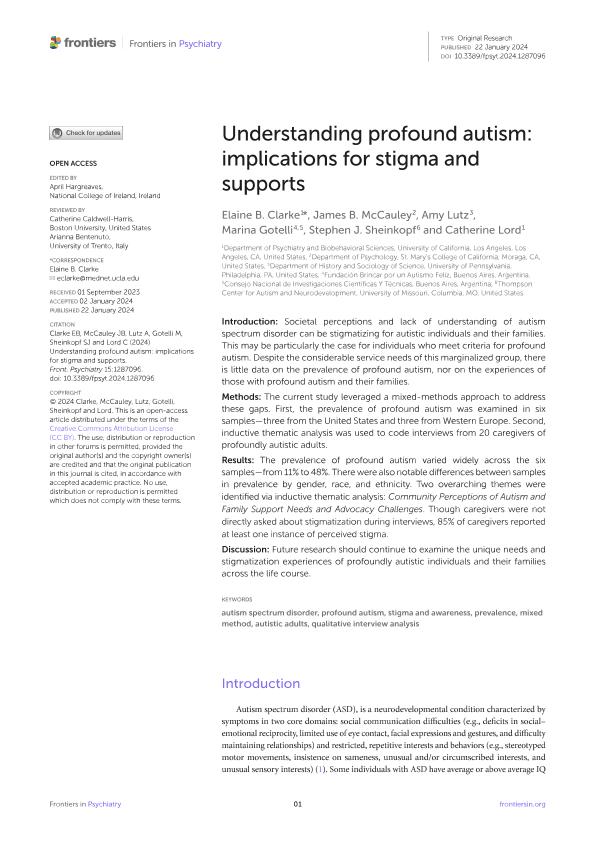
Introduction: Societal perceptions and lack of understanding of autism spectrum disorder can be stigmatizing for autistic individuals and their families. This may be particularly the case for individuals who meet criteria for profound autism. Despite the considerable service needs of this marginalized group, there is little data on the prevalence of profound autism, nor on the experiences of those with profound autism and their families.Methods: The current study leveraged a mixed-methods approach to address these gaps. First, the prevalence of profound autism was examined in six samples—three from the United States and three from Western Europe. Second, inductive thematic analysis was used to code interviews from 20 caregivers of profoundly autistic adults.Results: The prevalence of profound autism varied widely across the six samples—from 11% to 48%. There were also notable differences between samples in prevalence by gender, race, and ethnicity. Two overarching themes were identified via inductive thematic analysis: Community Perceptions of Autism and Family Support Needs and Advocacy Challenges. Though caregivers were not directly asked about stigmatization during interviews, 85% of caregivers reported at least one instance of perceived stigma.Discussion: Future research should continue to examine the unique needs and stigmatization experiences of profoundly autistic individuals and their families across the life course.
dc.format
application/pdf
dc.language.iso
eng
dc.publisher
Frontiers Media
dc.rights
info:eu-repo/semantics/openAccess
dc.rights.uri
https://creativecommons.org/licenses/by/2.5/ar/
dc.subject
AUTISM SPECTRUM DISORDER
dc.subject
PROFOUND AUTISM
dc.subject
STIGMA AND AWARENESS
dc.subject
PREVALENCE
dc.subject
MIXED METHOD
dc.subject
AUTISTIC ADULTS
dc.subject
QUALITATIVE INTERVIEW ANALYSIS
dc.subject.classification
Psicología especial
dc.subject.classification
Psicología
dc.subject.classification
CIENCIAS SOCIALES
dc.title
Understanding profound autism: implications for stigma and supports
dc.type
info:eu-repo/semantics/article
dc.type
info:ar-repo/semantics/artículo
dc.type
info:eu-repo/semantics/publishedVersion
dc.date.updated
2024-03-19T14:26:51Z
dc.identifier.eissn
1664-0640
dc.journal.volume
15
dc.journal.pagination
1-15
dc.journal.pais
Suiza
dc.description.fil
Fil: Clarke, Elaine B.. University of California at Los Angeles; Estados Unidos
dc.description.fil
Fil: McCauley, James B.. St. Mary's College Of California; Estados Unidos
dc.description.fil
Fil: Lutz, Amy. University of Pennsylvania; Estados Unidos
dc.description.fil
Fil: Gotelli, Marina María. Consejo Nacional de Investigaciones Científicas y Técnicas; Argentina. Fundación Brincar por un Autismo Feliz; Argentina
dc.description.fil
Fil: Sheinkopf, Stephen J.. University of Missouri; Estados Unidos
dc.description.fil
Fil: Lord, Catherine. University of California at Los Angeles; Estados Unidos
dc.journal.title
Frontiers in Psychiatry
dc.relation.alternativeid
info:eu-repo/semantics/altIdentifier/url/https://www.frontiersin.org/articles/10.3389/fpsyt.2024.1287096/full
dc.relation.alternativeid
info:eu-repo/semantics/altIdentifier/doi/http://dx.doi.org/10.3389/fpsyt.2024.1287096
Archivos asociados

Tamaño:
548.5Kb
Formato:
PDF