Artículo
Efficacy of adding selective electrical muscle stimulation to usual physical therapy for Bell’s palsy: immediate and six-month outcomes
Di Pietro, Antonio; Cameron, Michelle; Campana, Vilma; Leyes, Laura Elizabeth; Zalazar Cinat, Jessica Andrea Isabel ; Lochala, Carly; Johnson, Christopher Z.; Hildebrand, Andrea; Loyo, Myriam
; Lochala, Carly; Johnson, Christopher Z.; Hildebrand, Andrea; Loyo, Myriam
Fecha de publicación:
10/2023
Editorial:
Page Press Publications
Revista:
European Journal of Translational Myology
ISSN:
2037-7452
e-ISSN:
2037-7460
Idioma:
Inglés
Tipo de recurso:
Artículo publicado
Clasificación temática:
Resumen
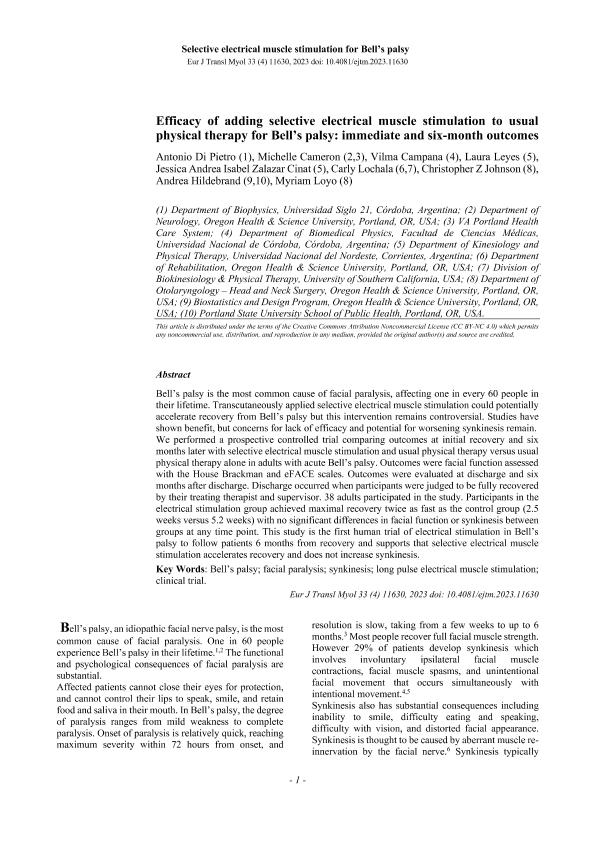
Bell’s palsy is the most common cause of facial paralysis, affecting one in every 60 people in their lifetime. Transcutaneously applied selective electrical muscle stimulation could potentially accelerate recovery from Bell’s palsy but this intervention remains controversial. Studies have shown benefit, but concerns for lack of efficacy and potential for worsening synkinesis remain. We performed a prospective controlled trial comparing outcomes at initial recovery and six months later with selective electrical muscle stimulation and usual physical therapy versus usual physical therapy alone in adults with acute Bell’s palsy. Outcomes were facial function assessed with the House Brackman and eFACE scales. Outcomes were evaluated at discharge and six months after discharge. Discharge occurred when participants were judged to be fully recovered by their treating therapist and supervisor. 38 adults participated in the study. Participants in the electrical stimulation group achieved maximal recovery twice as fast as the control group (2.5 weeks versus 5.2 weeks) with no significant differences in facial function or synkinesis between groups at any time point. This study is the first human trial of electrical stimulation in Bell’s palsy to follow patients 6 months from recovery and supports that selective electrical muscle stimulation accelerates recovery and does not increase synkinesis.
Archivos asociados

Tamaño:
809.7Kb
Formato:
PDF
Licencia
 Excepto donde se diga explícitamente, este item se publica bajo la siguiente descripción:
Creative Commons Attribution-NonCommercial-ShareAlike 2.5 Unported (CC BY-NC-SA 2.5)
Excepto donde se diga explícitamente, este item se publica bajo la siguiente descripción:
Creative Commons Attribution-NonCommercial-ShareAlike 2.5 Unported (CC BY-NC-SA 2.5)
Identificadores
Colecciones
Articulos(CCT - NORDESTE)
Articulos de CTRO.CIENTIFICO TECNOL.CONICET - NORDESTE
Articulos de CTRO.CIENTIFICO TECNOL.CONICET - NORDESTE
Citación
Di Pietro, Antonio; Cameron, Michelle; Campana, Vilma; Leyes, Laura Elizabeth; Zalazar Cinat, Jessica Andrea Isabel; et al.; Efficacy of adding selective electrical muscle stimulation to usual physical therapy for Bell’s palsy: immediate and six-month outcomes; Page Press Publications; European Journal of Translational Myology; 33; 4; 10-2023; 1-11
Compartir


Altmétricas