Artículo
Evidence for a regulated ca2+ entry in proximal tubular cells and its implication in calcium stone formation
Ibeh, Cliff Lawrence; Yiu, Allen J.; Kanaras, Yianni L.; Paal, Edina; Birnbaumer, Lutz ; Jose, Pedro A.; Bandyopadhyay, Bidhan C.
; Jose, Pedro A.; Bandyopadhyay, Bidhan C.
Fecha de publicación:
05/2019
Editorial:
Company of Biologists
Revista:
Journal of Cell Science
ISSN:
0021-9533
e-ISSN:
1477-9137
Idioma:
Inglés
Tipo de recurso:
Artículo publicado
Clasificación temática:
Resumen
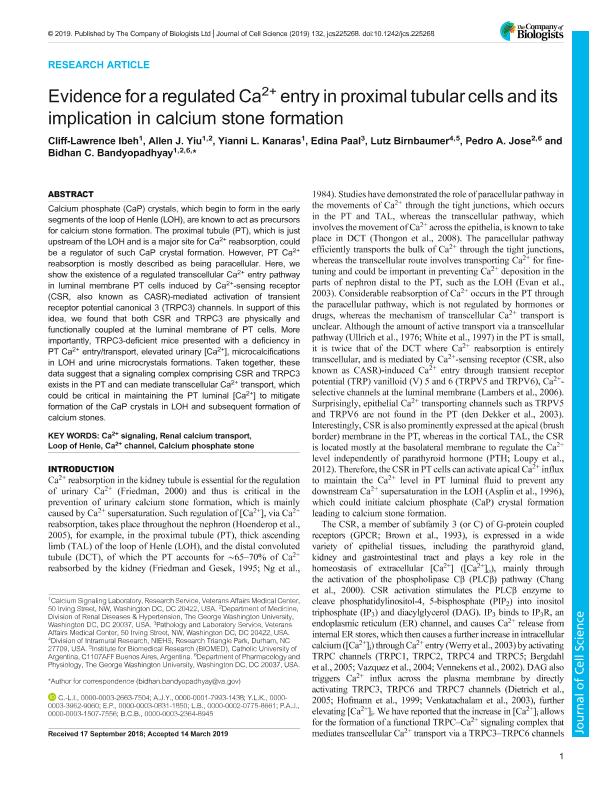
Calcium phosphate (CaP) crystals, which begin to form in the early segments of the loop of Henle (LOH), are known to act as precursors for calcium stone formation. The proximal tubule (PT), which is just upstream of the LOH and is a major site for Ca2+ reabsorption, could be a regulator of such CaP crystal formation. However, PT Ca2+ reabsorption is mostly described as being paracellular. Here, we show the existence of a regulated transcellular Ca2+ entry pathway in luminal membrane PT cells induced by Ca2+-sensing receptor (CSR, also known as CASR)-mediated activation of transient receptor potential canonical 3 (TRPC3) channels. In support of this idea, we found that both CSR and TRPC3 are physically and functionally coupled at the luminal membrane of PT cells. More importantly, TRPC3-deficient mice presented with a deficiency in PT Ca2+ entry/transport, elevated urinary [Ca2+], microcalcifications in LOH and urine microcrystals formations. Taken together, these data suggest that a signaling complex comprising CSR and TRPC3 exists in the PT and can mediate transcellular Ca2+ transport, which could be critical in maintaining the PT luminal [Ca2+] to mitigate formation of the CaP crystals in LOH and subsequent formation of calcium stones.
Archivos asociados

Tamaño:
12.52Mb
Formato:
PDF
Licencia
 Excepto donde se diga explícitamente, este item se publica bajo la siguiente descripción:
Creative Commons Attribution-NonCommercial-ShareAlike 2.5 Unported (CC BY-NC-SA 2.5)
Excepto donde se diga explícitamente, este item se publica bajo la siguiente descripción:
Creative Commons Attribution-NonCommercial-ShareAlike 2.5 Unported (CC BY-NC-SA 2.5)
Identificadores
Colecciones
Articulos(BIOMED)
Articulos de INSTITUTO DE INVESTIGACIONES BIOMEDICAS
Articulos de INSTITUTO DE INVESTIGACIONES BIOMEDICAS
Citación
Ibeh, Cliff Lawrence; Yiu, Allen J.; Kanaras, Yianni L.; Paal, Edina; Birnbaumer, Lutz; et al.; Evidence for a regulated ca2+ entry in proximal tubular cells and its implication in calcium stone formation; Company of Biologists; Journal of Cell Science; 132; 9; 5-2019; 1-17
Compartir


Altmétricas