Artículo
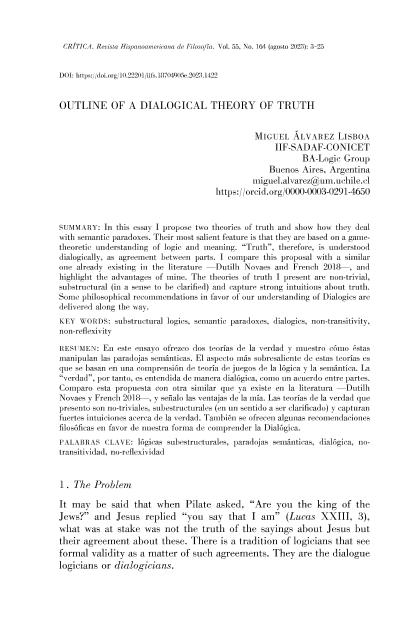
En este ensayo ofrezco dos teorías de la verdad y muestro cómo éstasmanipulan las paradojas semánticas. El aspecto más sobresaliente de estas teorías esque se basan en una comprensión de teoría de juegos de la lógica y la semántica. La“verdad”, por tanto, es entendida de manera dialógica, como un acuerdo entre partes.Comparo esta propuesta con otra similar que ya existe en la literatura —DutilhNovaes y French 2018—, y señalo las ventajas de la mía. Las teorías de la verdad quepresento son no-triviales, subestructurales (en un sentido a ser clarificado) y capturanfuertes intuiciones acerca de la verdad. También se ofrecen algunas recomendacionesfilosóficas en favor de nuestra forma de comprender la Dialógica. In this essay I propose two theories of truth and show how they deal with semantic paradoxes. Their most salient feature is that they are based on a game-theoretic understanding of logic and meaning. `Truth´, therefore, is understood dialogically, as agreement between parts. I compare this proposal with a similar one already existing in the literature (Novaes and French, 2018) and highlight the advantages of mine. The theories of truth I present are non-trivial, substructural (in a sense to be clarified) and capture strong intuitions about truth. Some philosophical recommendations in favor of our understanding of Dialogics are delivered along the way.
Outline of a dialogical theory of truth

Fecha de publicación:
02/2023
Editorial:
Universidad Nacional Autónoma de México. Instituto de Investigaciones Filosóficas
Revista:
Crítica
ISSN:
1870-4905
Idioma:
Inglés
Tipo de recurso:
Artículo publicado
Clasificación temática:
Resumen
Archivos asociados

Tamaño:
135.0Kb
Formato:
PDF
Licencia
 Excepto donde se diga explícitamente, este item se publica bajo la siguiente descripción:
Atribución-NoComercial-SinDerivadas 2.5 Argentina (CC BY-NC-ND 2.5 AR)
Excepto donde se diga explícitamente, este item se publica bajo la siguiente descripción:
Atribución-NoComercial-SinDerivadas 2.5 Argentina (CC BY-NC-ND 2.5 AR)
Identificadores
Colecciones
Articulos(IIF)
Articulos de INSTITUTO DE INVESTIGACIONES FILOSOFICAS
Articulos de INSTITUTO DE INVESTIGACIONES FILOSOFICAS
Citación
Alvarez Lisboa, Miguel Agustin; Outline of a dialogical theory of truth; Universidad Nacional Autónoma de México. Instituto de Investigaciones Filosóficas; Crítica; 55; 164; 2-2023; 3-25
Compartir


Altmétricas