Artículo
Lipid-like behavior of signal sequence peptides at air–water interface

Fecha de publicación:
11/2012
Editorial:
Elsevier Science
Revista:
Biochimica et Biophysica Acta - Biomembranes
ISSN:
0005-2736
Idioma:
Inglés
Tipo de recurso:
Artículo publicado
Clasificación temática:
Resumen
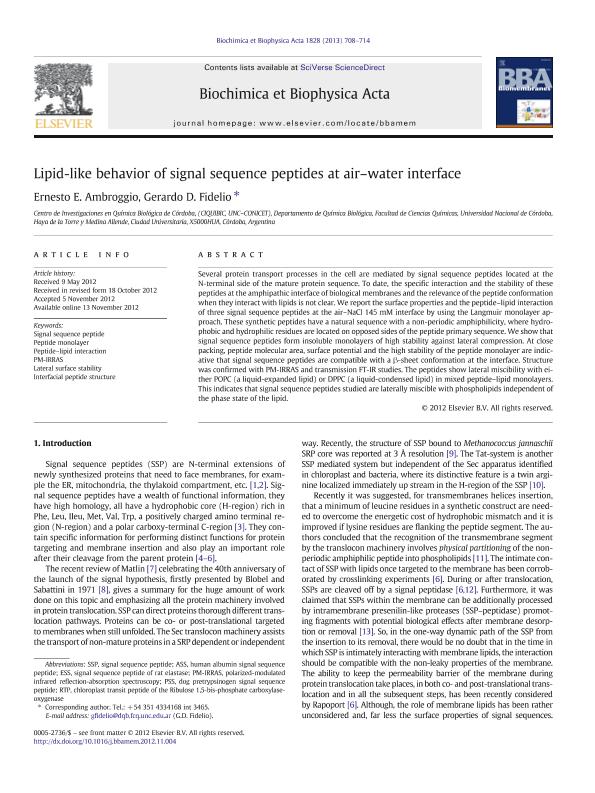
Several protein transport processes in the cell are mediated by signal sequence peptides located at the N-terminal side of the mature protein sequence. To date, the specific interaction and the stability of these peptides at the amphipathic interface of biological membranes and the relevance of the peptide conformation when they interact with lipids is not clear. We report the surface properties and the peptide–lipid interaction of three signal sequence peptides at the air–NaCl 145 mM interface by using the Langmuir monolayer approach. These synthetic peptides have a natural sequence with a non-periodic amphiphilicity, where hydrophobic and hydrophilic residues are located on opposed sides of the peptide primary sequence. We show that signal sequence peptides form insoluble monolayers of high stability against lateral compression. At close packing, peptide molecular area, surface potential and the high stability of the peptide monolayer are indicative that signal sequence peptides are compatible with a β-sheet conformation at the interface. Structure was confirmed with PM-IRRAS and transmission FT-IR studies. The peptides show lateral miscibility with either POPC (a liquid-expanded lipid) or DPPC (a liquid-condensed lipid) in mixed peptide–lipid monolayers. This indicates that signal sequence peptides studied are laterally miscible with phospholipids independent of the phase state of the lipid.
Archivos asociados

Tamaño:
861.5Kb
Formato:
PDF
Licencia
 Excepto donde se diga explícitamente, este item se publica bajo la siguiente descripción:
Creative Commons Attribution-NonCommercial-ShareAlike 2.5 Unported (CC BY-NC-SA 2.5)
Excepto donde se diga explícitamente, este item se publica bajo la siguiente descripción:
Creative Commons Attribution-NonCommercial-ShareAlike 2.5 Unported (CC BY-NC-SA 2.5)
Identificadores
Colecciones
Articulos(CIQUIBIC)
Articulos de CENTRO DE INVEST.EN QCA.BIOL.DE CORDOBA (P)
Articulos de CENTRO DE INVEST.EN QCA.BIOL.DE CORDOBA (P)
Citación
Ambroggio, Ernesto Esteban; Fidelio, Gerardo Daniel; Lipid-like behavior of signal sequence peptides at air–water interface; Elsevier Science; Biochimica et Biophysica Acta - Biomembranes; 1828; 2; 11-2012; 708-714
Compartir


Altmétricas