Artículo
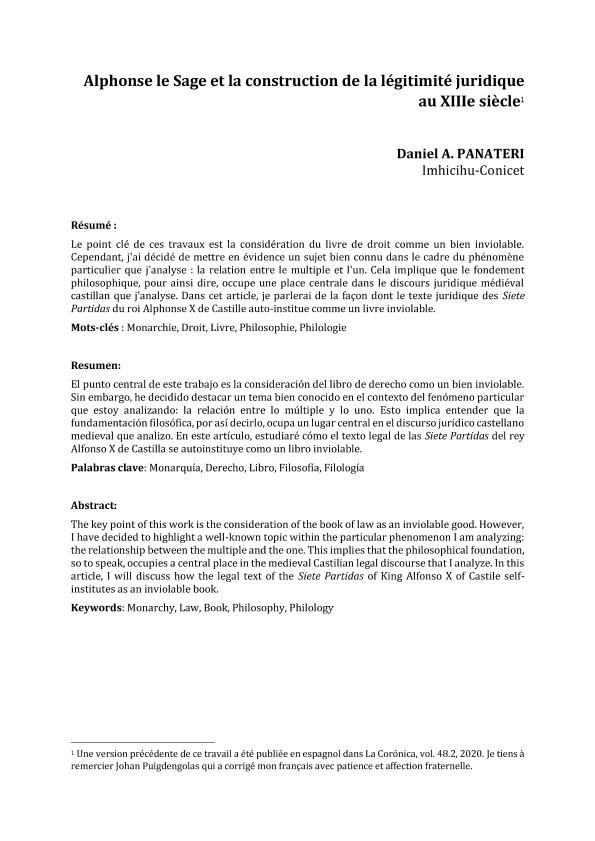
El punto central de este trabajo es la consideración del libro de derecho como un bien inviolable. Sin embargo, he decidido destacar un tema bien conocido en el contexto del fenómeno particular que estoy analizando: la relación entre lo múltiple y lo uno. Esto implica entender que la fundamentación filosófica, por así decirlo, ocupa un lugar central en el discurso jurídico castellano medieval que analizo. En este artículo, estudiaré cómo el texto legal de las Siete Partidas del rey Alfonso X de Castilla se autoinstituye como un libro inviolable. Le point clé de ces travaux est la considération du livre de droit comme un bien inviolable. Cependant, j'ai décidé de mettre en évidence un sujet bien connu dans le cadre du phénomène particulier que j'analyse : la relation entre le multiple et l'un. Cela implique que le fondement philosophique, pour ainsi dire, occupe une place centrale dans le discours juridique médiéval castillan que j’analyse. Dans cette article, je parlerai de la façon dont le texte juridique des Siete Partidas du roi Alphonse X de Castille auto-institue comme un livre inviolable. The key point of this work is the consideration of the book of law as an inviolable good. However, I have decided to highlight a well-known topic within the particular phenomenon I am analyzing: the relationship between the multiple and the one. This implies that the philosophical foundation, so to speak, occupies a central place in the medieval Castilian legal discourse that I analyze. In this article, I will discuss how the legal text of the Siete Partidas of King Alfonso X of Castile self-institutes as an inviolable book.
Alfonso el Sabio y la construcción de la legitimidad jurídica en el siglo XIII
Título:
Alphonse le Sage et la construction de la légitimité juridique au XIIIe siècle;
Alfonso the Wise and the construction of legal legitimacy in the 13th century
Alfonso the Wise and the construction of legal legitimacy in the 13th century

Fecha de publicación:
12/2023
Editorial:
Université Bourdeaux-Montaigne
Revista:
Conceptos
ISSN:
2742-9660
Idioma:
Frances
Tipo de recurso:
Artículo publicado
Clasificación temática:
Resumen
Palabras clave:
LIVRE
,
DROIT
,
MONARCHIE
,
PHILOSOPHIE
Archivos asociados

Tamaño:
327.8Kb
Formato:
PDF
Licencia
 Excepto donde se diga explícitamente, este item se publica bajo la siguiente descripción:
Creative Commons Attribution-NonCommercial-ShareAlike 2.5 Unported (CC BY-NC-SA 2.5)
Excepto donde se diga explícitamente, este item se publica bajo la siguiente descripción:
Creative Commons Attribution-NonCommercial-ShareAlike 2.5 Unported (CC BY-NC-SA 2.5)
Identificadores
Colecciones
Articulos (LICH)
Articulos de LABORATORIO DE INVESTIGACION EN CIENCIAS HUMANAS
Articulos de LABORATORIO DE INVESTIGACION EN CIENCIAS HUMANAS
Articulos(IMHICIHU)
Articulos de INST.MULTIDISCIP.DE HISTORIA Y CS.HUMANAS
Articulos de INST.MULTIDISCIP.DE HISTORIA Y CS.HUMANAS
Citación
Panateri, Daniel Alberto; Alfonso el Sabio y la construcción de la legitimidad jurídica en el siglo XIII; Université Bourdeaux-Montaigne; Conceptos; 8; 12-2023; 160-181
Compartir

