Artículo
Trapping Charge Mechanism in Hv1 Channels (CiHv1)
Fernández, Miguel; Alvear Arias, Juan José ; Carmona, Emerson M.; Carrillo, Christian; Pena Pichicoi, Antonio; Hernandez Ochoa, Erick O.; Neely, Alan; Alvarez, Osvaldo; Latorre, Ramon; Garate, Jose A.; Gonzalez, Carlos
; Carmona, Emerson M.; Carrillo, Christian; Pena Pichicoi, Antonio; Hernandez Ochoa, Erick O.; Neely, Alan; Alvarez, Osvaldo; Latorre, Ramon; Garate, Jose A.; Gonzalez, Carlos
Fecha de publicación:
12/2023
Editorial:
Molecular Diversity Preservation International
Revista:
International Journal of Molecular Sciences
ISSN:
1422-0067
Idioma:
Inglés
Tipo de recurso:
Artículo publicado
Clasificación temática:
Resumen
The majority of voltage-gated ion channels contain a defined voltage-sensing domain and a pore domain composed of highly conserved amino acid residues that confer electrical excitability via electromechanical coupling. In this sense, the voltage-gated proton channel (Hv1) is a unique protein in that voltage-sensing, proton permeation and pH-dependent modulation involve the same structural region. In fact, these processes synergistically work in concert, and it is difficult to separate them. To investigate the process of Hv1 voltage sensor trapping, we follow voltage-sensor movements directly by leveraging mutations that enable the measurement of Hv1 channel gating currents. We uncover that the process of voltage sensor displacement is due to two driving forces. The first reveals that mutations in the selectivity filter (D160) located in the S1 transmembrane interact with the voltage sensor. More hydrophobic amino acids increase the energy barrier for voltage sensor activation. On the other hand, the effect of positive charges near position 264 promotes the formation of salt bridges between the arginines of the voltage sensor domain, achieving a stable conformation over time. Our results suggest that the activation of the Hv1 voltage sensor is governed by electrostatic–hydrophobic interactions, and S4 arginines, N264 and selectivity filter (D160) are essential in the Ciona-Hv1 to understand the trapping of the voltage sensor.
Palabras clave:
CHARGE TRAPPING
,
CIONA INTESTINALIS
,
GATING CURRENTS
,
PROTON CHANNEL
Archivos asociados
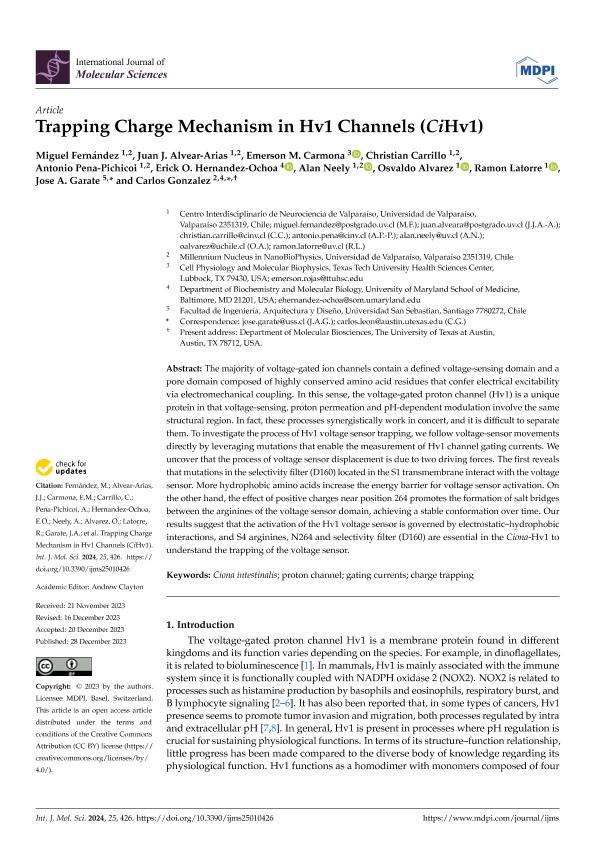

Tamaño:
3.792Mb
Formato:
PDF
Licencia
 Excepto donde se diga explícitamente, este item se publica bajo la siguiente descripción:
Creative Commons Attribution 2.5 Unported (CC BY 2.5)
Excepto donde se diga explícitamente, este item se publica bajo la siguiente descripción:
Creative Commons Attribution 2.5 Unported (CC BY 2.5)
Identificadores
Colecciones
Articulos(IBBEA)
Articulos de INSTITUTO DE BIODIVERSIDAD Y BIOLOGIA EXPERIMENTAL Y APLICADA
Articulos de INSTITUTO DE BIODIVERSIDAD Y BIOLOGIA EXPERIMENTAL Y APLICADA
Citación
Fernández, Miguel; Alvear Arias, Juan José; Carmona, Emerson M.; Carrillo, Christian; Pena Pichicoi, Antonio; et al.; Trapping Charge Mechanism in Hv1 Channels (CiHv1); Molecular Diversity Preservation International; International Journal of Molecular Sciences; 25; 1; 12-2023; 1-21
Compartir


Altmétricas