Mostrar el registro sencillo del ítem
dc.contributor.author
Soprano, Luciana Lía
dc.contributor.author
Ferrero, Maximiliano Ruben
dc.contributor.author
Jacobs, Thomas
dc.contributor.author
Couto, Alicia Susana
dc.contributor.author
Duschak, Vilma Gladys
dc.date.available
2024-02-22T13:42:26Z
dc.date.issued
2023-05
dc.identifier.citation
Soprano, Luciana Lía; Ferrero, Maximiliano Ruben; Jacobs, Thomas; Couto, Alicia Susana; Duschak, Vilma Gladys; Hallmarks of the relationship between host and Trypanosoma cruzi sulfated glycoconjugates along the course of Chagas disease; Frontiers Media; Frontiers in Cellular and Infection Microbiology; 13; 1028496; 5-2023; 1-15
dc.identifier.uri
http://hdl.handle.net/11336/228047
dc.description.abstract
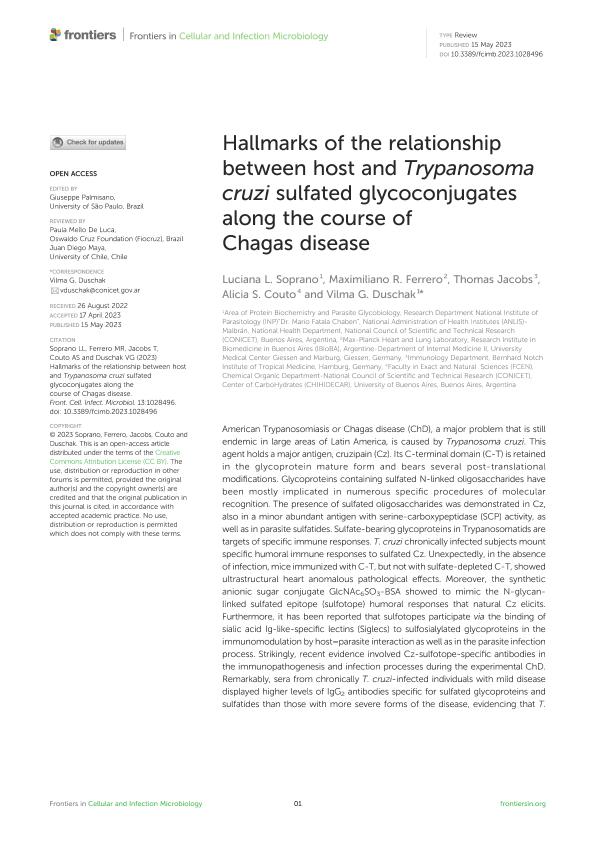
American Trypanosomiasis or Chagas disease (ChD), a major problem that is still endemic in large areas of Latin America, is caused by Trypanosoma cruzi. This agent holds a major antigen, cruzipain (Cz). Its C-terminal domain (C-T) is retained in the glycoprotein mature form and bears several post-translational modifications. Glycoproteins containing sulfated N-linked oligosaccharides have been mostly implicated in numerous specific procedures of molecular recognition. The presence of sulfated oligosaccharides was demonstrated in Cz, also in a minor abundant antigen with serine-carboxypeptidase (SCP) activity, as well as in parasite sulfatides. Sulfate-bearing glycoproteins in Trypanosomatids are targets of specific immune responses. T. cruzi chronically infected subjects mount specific humoral immune responses to sulfated Cz. Unexpectedly, in the absence of infection, mice immunized with C-T, but not with sulfate-depleted C-T, showed ultrastructural heart anomalous pathological effects. Moreover, the synthetic anionic sugar conjugate GlcNAc6SO3-BSA showed to mimic the N-glycan-linked sulfated epitope (sulfotope) humoral responses that natural Cz elicits. Furthermore, it has been reported that sulfotopes participate via the binding of sialic acid Ig-like-specific lectins (Siglecs) to sulfosialylated glycoproteins in the immunomodulation by host–parasite interaction as well as in the parasite infection process. Strikingly, recent evidence involved Cz-sulfotope-specific antibodies in the immunopathogenesis and infection processes during the experimental ChD. Remarkably, sera from chronically T. cruzi-infected individuals with mild disease displayed higher levels of IgG2 antibodies specific for sulfated glycoproteins and sulfatides than those with more severe forms of the disease, evidencing that T. cruzi sulfotopes are antigenic independently of the sulfated glycoconjugate type. Ongoing assays indicate that antibodies specific for sulfotopes might be considered biomarkers of human cardiac ChD progression, playing a role as predictors of stability from the early mild stages of chronic ChD.
dc.format
application/pdf
dc.language.iso
eng
dc.publisher
Frontiers Media
dc.rights
info:eu-repo/semantics/openAccess
dc.rights.uri
https://creativecommons.org/licenses/by/2.5/ar/
dc.subject
BIOMARKERS
dc.subject
CHAGAS DISEASE
dc.subject
IMMUNOMODULATION
dc.subject
IMMUNOPATHOGENESIS
dc.subject
INFECTION
dc.subject
SULFATED GLYCOCONJUGATES
dc.subject
SULFOTOPES
dc.subject
TRYPANOSOMA CRUZI
dc.subject.classification
Química Orgánica
dc.subject.classification
Ciencias Químicas
dc.subject.classification
CIENCIAS NATURALES Y EXACTAS
dc.title
Hallmarks of the relationship between host and Trypanosoma cruzi sulfated glycoconjugates along the course of Chagas disease
dc.type
info:eu-repo/semantics/article
dc.type
info:ar-repo/semantics/artículo
dc.type
info:eu-repo/semantics/publishedVersion
dc.date.updated
2024-02-22T11:23:26Z
dc.identifier.eissn
2235-2988
dc.journal.volume
13
dc.journal.number
1028496
dc.journal.pagination
1-15
dc.journal.pais
Suiza
dc.journal.ciudad
Lausanne
dc.description.fil
Fil: Soprano, Luciana Lía. Dirección Nacional de Instituto de Investigación. Administración Nacional de Laboratorio e Instituto de Salud “Dr. C. G. Malbrán”. Instituto Nacional de Parasitología "Dr. Mario Fatala Chaben”; Argentina. Consejo Nacional de Investigaciones Científicas y Técnicas; Argentina
dc.description.fil
Fil: Ferrero, Maximiliano Ruben. Consejo Nacional de Investigaciones Científicas y Técnicas. Oficina de Coordinación Administrativa Parque Centenario. Instituto de Investigación en Biomedicina de Buenos Aires - Instituto Partner de la Sociedad Max Planck; Argentina
dc.description.fil
Fil: Jacobs, Thomas. Bernhard Nocht Institute For Tropical Medicine.; Alemania
dc.description.fil
Fil: Couto, Alicia Susana. Consejo Nacional de Investigaciones Científicas y Técnicas. Oficina de Coordinación Administrativa Ciudad Universitaria. Centro de Investigaciones en Hidratos de Carbono. Universidad de Buenos Aires. Facultad de Ciencias Exactas y Naturales. Centro de Investigaciones en Hidratos de Carbono; Argentina
dc.description.fil
Fil: Duschak, Vilma Gladys. Consejo Nacional de Investigaciones Científicas y Técnicas; Argentina. Dirección Nacional de Instituto de Investigación. Administración Nacional de Laboratorio e Instituto de Salud “Dr. C. G. Malbrán”. Instituto Nacional de Parasitología "Dr. Mario Fatala Chaben”; Argentina
dc.journal.title
Frontiers in Cellular and Infection Microbiology
dc.relation.alternativeid
info:eu-repo/semantics/altIdentifier/url/https://www.frontiersin.org/articles/10.3389/fcimb.2023.1028496
dc.relation.alternativeid
info:eu-repo/semantics/altIdentifier/doi/https://doi.org/10.3389/fcimb.2023.1028496
Archivos asociados

Tamaño:
4.730Mb
Formato:
PDF