Mostrar el registro sencillo del ítem
dc.contributor.author
Moretti, Bruno
dc.contributor.author
Rodriguez Alvarez, Santiago Nicolas
dc.contributor.author
Grecco, Hernan Edgardo
dc.date.available
2024-02-22T13:34:23Z
dc.date.issued
2023-12
dc.identifier.citation
Moretti, Bruno; Rodriguez Alvarez, Santiago Nicolas; Grecco, Hernan Edgardo; Nfinder: automatic inference of cell neighborhood in 2D and 3D using nuclear markers; BioMed Central; BMC Bioinformatics; 24; 1; 12-2023; 1-12
dc.identifier.issn
1471-2105
dc.identifier.uri
http://hdl.handle.net/11336/228030
dc.description.abstract
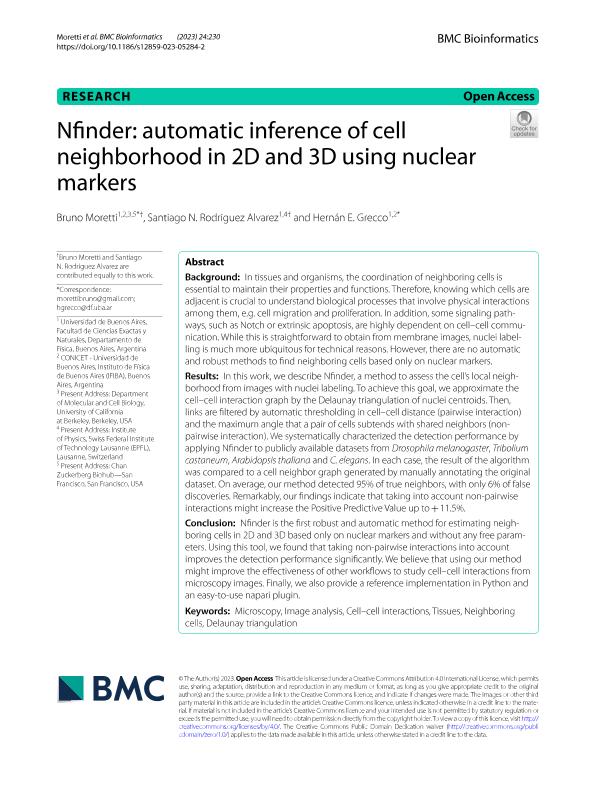
Background: In tissues and organisms, the coordination of neighboring cells is essential to maintain their properties and functions. Therefore, knowing which cells are adjacent is crucial to understand biological processes that involve physical interactions among them, e.g. cell migration and proliferation. In addition, some signaling pathways, such as Notch or extrinsic apoptosis, are highly dependent on cell–cell communication. While this is straightforward to obtain from membrane images, nuclei labelling is much more ubiquitous for technical reasons. However, there are no automatic and robust methods to find neighboring cells based only on nuclear markers. Results: In this work, we describe Nfinder, a method to assess the cell’s local neighborhood from images with nuclei labeling. To achieve this goal, we approximate the cell–cell interaction graph by the Delaunay triangulation of nuclei centroids. Then, links are filtered by automatic thresholding in cell–cell distance (pairwise interaction) and the maximum angle that a pair of cells subtends with shared neighbors (non-pairwise interaction). We systematically characterized the detection performance by applying Nfinder to publicly available datasets from Drosophila melanogaster, Tribolium castaneum, Arabidopsis thaliana and C. elegans. In each case, the result of the algorithm was compared to a cell neighbor graph generated by manually annotating the original dataset. On average, our method detected 95% of true neighbors, with only 6% of false discoveries. Remarkably, our findings indicate that taking into account non-pairwise interactions might increase the Positive Predictive Value up to + 11.5%. Conclusion: Nfinder is the first robust and automatic method for estimating neighboring cells in 2D and 3D based only on nuclear markers and without any free parameters. Using this tool, we found that taking non-pairwise interactions into account improves the detection performance significantly. We believe that using our method might improve the effectiveness of other workflows to study cell–cell interactions from microscopy images. Finally, we also provide a reference implementation in Python and an easy-to-use napari plugin.
dc.format
application/pdf
dc.language.iso
eng
dc.publisher
BioMed Central
dc.rights
info:eu-repo/semantics/openAccess
dc.rights.uri
https://creativecommons.org/licenses/by/2.5/ar/
dc.subject
CELL–CELL INTERACTIONS
dc.subject
DELAUNAY TRIANGULATION
dc.subject
IMAGE ANALYSIS
dc.subject
MICROSCOPY
dc.subject
NEIGHBORING CELLS
dc.subject
TISSUES
dc.subject.classification
Biofísica
dc.subject.classification
Ciencias Biológicas
dc.subject.classification
CIENCIAS NATURALES Y EXACTAS
dc.title
Nfinder: automatic inference of cell neighborhood in 2D and 3D using nuclear markers
dc.type
info:eu-repo/semantics/article
dc.type
info:ar-repo/semantics/artículo
dc.type
info:eu-repo/semantics/publishedVersion
dc.date.updated
2024-02-22T11:20:00Z
dc.journal.volume
24
dc.journal.number
1
dc.journal.pagination
1-12
dc.journal.pais
Reino Unido
dc.journal.ciudad
Londres
dc.description.fil
Fil: Moretti, Bruno. University of California at Berkeley; Estados Unidos. Consejo Nacional de Investigaciones Científicas y Técnicas. Oficina de Coordinación Administrativa Ciudad Universitaria. Instituto de Física de Buenos Aires. Universidad de Buenos Aires. Facultad de Ciencias Exactas y Naturales. Instituto de Física de Buenos Aires; Argentina
dc.description.fil
Fil: Rodriguez Alvarez, Santiago Nicolas. Universidad de Buenos Aires. Facultad de Ciencias Exactas y Naturales. Departamento de Física; Argentina
dc.description.fil
Fil: Grecco, Hernan Edgardo. Consejo Nacional de Investigaciones Científicas y Técnicas. Oficina de Coordinación Administrativa Ciudad Universitaria. Instituto de Física de Buenos Aires. Universidad de Buenos Aires. Facultad de Ciencias Exactas y Naturales. Instituto de Física de Buenos Aires; Argentina
dc.journal.title
BMC Bioinformatics
dc.relation.alternativeid
info:eu-repo/semantics/altIdentifier/doi/http://dx.doi.org/10.1186/s12859-023-05284-2
Archivos asociados

Tamaño:
2.452Mb
Formato:
PDF