Mostrar el registro sencillo del ítem
dc.contributor.author
Montagna, Daniela Romina
dc.contributor.author
Ruggiero, Raul Alejandro
dc.date.available
2024-02-21T12:44:45Z
dc.date.issued
2023-11
dc.identifier.citation
Montagna, Daniela Romina; Ruggiero, Raul Alejandro; The common origin of multicellularity and cancer: Lessons from the fossil record; Sapienza University of Rome. Department of Experimental Medicine; Organisms; 6; 2; 11-2023; 43-69
dc.identifier.issn
2532-5876
dc.identifier.uri
http://hdl.handle.net/11336/227734
dc.description.abstract
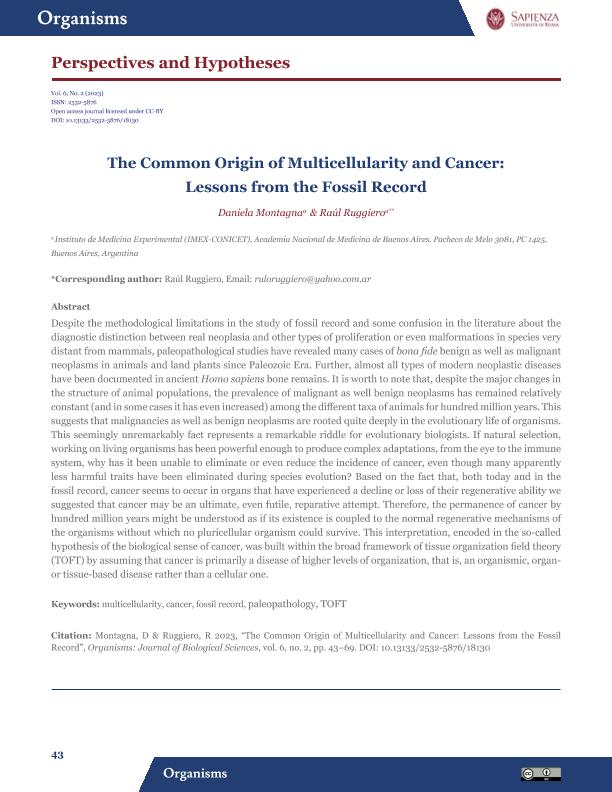
Despite the methodological limitations in the study of fossil record and some confusion in the literature about the diagnostic distinction between real neoplasia and other types of proliferation or even malformations in species very distant from mammals, paleopathological studies have revealed many cases of bona fide benign as well as malignant neoplasms in animals and land plants since Paleozoic Era. Further, almost all types of modern neoplastic diseases have been documented in ancient Homo sapiens bone remains. It is worth to note that, despite the major changes in the structure of animal populations, the prevalence of malignant as well benign neoplasms has remained relatively constant (and in some cases it has even increased) among the different taxa of animals for hundred million years. This suggests that malignancies as well as benign neoplasms are rooted quite deeply in the evolutionary life of organisms. This seemingly unremarkably fact represents a remarkable riddle for evolutionary biologists. If natural selection, working on living organisms has been powerful enough to produce complex adaptations, from the eye to the immune system, why has it been unable to eliminate or even reduce the incidence of cancer, even though many apparently less harmful traits have been eliminated during species evolution? Based on the fact that, both today and in the fossil record, cancer seems to occur in organs that have experienced a decline or loss of their regenerative ability we suggested that cancer may be an ultimate, even futile, reparative attempt. Therefore, the permanence of cancer by hundred million years might be understood as if its existence is coupled to the normal regenerative mechanisms of the organisms without which no pluricellular organism could survive. This interpretation, encoded in the so-called hypothesis of the biological sense of cancer, was built within the broad framework of tissue organization field theory (TOFT) by assuming that cancer is primarily a disease of higher levels of organization, that is, an organismic, organor tissue-based disease rather than a cellular one.
dc.format
application/pdf
dc.language.iso
eng
dc.publisher
Sapienza University of Rome. Department of Experimental Medicine
dc.rights
info:eu-repo/semantics/openAccess
dc.rights.uri
https://creativecommons.org/licenses/by/2.5/ar/
dc.subject
Multicellularity
dc.subject
Cancer
dc.subject
Fossil record
dc.subject
Theories of cancer origin
dc.subject.classification
Otras Ciencias Biológicas
dc.subject.classification
Ciencias Biológicas
dc.subject.classification
CIENCIAS NATURALES Y EXACTAS
dc.title
The common origin of multicellularity and cancer: Lessons from the fossil record
dc.type
info:eu-repo/semantics/article
dc.type
info:ar-repo/semantics/artículo
dc.type
info:eu-repo/semantics/publishedVersion
dc.date.updated
2024-02-20T12:27:37Z
dc.journal.volume
6
dc.journal.number
2
dc.journal.pagination
43-69
dc.journal.pais
Italia
dc.journal.ciudad
Roma
dc.description.fil
Fil: Montagna, Daniela Romina. Consejo Nacional de Investigaciones Científicas y Técnicas. Instituto de Medicina Experimental. Academia Nacional de Medicina de Buenos Aires. Instituto de Medicina Experimental; Argentina
dc.description.fil
Fil: Ruggiero, Raul Alejandro. Consejo Nacional de Investigaciones Científicas y Técnicas. Instituto de Medicina Experimental. Academia Nacional de Medicina de Buenos Aires. Instituto de Medicina Experimental; Argentina
dc.journal.title
Organisms
dc.relation.alternativeid
info:eu-repo/semantics/altIdentifier/url/https://rosa.uniroma1.it/rosa04/organisms/article/view/18130
dc.relation.alternativeid
info:eu-repo/semantics/altIdentifier/doi/https://doi.org/10.13133/2532-5876/18130
Archivos asociados

Tamaño:
1.083Mb
Formato:
PDF