Artículo
Worldwide host associations of the tick genus Ixodes suggest relationships based on environmental sharing rather than on co-phylogenetic events

Fecha de publicación:
02/2023
Editorial:
BioMed Central
Revista:
Parasites and Vectors
ISSN:
1756-3305
Idioma:
Inglés
Tipo de recurso:
Artículo publicado
Clasificación temática:
Resumen
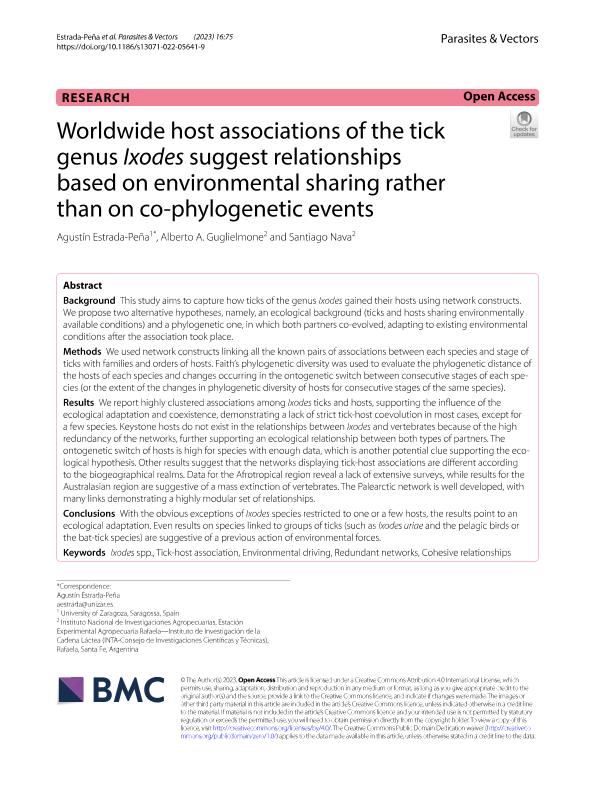
Background: This study aims to capture how ticks of the genus Ixodes gained their hosts using network constructs. We propose two alternative hypotheses, namely, an ecological background (ticks and hosts sharing environmentally available conditions) and a phylogenetic one, in which both partners co-evolved, adapting to existing environmental conditions after the association took place. Methods: We used network constructs linking all the known pairs of associations between each species and stage of ticks with families and orders of hosts. Faith’s phylogenetic diversity was used to evaluate the phylogenetic distance of the hosts of each species and changes occurring in the ontogenetic switch between consecutive stages of each species (or the extent of the changes in phylogenetic diversity of hosts for consecutive stages of the same species). Results: We report highly clustered associations among Ixodes ticks and hosts, supporting the influence of the ecological adaptation and coexistence, demonstrating a lack of strict tick-host coevolution in most cases, except for a few species. Keystone hosts do not exist in the relationships between Ixodes and vertebrates because of the high redundancy of the networks, further supporting an ecological relationship between both types of partners. The ontogenetic switch of hosts is high for species with enough data, which is another potential clue supporting the ecological hypothesis. Other results suggest that the networks displaying tick-host associations are different according to the biogeographical realms. Data for the Afrotropical region reveal a lack of extensive surveys, while results for the Australasian region are suggestive of a mass extinction of vertebrates. The Palearctic network is well developed, with many links demonstrating a highly modular set of relationships. Conclusions: With the obvious exceptions of Ixodes species restricted to one or a few hosts, the results point to an ecological adaptation. Even results on species linked to groups of ticks (such as Ixodes uriae and the pelagic birds or the bat-tick species) are suggestive of a previous action of environmental forces.
Archivos asociados

Tamaño:
33.00Mb
Formato:
PDF
Licencia
 Excepto donde se diga explícitamente, este item se publica bajo la siguiente descripción:
Creative Commons Attribution 2.5 Unported (CC BY 2.5)
Excepto donde se diga explícitamente, este item se publica bajo la siguiente descripción:
Creative Commons Attribution 2.5 Unported (CC BY 2.5)
Identificadores
Colecciones
Articulos (IDICAL)
Articulos de INSTITUTO DE INVESTIGACION DE LA CADENA LACTEA
Articulos de INSTITUTO DE INVESTIGACION DE LA CADENA LACTEA
Citación
Estrada Peña, Agustín; Guglielmone, Alberto Alejandro; Nava, Santiago; Worldwide host associations of the tick genus Ixodes suggest relationships based on environmental sharing rather than on co-phylogenetic events; BioMed Central; Parasites and Vectors; 16; 1; 2-2023; 1-17
Compartir


Altmétricas