Artículo
In situ or Ex situ Synthesis for Electrochemical Detection of Hydrogen Peroxide—An Evaluation of Co2SnO4/RGO Nanohybrids
Venegas, Constanza J.; Gutierrez, Fabiana Andrea ; Reeves McLaren, Nik; Rivas, Gustavo Adolfo
; Ruiz León, Domingo; Bollo, Soledad
; Reeves McLaren, Nik; Rivas, Gustavo Adolfo
; Ruiz León, Domingo; Bollo, Soledad
; Reeves McLaren, Nik; Rivas, Gustavo Adolfo
; Ruiz León, Domingo; Bollo, Soledad
Fecha de publicación:
05/2023
Editorial:
MDPI
Revista:
Micromachines
ISSN:
2072-666X
Idioma:
Inglés
Tipo de recurso:
Artículo publicado
Clasificación temática:
Resumen
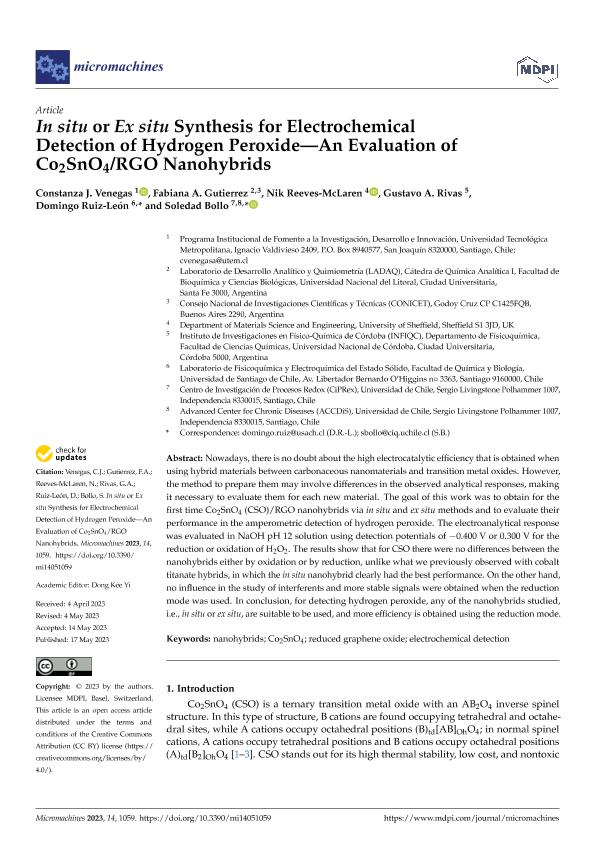
Nowadays, there is no doubt about the high electrocatalytic efficiency that is obtained when using hybrid materials between carbonaceous nanomaterials and transition metal oxides. However, the method to prepare them may involve differences in the observed analytical responses, making it necessary to evaluate them for each new material. The goal of this work was to obtain for the first time Co2SnO4 (CSO)/RGO nanohybrids via in situ and ex situ methods and to evaluate their performance in the amperometric detection of hydrogen peroxide. The electroanalytical response was evaluated in NaOH pH 12 solution using detection potentials of −0.400 V or 0.300 V for the reduction or oxidation of H2O2. The results show that for CSO there were no differences between the nanohybrids either by oxidation or by reduction, unlike what we previously observed with cobalt titanate hybrids, in which the in situ nanohybrid clearly had the best performance. On the other hand, no influence in the study of interferents and more stable signals were obtained when the reduction mode was used. In conclusion, for detecting hydrogen peroxide, any of the nanohybrids studied, i.e., in situ or ex situ, are suitable to be used, and more efficiency is obtained using the reduction mode.
Palabras clave:
CO2SNO4
,
ELECTROCHEMICAL DETECTION
,
NANOHYBRIDS
,
REDUCED GRAPHENE OXIDE
Archivos asociados

Tamaño:
17.99Mb
Formato:
PDF
Licencia
 Excepto donde se diga explícitamente, este item se publica bajo la siguiente descripción:
Creative Commons Attribution 2.5 Unported (CC BY 2.5)
Excepto donde se diga explícitamente, este item se publica bajo la siguiente descripción:
Creative Commons Attribution 2.5 Unported (CC BY 2.5)
Identificadores
Colecciones
Articulos(CCT - SANTA FE)
Articulos de CTRO.CIENTIFICO TECNOL.CONICET - SANTA FE
Articulos de CTRO.CIENTIFICO TECNOL.CONICET - SANTA FE
Articulos(INFIQC)
Articulos de INST.DE INVESTIGACIONES EN FISICO- QUIMICA DE CORDOBA
Articulos de INST.DE INVESTIGACIONES EN FISICO- QUIMICA DE CORDOBA
Citación
Venegas, Constanza J.; Gutierrez, Fabiana Andrea; Reeves McLaren, Nik; Rivas, Gustavo Adolfo; Ruiz León, Domingo; et al.; In situ or Ex situ Synthesis for Electrochemical Detection of Hydrogen Peroxide—An Evaluation of Co2SnO4/RGO Nanohybrids; MDPI; Micromachines; 14; 5; 5-2023; 1-11
Compartir


Altmétricas