Artículo
Nutritional Composition and Bioactive Properties of Wild Edible Mushrooms from Native Nothofagus Patagonian Forests
Rugolo, Maximiliano ; Mascoloti Spréa, Rafael; Dias, Maria Inês; Pires, Tânia C. S. P.; Añibarro Ortega, Mikel; Barroetaveña, Carolina
; Caleja, Cristina; Barros, Lillian
; Mascoloti Spréa, Rafael; Dias, Maria Inês; Pires, Tânia C. S. P.; Añibarro Ortega, Mikel; Barroetaveña, Carolina
; Caleja, Cristina; Barros, Lillian
; Mascoloti Spréa, Rafael; Dias, Maria Inês; Pires, Tânia C. S. P.; Añibarro Ortega, Mikel; Barroetaveña, Carolina
; Caleja, Cristina; Barros, Lillian
Fecha de publicación:
11/2022
Editorial:
MDPI
Revista:
Foods
ISSN:
2304-8158
Idioma:
Inglés
Tipo de recurso:
Artículo publicado
Clasificación temática:
Resumen
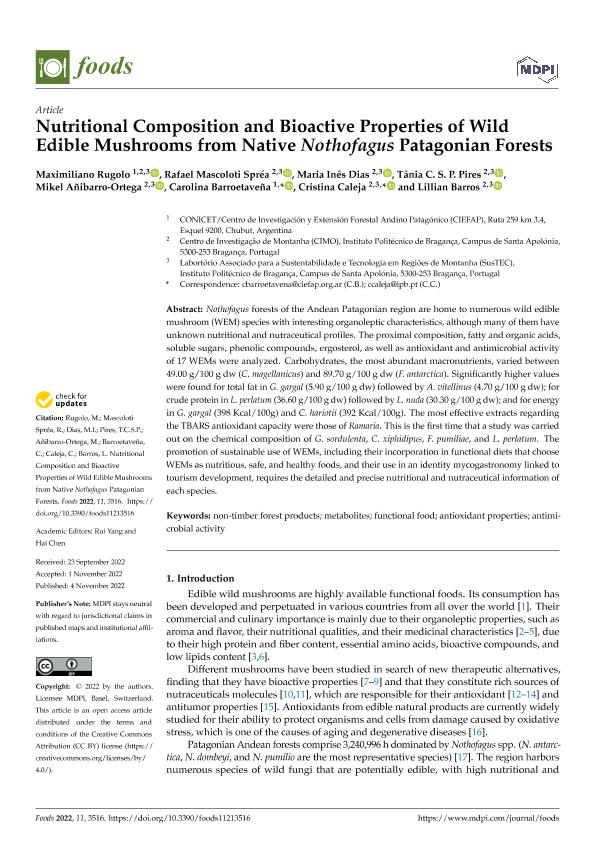
Nothofagus forests of the Andean Patagonian region are home to numerous wild edible mushroom (WEM) species with interesting organoleptic characteristics, although many of them have unknown nutritional and nutraceutical profiles. The proximal composition, fatty and organic acids, soluble sugars, phenolic compounds, ergosterol, as well as antioxidant and antimicrobial activity of 17 WEMs were analyzed. Carbohydrates, the most abundant macronutrients, varied between 49.00 g/100 g dw (C. magellanicus) and 89.70 g/100 g dw (F. antarctica). Significantly higher values were found for total fat in G. gargal (5.90 g/100 g dw) followed by A. vitellinus (4.70 g/100 g dw); for crude protein in L. perlatum (36.60 g/100 g dw) followed by L. nuda (30.30 g/100 g dw); and for energy in G. gargal (398 Kcal/100g) and C. hariotii (392 Kcal/100g). The most effective extracts regarding the TBARS antioxidant capacity were those of Ramaria. This is the first time that a study was carried out on the chemical composition of G. sordulenta, C. xiphidipus, F. pumiliae, and L. perlatum. The promotion of sustainable use of WEMs, including their incorporation in functional diets that choose WEMs as nutritious, safe, and healthy foods, and their use in an identity mycogastronomy linked to tourism development, requires the detailed and precise nutritional and nutraceutical information of each species.
Archivos asociados

Tamaño:
1.057Mb
Formato:
PDF
Licencia
 Excepto donde se diga explícitamente, este item se publica bajo la siguiente descripción:
Creative Commons Attribution 2.5 Unported (CC BY 2.5)
Excepto donde se diga explícitamente, este item se publica bajo la siguiente descripción:
Creative Commons Attribution 2.5 Unported (CC BY 2.5)
Identificadores
Colecciones
Articulos(SEDE CENTRAL)
Articulos de SEDE CENTRAL
Articulos de SEDE CENTRAL
Citación
Rugolo, Maximiliano; Mascoloti Spréa, Rafael; Dias, Maria Inês; Pires, Tânia C. S. P.; Añibarro Ortega, Mikel; et al.; Nutritional Composition and Bioactive Properties of Wild Edible Mushrooms from Native Nothofagus Patagonian Forests; MDPI; Foods; 11; 21; 11-2022; 1-18
Compartir


Altmétricas