Artículo
Low-ionization structures in planetary nebulae - III: The statistical analysis of physico-chemical parameters and excitation mechanisms

Fecha de publicación:
10/2023
Editorial:
Wiley Blackwell Publishing, Inc
Revista:
Monthly Notices of the Royal Astronomical Society
ISSN:
0035-8711
Idioma:
Inglés
Tipo de recurso:
Artículo publicado
Clasificación temática:
Resumen
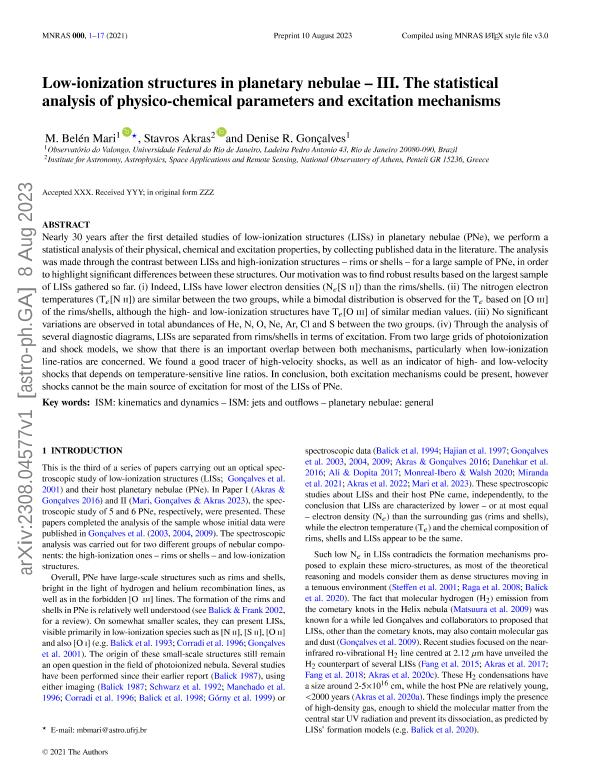
Nearly 30 yr after the first detailed studies of low-ionization structures (LISs) in planetary nebulae (PNe), we perform a statistical analysis of their physical, chemical, and excitation properties, by collecting published data in the literature. The analysis was made through the contrast between LISs and high-ionization structures - rims or shells - for a large sample of PNe, in order to highlight significant differences between these structures. Our motivation was to find robust results based on the largest sample of LISs gathered so far. (i) Indeed, LISs have lower electron densities (Ne[S ii]) than the rims/shells. (ii) The nitrogen electron temperatures (Te[N ii]) are similar between the two groups, while a bimodal distribution is observed for the Te based on [O iii] of the rims/shells, although the high- and low-ionization structures have Te[O iii] of similar median values. (iii) No significant variations are observed in total abundances of He, N, O, Ne, Ar, Cl, and S between the two groups. (iv) Through the analysis of several diagnostic diagrams, LISs are separated from rims/shells in terms of excitation. From two large grids of photoionization and shock models, we show that there is an important overlap between both mechanisms, particularly when low-ionization line ratios are concerned. We found a good tracer of high-velocity shocks, as well as an indicator of high- and low-velocity shocks that depends on temperature-sensitive line ratios. In conclusion, both excitation mechanisms could be present; however, shocks cannot be the main source of excitation for most of the LISs of PNe.
Archivos asociados

Tamaño:
1.491Mb
Formato:
PDF
Licencia
 Excepto donde se diga explícitamente, este item se publica bajo la siguiente descripción:
Atribución-NoComercial-SinDerivadas 2.5 Argentina (CC BY-NC-ND 2.5 AR)
Excepto donde se diga explícitamente, este item se publica bajo la siguiente descripción:
Atribución-NoComercial-SinDerivadas 2.5 Argentina (CC BY-NC-ND 2.5 AR)
Identificadores
Colecciones
Articulos(CCT - CORDOBA)
Articulos de CTRO.CIENTIFICO TECNOL.CONICET - CORDOBA
Articulos de CTRO.CIENTIFICO TECNOL.CONICET - CORDOBA
Citación
Mari, María Belén; Akras, Stavros; Gonçalves, Denise R.; Low-ionization structures in planetary nebulae - III: The statistical analysis of physico-chemical parameters and excitation mechanisms; Wiley Blackwell Publishing, Inc; Monthly Notices of the Royal Astronomical Society; 525; 2; 10-2023; 1998-2014
Compartir


Altmétricas